A $60 billion tool has emerged, suggesting that yen intervention will no longer rely on selling US Treasury bonds?
2026-08-03 20:34:53
On Monday, August 3rd, the USD/JPY pair fell to around 155.20 during the Asian session, currently hovering around 156.70, a significant drop from last week's high of nearly 163.8. The US and Japan confirmed their joint foreign exchange market intervention last Friday and explicitly reserved the possibility of further action. This marks the first time the two sides have jointly intervened in the foreign exchange market since March 2011. Meanwhile, Brent crude oil fell to around $83 per barrel, a nearly 5% drop in a single day. Lower-than-expected energy input costs, coupled with expectations of policy normalization from the Bank of Japan, strengthened the yen's rebound. The current market movement is no longer a simple technical correction, but rather a revaluation following simultaneous changes in policy credibility, interest rate differentials, and energy trade terms. 
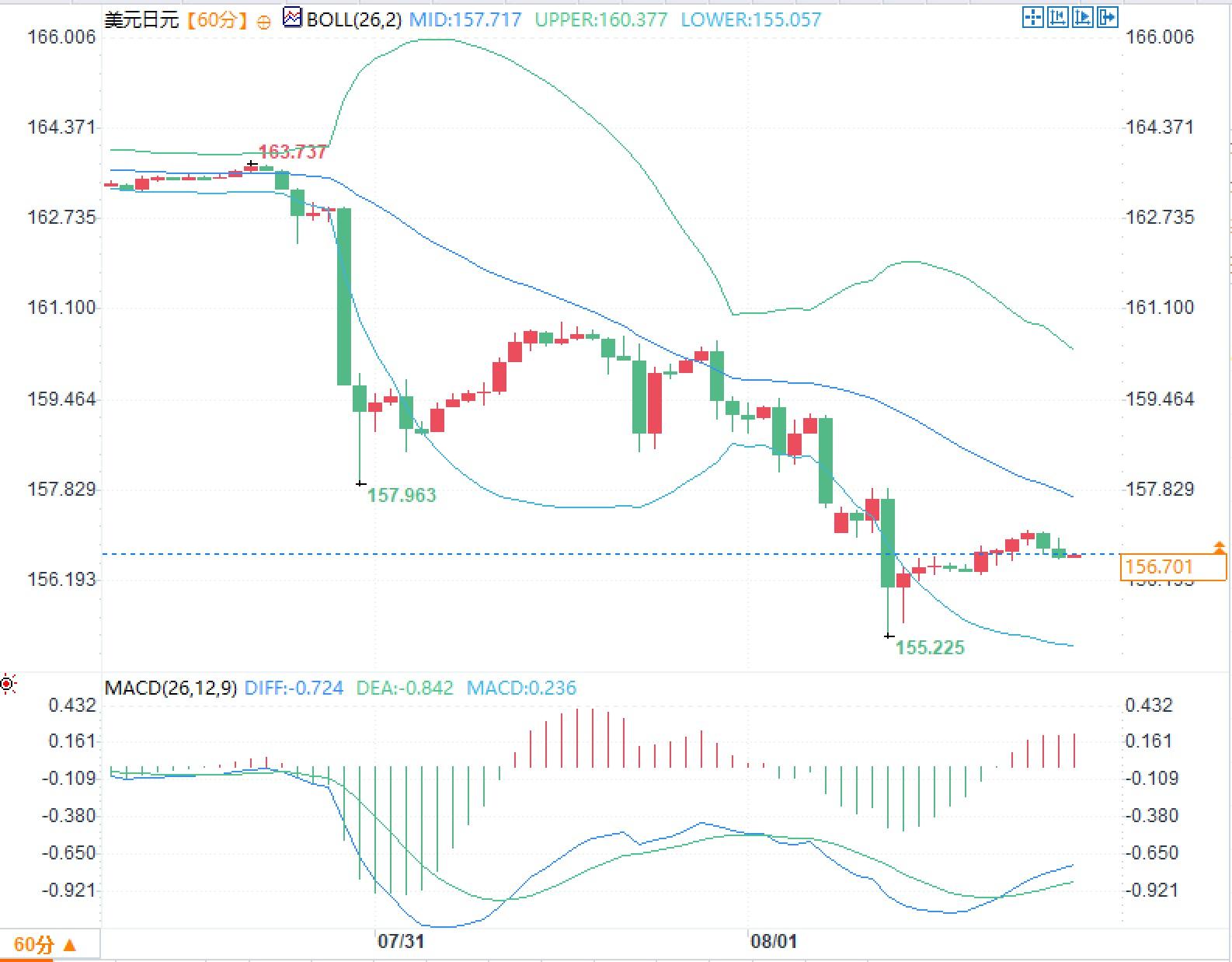 From the 60-minute chart, the USD/JPY pair fell rapidly from 163.737 to 155.225, with the latest price around 156.70. The Bollinger Band middle line is at 157.717, the upper line at 160.377, and the lower line at 155.057. The price is still below the middle line, indicating that the dominant trend has not yet been fully restored. The MACD DIFF is -0.724, the DEA is -0.842, and the histogram has turned to +0.236, reflecting a temporary weakening of downward momentum, but this is more of a momentum rebound after an oversold condition. The key dividing line in the current market is not a single technical level, but whether intervention and deterrence can form a continuous policy combination with the expectation of a Bank of Japan interest rate hike.
Joint intervention changes risk pricing
Conventional unilateral intervention faces two problems: first, the market can estimate the size of funds available to the fiscal authorities; second, as long as the interest rate differential structure remains unchanged, the liquidity shock caused by the intervention may be reabsorbed by arbitrage funds. The difference in this action lies in the direct participation of the US in supporting the yen, meaning the market is no longer facing a single fiscal authority, but rather two sets of policy balance sheets and their coordination capabilities. The joint action first raises the tail cost of shorting the yen. Previously, when the USD/JPY exchange rate approached 163.8, the market's positioning logic was based on low Japanese interest rates, a widening energy import bill, and a delayed policy response. Now, the fiscal authorities have publicly stated that they will not rule out further joint intervention, meaning that the closer the exchange rate is to the disordered range, the more non-linearly the potential policy shock will amplify. Even if the actual funds injected subsequently decrease, the public commitment itself will compress the risk budget of speculative positions. More importantly, the US reportedly participated in the action by selling euros and buying yen, making the intervention not entirely dependent on Japan selling dollar assets. This arrangement diversifies the trading path and reduces the market's ability to identify fund flows in advance and engage in reverse speculation. The core of the joint intervention is not to permanently determine the equilibrium exchange rate, but to force the market to re-incorporate the policy reaction function.Why FIMA tools deserve more attention than intervention amounts
Japan plans to use the Federal Reserve's repurchase agreement (FIMA) facility for foreign official institutions. It's important to clarify that this facility is not simply a daily quota of $60 billion, but rather a maximum of $60 billion in financing available to a single counterparty at any given time, with terms ranging from overnight to a maximum of seven days. Japan can use its holdings of U.S. Treasury bonds as collateral to temporarily obtain dollars, then support its exchange rate by selling dollars and buying yen, without immediately selling U.S. Treasury bonds in the secondary market. This mechanism resolves balance sheet frictions during intervention. In the traditional model, large-scale yen purchases typically deplete foreign exchange reserves. If the funding source involves concentrated sales of U.S. Treasury bonds, it could push up bond yields, widening the Japan-U.S. interest rate differential and weakening the yen. FIMA repurchase agreements effectively transform foreign exchange reserves from assets that must be sold into collateral that can be financed, thus severing part of the feedback chain between intervention and selling pressure in the bond market. As of the end of May 2026, Japan's official reserve assets were approximately $1.306 trillion, still a substantial amount. The issue is never just whether reserves are sufficient, but whether using reserves will produce cross-market side effects. The FIMA tool improves the efficiency of fund allocation and means that joint actions can last longer and take more flexible forms.The Bank of Japan and oil prices are working to close the fundamental gap in the yen.
Intervention can compress short-term positions, but the medium-term direction remains determined by interest rate differentials and terms of trade. The Bank of Japan's current policy rate remains at 1.0%, with the next policy meeting scheduled for September 17-18. Recent policy statements indicate that wages are continuing to grow, the labor market is tight, and core inflation is around 1.5%, thus increasing the market's likelihood of a further rate hike at the next meeting. For the yen, the significance of the expected rate hike lies not only in narrowing the nominal interest rate differential but also in changing the volatility structure of carry trades. When the interest rate of the funding currency rises, and there is a risk of official intervention in the exchange rate, the previously stable positive interest rate differential may be offset by a rapid appreciation, forcing leveraged funds to reduce their positions. The decline in oil prices constitutes a second support chain. Brent crude oil has fallen back to the $83 per barrel area, reducing Japan's energy import costs and pressure on terms of trade, and also mitigating the erosion of real income by imported inflation. The Bank of Japan previously projected that Dubai crude oil prices would gradually fall from around $80 per barrel to around $70 per barrel during the forecast period. If the energy risk premium continues to decline, the yen will simultaneously benefit from improvements in the current account and optimization of the inflation structure, rather than solely relying on administrative forces. From the 60-minute chart, the USD/JPY pair fell rapidly from 163.737 to 155.225, with the latest price around 156.70. The Bollinger Band middle line is at 157.717, the upper line at 160.377, and the lower line at 155.057. The price is still below the middle line, indicating that the dominant trend has not yet been fully restored. The MACD DIFF is -0.724, the DEA is -0.842, and the histogram has turned to +0.236, reflecting a temporary weakening of downward momentum, but this is more of a momentum rebound after an oversold condition. The key dividing line in the current market is not a single technical level, but whether intervention and deterrence can form a continuous policy combination with the expectation of a Bank of Japan interest rate hike.
- Risk Warning and Disclaimer
- The market involves risk, and trading may not be suitable for all investors. This article is for reference only and does not constitute personal investment advice, nor does it take into account certain users’ specific investment objectives, financial situation, or other needs. Any investment decisions made based on this information are at your own risk.