Ultimate details of US-Japan intervention, and the "tacitly allowed" weakening of the dollar.
2026-08-03 21:50:53
A temporary easing of geopolitical risks in the Middle East led to a decline in crude oil prices, coupled with the unprecedented intervention in the Euro/Yen cross-currency pair by the US and Japan, resulting in a dual reshaping of global asset pricing. This time, the US abandoned the traditional "sell dollars, buy yen" approach, instead employing a precise tactic of selling euros and buying yen. This strategy both supported the yen to mitigate the risk of a US Treasury bond collapse and maintained the strength of the dollar, preventing worsening inflation. The convergence of these two main factors will determine the subsequent wide-ranging fluctuations in the dollar index. 
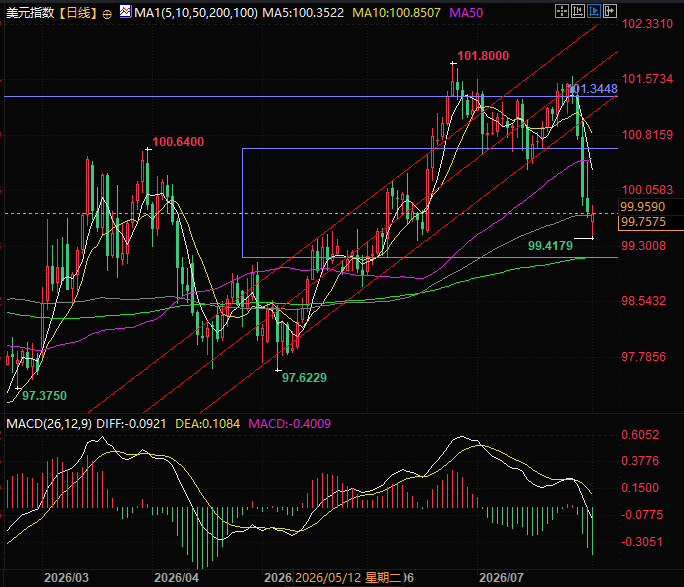 (US Dollar Index Daily Chart, Source: FX678) At 21:48 Beijing time, the US Dollar Index is currently at 99.76.
The geopolitical conflict between the US and Iran has briefly eased, and oil prices have retreated, but underlying risks remain.
The recent tensions in the Middle East have eased somewhat, with the US halting its military strikes against Iran and signaling a willingness to negotiate, quickly easing geopolitical anxieties in the Strait of Hormuz. The market subsequently exhibited typical cyclical patterns: Brent crude oil prices fluctuated and corrected, risk appetite improved, and global stock markets continued their previous rebound. However, this easing is highly temporary. Historical patterns show that Middle East conflicts are prone to recurrence, and the probability of a renewed escalation later this week is high. If negotiations break down and conflict resumes, it will quickly trigger the classic trading pattern of "oil price rebound, stock market decline, and rising US Treasury yields." From an energy supply and demand perspective, the market has already fully absorbed the negative impact of declining global inventories, and rising oil prices have not yet triggered a large-scale demand collapse. Meanwhile, high prices continue to stimulate supply expansion: since the Middle East conflict, the number of US oil drilling rigs has increased by 11%, and refinery utilization rates have steadily increased; OPEC+ has also officially announced an additional 188,000 barrels per day production quota starting in September. However, due to geopolitical disturbances in Eastern Europe and the Middle East, the short-term increase in production is extremely difficult to implement, and supply bottlenecks remain prominent. The price spread between Singapore diesel and Brent crude oil has remained above the historical average, which is sufficient to confirm that the current tight supply of refined oil products has not been substantially alleviated, and the medium- to long-term support for oil prices remains.The US and Japan have launched an unprecedented intervention: abandoning the dollar and selling euros to support the yen.
As geopolitical and energy markets stabilized, the foreign exchange market witnessed a significant historical event: the US and Japan launched a rare joint intervention to curb the disorderly depreciation of the yen, with this intervention method completely overturning traditional patterns. In the past, joint US-Japan interventions consistently involved selling dollars and buying yen; however, this time a historic divergence occurred: Japan continued to sell dollars and buy yen in the USD/JPY exchange rate, while the US Treasury sold euros and bought yen in the EUR/JPY cross rate. Multiple investment banks and brokers confirmed that the US did not use any dollar reserves this time, relying entirely on euros as its intervention tool. HSBC stated that this was an unprecedented and unconventional operation. The policy effect was immediate: the extremely oversold yen rebounded strongly from a 40-year low of 164, appreciating nearly 4% in a single week, marking its largest weekly gain in two years; the euro/yen exchange rate plummeted from a high of 187.4, briefly falling below the 180 mark. This time, Japan unilaterally deployed up to $36.58 billion in intervention funds, coupled with coordinated operations by the US, directly triggering a wave of short covering in the market and completely reversing the short-term weakness of the yen. However, constrained by the US's mere approximately €26 billion in available intervention reserves, this euro-selling intervention model is not sustainable in the long term. Meanwhile, although the ECB has not publicly commented, it has maintained close communication with the Federal Reserve, and the market is closely watching whether a new pattern of coordinated efforts by multiple countries to stabilize exchange rates will emerge.Core of the top-level game theory: America's "half-hidden" weak dollar strategy
The market widely misinterprets this intervention as a desperate attempt to "defend a strong dollar." However, the deeper, more sophisticated operational logic is far more nuanced: the US is willing to enjoy the benefits of a moderately weakening dollar, but it absolutely will not allow the market to price in the expectation that "the US is actively allowing the dollar to depreciate." This intervention, abandoning the dollar and opting for the euro, is a classic example of sophisticated, albeit somewhat veiled, currency manipulation, concealing three deep-seated self-interested calculations: First, stabilizing the US Treasury bond base and preventing passive financial shocks. Japan holds over $1.14 trillion in US Treasury bonds, making it the largest foreign creditor of the US. If the yen were to collapse disorderly, Japan would have no choice but to sell US Treasury bonds to repatriate dollars and rescue the market, directly triggering a surge in US Treasury yields and impacting the US debt system. The US's support for the yen is a preemptive measure to defuse potential risks and safeguard the fundamentals of the US financial system. Secondly, by secretly benefiting from a weak dollar and rejecting overt expectations of depreciation, the US desperately needs a controlled, moderate, and subtle weakening of the dollar: this would alleviate the pressure of massive US debt, boost overseas revenues for multinational corporations, and correct the trade deficit, while also moderately offsetting the suppression of exports by a strong dollar. However, US inflation remains high, and what the US fears most is not a falling dollar, but rather that "the market knows the US wants the dollar to fall." If the US routinely sells dollars to buy yen, it would be tantamount to openly declaring that "the Fed tacitly approves of a weak dollar," leading to a frenzy of shorting the dollar, triggering a disorderly plunge and a backlash of imported inflation, resulting in complete loss of control. Thirdly, by using the euro as a shield, the US achieves the perfect paradox of "secretly depreciating while appearing strong."The essence of this intervention: all depreciation pressure is shifted to the euro, while the dollar only reaps the benefits and bears no blame.
A stronger yen suppresses the dollar index (profiting from a moderate depreciation); a sharp drop in the euro hedges against the dollar index's decline (locking in the depreciation pace and preventing a collapse); the entire operation requires no dollar selling—the market has absolutely no leverage to detect any "quantitative easing and devaluation" by the US. In short: the US outwardly maintains a strong dollar stance while secretly enjoying the benefits of a moderately weakening dollar, controlling depreciation, never revealing its hand, and never losing control. This is the true top-level design of this unprecedented euro intervention.The Two-Front Game Sets the Tone for the Market Outlook: Medium- to Long-Term Trend of the US Dollar Index
The Middle East geopolitical energy cycle and unconventional US-Japan foreign exchange market intervention are two main factors that counterbalance each other, jointly defining the short-term and medium-term trends of the US dollar index, presenting an overall pattern of short-term pressure and strong medium-term resilience. The short-term pressure logic: De-escalation in the Middle East has lowered oil prices, and inflation expectations have slightly declined, weakening expectations of a Fed rate hike; simultaneously, the yen, as the second-largest weighted currency in the US dollar index, has appreciated significantly, directly dragging down the dollar index. The medium-term controllable depreciation logic: This intervention perfectly achieved the US's desired outcome: a slight, gentle weakening of the dollar, but without market expectations of further depreciation. The sharp drop in the euro offset the index's decline, resulting in a healthy, slightly weak, oscillating trend for the dollar index, diluting debt, boosting the economy, and avoiding triggering inflationary backlash and capital flight. Once US-Iran geopolitical risks resurface and oil prices rebound, rising inflation expectations will again support the dollar, forming a perfectly controllable pattern of "a floor for declines and support for rises." The underlying core logic remains unchanged: Foreign exchange market intervention can only change the short-term market rhythm and cannot overturn the core underlying logic of the US-Japan interest rate differential structure. As long as the Federal Reserve maintains a tight monetary policy and the Bank of Japan's interest rate hikes lag behind, the yen carry trade in the market will not be completely cleared out, and the medium- to long-term pressure for yen depreciation will remain.Key points to watch for the market outlook
Before multiple policy and geopolitical uncertainties are resolved, the US dollar index will continue to fluctuate widely, with its future direction entirely dependent on three core variables: First, the progress of US-Iran diplomatic negotiations will determine the sustainability of energy inflation; second, whether the Bank of Japan's September policy meeting results in an interest rate hike will determine whether the yen can escape its weakness and establish a long-term bottom; and third, core US inflation and employment data will ultimately anchor the Federal Reserve's monetary policy path, dominating the medium- to long-term trend of the US dollar. Technically, the US dollar index has broken below its trading range and upward channel. Watch the resistance level around 99.95, the 50% Fibonacci retracement level of the trading range. A successful break above this level would trigger a rebound in the dollar, potentially pushing it back above 100. (US Dollar Index Daily Chart, Source: FX678) At 21:48 Beijing time, the US Dollar Index is currently at 99.76.
- Risk Warning and Disclaimer
- The market involves risk, and trading may not be suitable for all investors. This article is for reference only and does not constitute personal investment advice, nor does it take into account certain users’ specific investment objectives, financial situation, or other needs. Any investment decisions made based on this information are at your own risk.