A chart shows the Baltic Dry Index rising to its highest level in over two weeks, boosted by stronger shipping prices.
2026-08-03 22:50:52
Latest data shows that the Baltic Dry Index (BDI) reached 2843 points on August 3, 2026, a new high since July 15, 2026, up 4.06% month-on-month, the largest increase since July 8, 2026, and marking the third consecutive day of increase (including zero growth). Looking at the short-term charts, the recent 11 BDI data points show: 6 positive increases, 5 negative increases, and 0 zero increases. Specifically, the Panamax Freight Index (BPI) reached 2135 points, up 2.30% from the previous value; the Capesize Freight Index (BCI) reached 4564 points, up 6.24%; and the Supramax Freight Index (BSI) reached 1610 points, up 0.06%. For detailed 720-day and 10-year trend charts of the Baltic Dry Index and its three main sub-indices, please refer to the charts specially created by FX678. 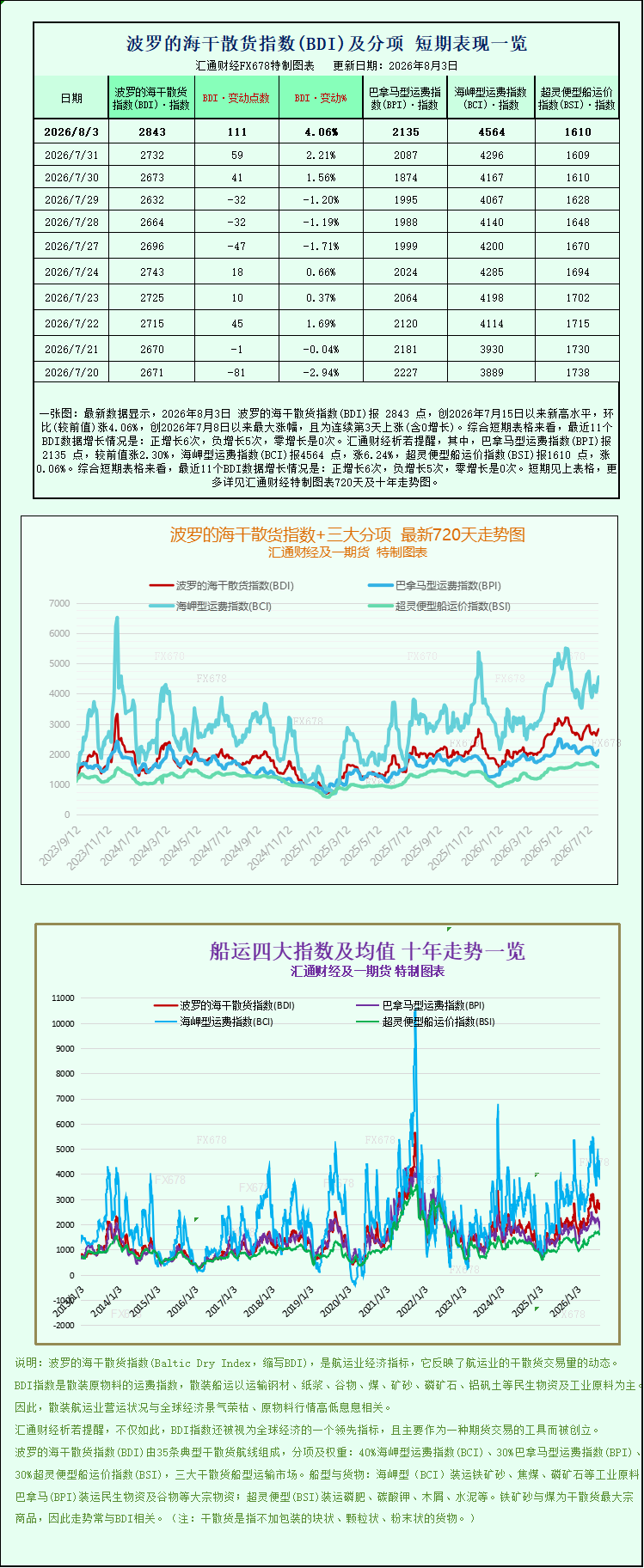 On Monday, the international dry bulk shipping market saw a comprehensive recovery, with freight rates for all major vessel types rising simultaneously. This drove a significant increase in the Baltic Dry Index (BDI), reaching a new high since mid-July. This rebound broke the previous pattern of market volatility and weakness, highlighting a phased recovery in global bulk shipping demand and a marginal improvement in the market's supply-demand structure, laying the initial foundation for the peak season in dry bulk shipping in the second half of the year. Data shows that the Baltic Dry Index (BDI), which tracks freight rates for the three major dry bulk vessel types—Capesize, Panamax, and Supramax—surged 111 points, a 4.1% increase, closing at 2843 points, a more than two-week high since July 15th. As a core indicator of the global dry bulk shipping market, the significant rebound in the Baltic Dry Index directly reflects the substantial increase in the activity of global maritime trade in basic raw materials such as iron ore, coal, and grains, and is an important signal of the recovery in the global industrial supply chain and commodity trade. Looking at the performance of specific vessel types, Capesize vessels, the largest in size and the main carriers of industrial raw materials, have become the core driver of this index rise, showing the most outstanding performance. Data shows that the Capesize vessel index surged 268 points in a single day, a significant increase of 6.2%, leading all vessel types, closing at 4564 points, also a new high in more than two weeks. In terms of specific operating revenue, Capesize vessels, mainly engaged in the transportation of 150,000-ton bulk cargoes, primarily carrying industrial raw materials such as iron ore, thermal coal, and metallurgical coal, saw a substantial increase in average daily operating revenue on Monday, rising by $2435 to $37892, with a significant recovery in per-vessel profitability. Industry analysts point out that the strong rebound in the Capesize vessel market is mainly due to the concentrated release of demand for ocean-going industrial raw material transportation. Recently, major iron ore exporting countries such as Brazil and Australia have steadily accelerated their shipping pace, coupled with rising restocking demand from industrial production in many parts of the world, leading to an increase in long-haul ocean shipping orders. Meanwhile, the global dry bulk shipping capacity supply remains tight, with limited new ship deliveries expected in 2026. A significant portion of shipbuilding capacity is being squeezed by LNG carriers and container ships, making it difficult for new capacity to offset increased demand in the short term, thus supporting the continued rise in large bulk carrier freight rates. It is worth noting that this strengthening of the shipping market is significantly diverging from the commodity futures market. On Monday, international iron ore futures prices continued their weakness, falling for the seventh consecutive trading day. The core reason is the continued weakness in domestic steel industry end-user demand, cautious operating intentions of steel mills, and the continuous accumulation of iron ore inventories at ports. The commodity spot market and the shipping market exhibit a structural divergence characterized by "weak cargo prices and strong freight rates." The medium-sized Panamax vessel market also rose in tandem, continuing its moderate recovery. Baltic Exchange data shows that the Panamax index rose 48 points, or 2.3%, to close at 2135 points, reaching its highest level since July 21. This vessel type primarily carries 60,000 to 70,000 tons of bulk commodities such as coal, grain, and fertilizer, while also transporting industrial raw materials and agricultural products for daily use. Its routes cover major trade routes in the Atlantic and Pacific Oceans. Its average daily operating revenue increased by $432 to $19,212, with continued improvement in profitability stability. The Panamax market rebounded, mainly benefiting from the accelerated global grain trade, the opening of the grain harvest and export window in the Northern Hemisphere, and support from energy restocking demand in Southeast Asia and Europe. Cargo volume on short- and medium-haul and transoceanic routes steadily increased, driving up freight rates. The small dry bulk carrier market remained generally stable, with relatively moderate increases. The Supramax index rose slightly by 1 point, a mere 0.06%, closing at 1610 points, showing relatively stable performance. Compared to large and medium-sized vessels, Supramax vessels are mostly used for short-haul, small-volume bulk cargo transportation. Market demand is more dispersed, and they are less affected by the concentrated transportation of bulk raw materials, thus their market elasticity is limited, maintaining an overall stable operating pattern. From a comprehensive market perspective, the dry bulk shipping market is currently at a crucial juncture in the start of the traditional peak season. Late July to August is historically a traditional upward cycle for global dry bulk shipping. With the gradual recovery of global industrial production, the early release of autumn/winter energy restocking demand, and the continued tightness of global effective shipping capacity, freight rates still have room for further recovery. However, uncertainties remain in the market. Weak domestic demand in the steel industry and fluctuations in commodity prices may temporarily suppress the recovery of shipping demand. The future market trend will depend heavily on global industrial operating rates, iron ore and coal shipments, and the recovery of end-consumer demand. The recent rebound in the Baltic Dry Index directly reflects the rebalancing of supply and demand in the shipping market, demonstrating both the resilient recovery of global bulk trade and highlighting the structural differentiation within the industry. In the short term, freight rates for all vessel types are expected to continue their upward trend, and the peak season effect is likely to continue.
On Monday, the international dry bulk shipping market saw a comprehensive recovery, with freight rates for all major vessel types rising simultaneously. This drove a significant increase in the Baltic Dry Index (BDI), reaching a new high since mid-July. This rebound broke the previous pattern of market volatility and weakness, highlighting a phased recovery in global bulk shipping demand and a marginal improvement in the market's supply-demand structure, laying the initial foundation for the peak season in dry bulk shipping in the second half of the year. Data shows that the Baltic Dry Index (BDI), which tracks freight rates for the three major dry bulk vessel types—Capesize, Panamax, and Supramax—surged 111 points, a 4.1% increase, closing at 2843 points, a more than two-week high since July 15th. As a core indicator of the global dry bulk shipping market, the significant rebound in the Baltic Dry Index directly reflects the substantial increase in the activity of global maritime trade in basic raw materials such as iron ore, coal, and grains, and is an important signal of the recovery in the global industrial supply chain and commodity trade. Looking at the performance of specific vessel types, Capesize vessels, the largest in size and the main carriers of industrial raw materials, have become the core driver of this index rise, showing the most outstanding performance. Data shows that the Capesize vessel index surged 268 points in a single day, a significant increase of 6.2%, leading all vessel types, closing at 4564 points, also a new high in more than two weeks. In terms of specific operating revenue, Capesize vessels, mainly engaged in the transportation of 150,000-ton bulk cargoes, primarily carrying industrial raw materials such as iron ore, thermal coal, and metallurgical coal, saw a substantial increase in average daily operating revenue on Monday, rising by $2435 to $37892, with a significant recovery in per-vessel profitability. Industry analysts point out that the strong rebound in the Capesize vessel market is mainly due to the concentrated release of demand for ocean-going industrial raw material transportation. Recently, major iron ore exporting countries such as Brazil and Australia have steadily accelerated their shipping pace, coupled with rising restocking demand from industrial production in many parts of the world, leading to an increase in long-haul ocean shipping orders. Meanwhile, the global dry bulk shipping capacity supply remains tight, with limited new ship deliveries expected in 2026. A significant portion of shipbuilding capacity is being squeezed by LNG carriers and container ships, making it difficult for new capacity to offset increased demand in the short term, thus supporting the continued rise in large bulk carrier freight rates. It is worth noting that this strengthening of the shipping market is significantly diverging from the commodity futures market. On Monday, international iron ore futures prices continued their weakness, falling for the seventh consecutive trading day. The core reason is the continued weakness in domestic steel industry end-user demand, cautious operating intentions of steel mills, and the continuous accumulation of iron ore inventories at ports. The commodity spot market and the shipping market exhibit a structural divergence characterized by "weak cargo prices and strong freight rates." The medium-sized Panamax vessel market also rose in tandem, continuing its moderate recovery. Baltic Exchange data shows that the Panamax index rose 48 points, or 2.3%, to close at 2135 points, reaching its highest level since July 21. This vessel type primarily carries 60,000 to 70,000 tons of bulk commodities such as coal, grain, and fertilizer, while also transporting industrial raw materials and agricultural products for daily use. Its routes cover major trade routes in the Atlantic and Pacific Oceans. Its average daily operating revenue increased by $432 to $19,212, with continued improvement in profitability stability. The Panamax market rebounded, mainly benefiting from the accelerated global grain trade, the opening of the grain harvest and export window in the Northern Hemisphere, and support from energy restocking demand in Southeast Asia and Europe. Cargo volume on short- and medium-haul and transoceanic routes steadily increased, driving up freight rates. The small dry bulk carrier market remained generally stable, with relatively moderate increases. The Supramax index rose slightly by 1 point, a mere 0.06%, closing at 1610 points, showing relatively stable performance. Compared to large and medium-sized vessels, Supramax vessels are mostly used for short-haul, small-volume bulk cargo transportation. Market demand is more dispersed, and they are less affected by the concentrated transportation of bulk raw materials, thus their market elasticity is limited, maintaining an overall stable operating pattern. From a comprehensive market perspective, the dry bulk shipping market is currently at a crucial juncture in the start of the traditional peak season. Late July to August is historically a traditional upward cycle for global dry bulk shipping. With the gradual recovery of global industrial production, the early release of autumn/winter energy restocking demand, and the continued tightness of global effective shipping capacity, freight rates still have room for further recovery. However, uncertainties remain in the market. Weak domestic demand in the steel industry and fluctuations in commodity prices may temporarily suppress the recovery of shipping demand. The future market trend will depend heavily on global industrial operating rates, iron ore and coal shipments, and the recovery of end-consumer demand. The recent rebound in the Baltic Dry Index directly reflects the rebalancing of supply and demand in the shipping market, demonstrating both the resilient recovery of global bulk trade and highlighting the structural differentiation within the industry. In the short term, freight rates for all vessel types are expected to continue their upward trend, and the peak season effect is likely to continue.
- Risk Warning and Disclaimer
- The market involves risk, and trading may not be suitable for all investors. This article is for reference only and does not constitute personal investment advice, nor does it take into account certain users’ specific investment objectives, financial situation, or other needs. Any investment decisions made based on this information are at your own risk.