The truth behind why the United States intervened to support the yen after decades and joined forces to save the market has been revealed!
2026-08-04 11:22:52
In early August 2026, the international foreign exchange market was hit with a bombshell – the US and Japanese governments announced a joint intervention to buy yen. This marked the first time since 1998 that the two countries had joined forces to directly support the yen's exchange rate; expanding the scope to the G7 level, this was also the first time the US and Japan had conducted such a high-level coordinated exchange rate intervention since the G7's actions to weaken the yen following the 2011 Great East Japan Earthquake. The backdrop to this action was that the yen-dollar exchange rate had fallen to a near 40-year low of 163.73 yen to the dollar in July 2026. Faced with the limited effectiveness of unilateral intervention, Tokyo finally received help from Washington. However, the logic behind this joint action, spanning 28 years, goes far beyond simply "helping Japan" – the stability of the US Treasury market, potential risks in the global bond market, and the profound evolution of the US-Japan alliance are all intertwined in this exchange rate battle. 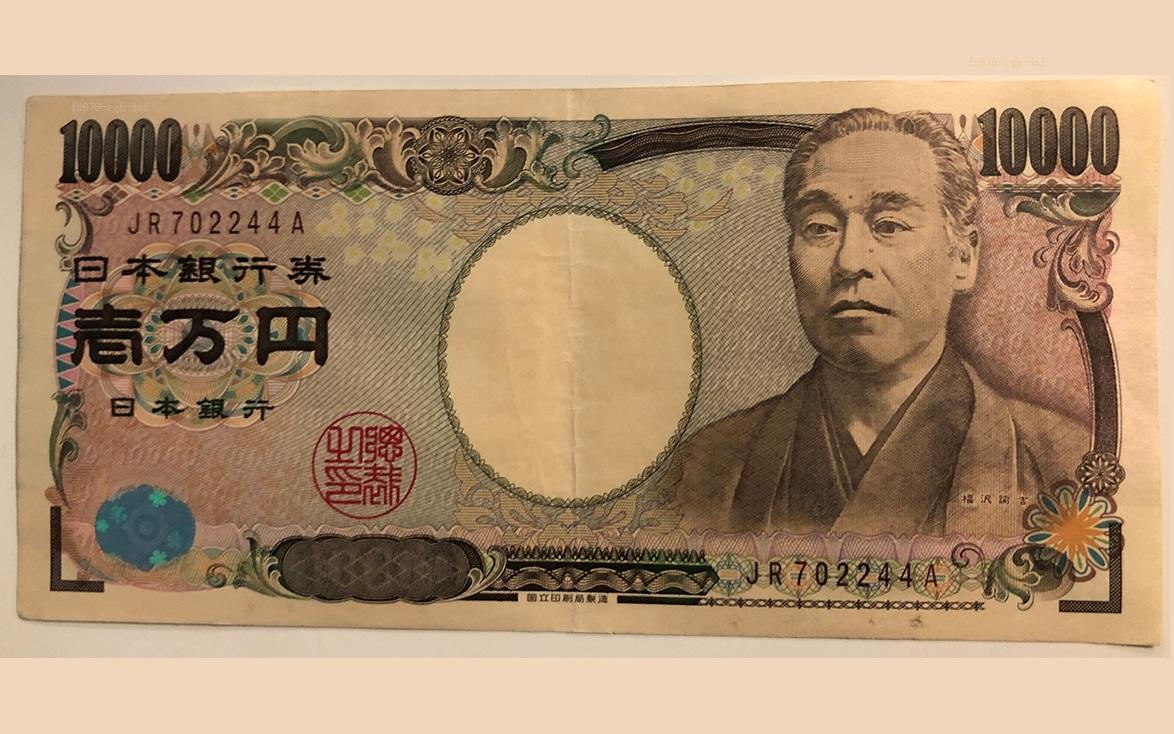
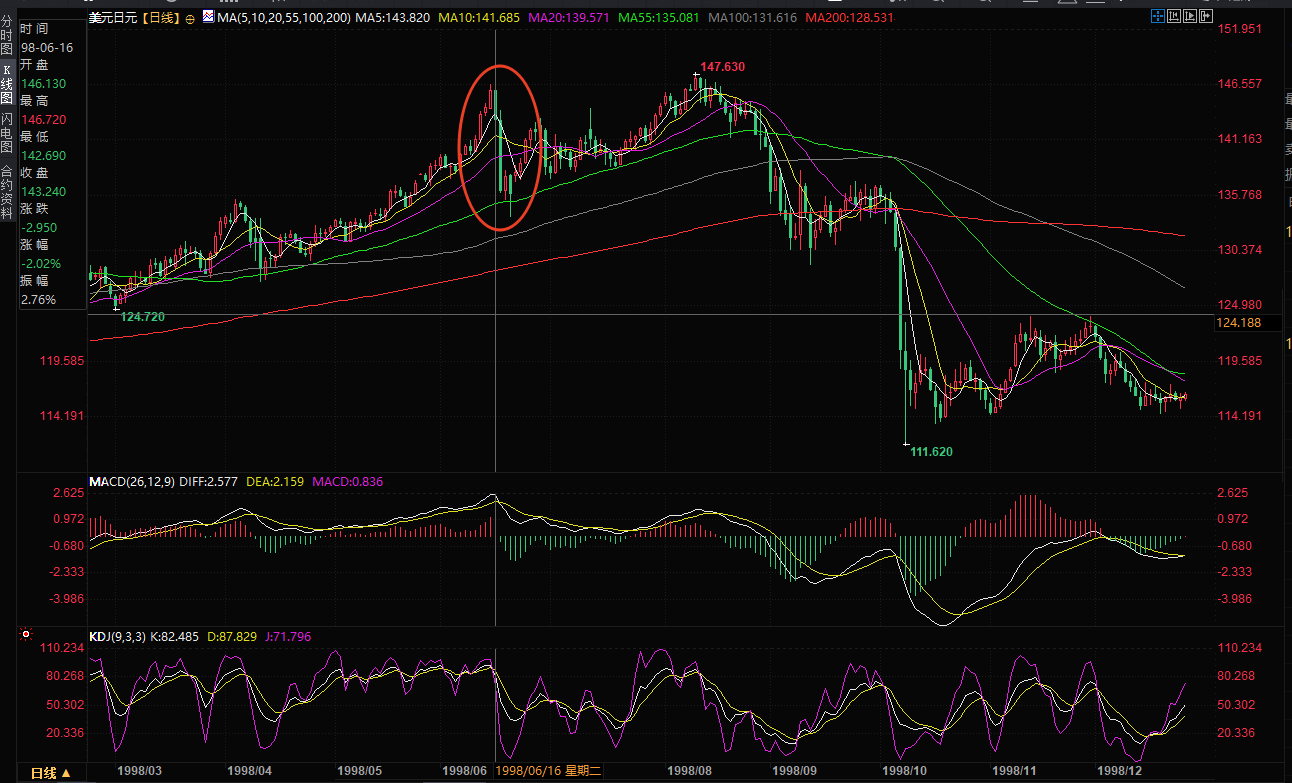 (Daily chart of USD/JPY before and after the 1998 US-Japan joint intervention, source: EasyForex) State Street Bank's Masahiko Loo also emphasized that intervention can buy time, but cannot change the long-term trajectory: "Intervention may affect the next few months. The Bank of Japan's normalization and hedging flows will determine the next few years." Brooks of the Brookings Institution is even more pessimistic, believing that as long as Japanese government bond yields are artificially suppressed, the yen is overvalued and needs to fall—intervention ultimately cannot reverse the depreciation trend driven by the Japanese bond market.
I. The Origins of the Joint Intervention: The Yen Plunged to a Forty-Year Low
The recent weakness of the yen has caused considerable anxiety in Tokyo. In July 2026, the yen fell to its lowest level against the dollar in nearly four decades. Prior to this, the Japanese Ministry of Finance had already invested a record 11.7 trillion yen (approximately US$73.5 billion) between April and May 2026 in a unilateral operation of buying yen and selling dollars. However, Tokyo alone has struggled to reverse the yen's continued decline. The root of the problem lies in the significant interest rate differential between the US and Japan. Although the Bank of Japan raised its policy rate to 1% in June 2026, borrowing costs in the US remain far higher than in Japan. In this environment, investors borrow low-interest yen and then buy high-yield dollar assets—the so-called "carry trade"—continuously putting downward pressure on the yen. As Christy Tan, global investment strategist at the Franklin Templeton Institute, put it, “Intervention can slow the decline, punish speculation, and send official warning signals, but it cannot overturn economic laws.” It was in this predicament, where unilateral intervention proved ineffective, that Tokyo turned to Washington, which unexpectedly offered assistance.II. Washington's Calculations: Defending the Treasury Market and Self-Preservation
Why did the US suddenly decide to join forces with Japan to buy yen after decades? This is the core question that the market is most concerned about. Many analysts point out that Washington's primary consideration is not simply "alliance," but a carefully calculated "self-protection" calculation. The potential risks in the US Treasury market are the biggest variable. Japan is the largest foreign holder of US Treasury bonds. If Tokyo were to sell off US Treasury bonds on a large scale to raise funds for intervention, it would inevitably push up US Treasury yields, thereby disrupting the stability of the US funding market. Louise Loo, head of Asian economics at Oxford Economics, bluntly stated that this "may be one of the key reasons for US participation," and that "there is an element of self-protection" —market volatility driven by Japan's aggressive fiscal policy could spread to the US Treasury market, thus shaking the foundation of the dollar. The FIMA repurchase facility has become a key institutional arrangement. It is noteworthy that the Japanese Ministry of Finance clearly stated on August 4, 2026, that it plans to use the standing FIMA repurchase mechanism established by the Federal Reserve for future interventions. This mechanism allows foreign central banks to obtain dollar liquidity without directly selling US Treasury bonds. State Street senior macro strategist Masahiko Loo points out that this signal "may be more important than the intervention itself"—it tells the market that Japan can raise dollars without selling its government bonds, thus alleviating market concerns that Japanese intervention might put pressure on the US funding market by selling short-term US Treasury bonds. The spillover effects on the global bond market cannot be ignored. Analysts also warn that continued yen weakness could trigger further selling of Japanese government bonds, and higher Japanese government bond yields would spill over into the global bond market . Meanwhile, the US is also facing pressure from rising long-term borrowing costs—the yield on 10-year US Treasury bonds has risen by nearly 57 basis points since the beginning of 2026. Stabilizing the yen, in a sense, is also "defusing a landmine" for the global bond market.III. The mystery of the operation: Why sell euros instead of dollars?
One detail of this intervention has caused widespread confusion in the market—reportedly, the US did not directly sell dollars to buy yen, but rather sold euros and bought yen through the Federal Reserve Bank of New York. Traditionally, coordinated exchange rate interventions are usually financed with dollar assets. Robin Brooks, a senior fellow at the Brookings Institution, questioned this approach, saying it "is confusing the market and will prove counterproductive." He believes this workaround weakens the effectiveness of US participation because the market will inevitably wonder why the US didn't directly use dollars to buy yen. However, from another perspective, this operation may precisely reflect Washington's prudent considerations—to provide support for the yen without further strengthening the dollar, while avoiding direct depletion of dollar reserves. In any case, this unconventional approach certainly leaves more room for interpretation in the market.IV. Geopolitical Dimension: US-Japan Relations Enter a "New Phase"
Beyond economic and financial considerations, this joint intervention carries deeper geopolitical implications. It fulfills a commitment to an ally. US President Donald Trump stated that the US's participation in this coordinated intervention was to help the yen, both as a gesture of support for Japan and to maintain global economic stability. Monex expert director Jesper Koll sees this action as a sign of a broader shift in US-Japan relations, stating that "US-Japan cooperation and partnership have entered a new phase," and that the coordinated intervention demonstrates that "when Japan asks for help, the US will respond to Japan's call." It sends a geopolitical signal to major Asian powers. Koll also points out that this move sends a clear geopolitical signal to major Asian powers because "leaders of major Asian powers care about action, not empty words." Against the backdrop of increasingly complex geopolitical competition in the Asia-Pacific region, the joint US-Japan intervention in the exchange rate undoubtedly has strategic significance beyond the financial market. It reflects a concern for fair trade. Louise Loo of Oxford Economics analyzes it from a trade perspective, pointing out that the US has repeatedly argued that the yen is "significantly undervalued," providing an incentive to correct what it perceives as an unfair trade advantage—a weaker yen makes Japanese exports more competitive.V. Deterrence and Effectiveness: How Far Can Intervention Go?
Judging from market reactions, the short-term effects of this joint intervention were immediate. After reaching a high of 163.73 against the Japanese yen last Thursday, the exchange rate fell to 157.57 on Friday, and hit a low of around 155.22 on Monday (August 3), but has since rebounded to around 157.66. Vishnu Varathan, head of Asian macro research at Mizuho Securities, pointed out that the US involvement "significantly enhanced" the effect of the foreign exchange intervention, as the market has more reason to believe that the authorities will act again if necessary. However, most analysts are cautious about the long-term effects of the intervention. The MUFG research team pointed out that historically, joint US-Japan intervention in the yen has usually occurred near key turning points in the USD/JPY exchange rate, but a true reversal of the trend often takes longer. For example, while the joint intervention in June 1998 caused the USD/JPY to fall from 146 to 136 within three weeks, the long-term trend was not truly broken until more than two months later (August), when the underlying logic of the Asian financial crisis changed, and the exchange rate briefly fell to around 112 in October 1988. (Daily chart of USD/JPY before and after the 1998 US-Japan joint intervention, source: EasyForex) State Street Bank's Masahiko Loo also emphasized that intervention can buy time, but cannot change the long-term trajectory: "Intervention may affect the next few months. The Bank of Japan's normalization and hedging flows will determine the next few years." Brooks of the Brookings Institution is even more pessimistic, believing that as long as Japanese government bond yields are artificially suppressed, the yen is overvalued and needs to fall—intervention ultimately cannot reverse the depreciation trend driven by the Japanese bond market.Conclusion
The joint purchase of yen by the US and Japan, the first such move in 28 years, is both an emergency rescue of the financial markets and a concentrated projection of geoeconomic competition. Protecting the US Treasury market, alleviating pressure on global bond markets, fulfilling alliance commitments, and sending geopolitical signals—multiple objectives are intertwined in this single intervention. However, no matter how powerful the joint intervention, it is ultimately just a tool to "buy time." The long-term trend of the yen exchange rate ultimately depends on whether the Bank of Japan can continue to normalize its monetary policy and whether the US-Japan interest rate differential can truly narrow. For investors, the next act of this major financial game has only just begun. At 11:20 Beijing time, the USD/JPY exchange rate was 157.62/63.- Risk Warning and Disclaimer
- The market involves risk, and trading may not be suitable for all investors. This article is for reference only and does not constitute personal investment advice, nor does it take into account certain users’ specific investment objectives, financial situation, or other needs. Any investment decisions made based on this information are at your own risk.