Kaohsiung City's proposal to implement both tax cuts and subsidies poses a "chronic negative" test for the yen.
2026-08-04 12:06:53
On Tuesday (August 4) during Asian trading hours, the USD/JPY pair rebounded slightly, currently trading around 157.50. After its most severe decline in nearly two years, the USD/JPY is attempting to stabilize. Japan's latest fiscal policy developments are likely to continue to influence market expectations regarding the long-term value of the yen. Japan's ruling party recently formally approved a proposal to significantly reduce the food consumption tax, planning to cut the rate from 8% to 1% for two years, along with an annual cash subsidy program of approximately 600 billion yen. However, the source of funding for this fiscal expansion measure remains unclear. Against the backdrop of Japan's already high public debt levels globally, market expectations for a medium- to long-term weakening of the yen have further strengthened. 
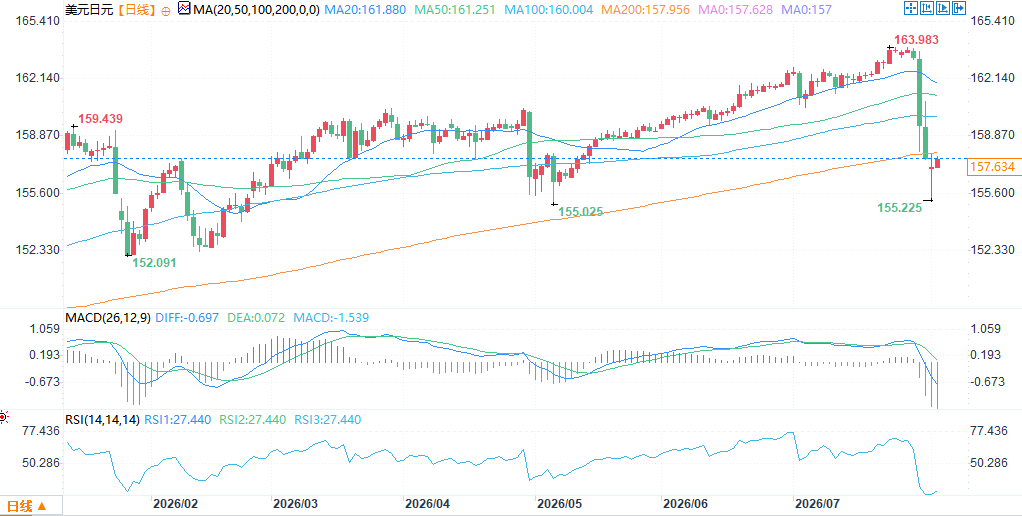 (USD/JPY daily chart, source: FX678) At 12:05 Beijing time on August 4, the USD/JPY exchange rate was 157.60/61.
The tax cut plan was approved within the Party, and its implementation is progressing rapidly.
According to a report by Nikkei, the ruling party's Tax System and Social Security Committee has approved the government's proposed reduction of the food consumption tax. The plan aims to lower the food consumption tax rate from the current 8% to 1% starting next April, for a period of two years. This proposal is closely linked to Prime Minister Sanae Takaichi's political commitments, and although the source of funding remains unclear, the plan has made substantial progress within the party. The next step is for the plan to enter a multi-stage approval process. The government plans to seek formal cabinet approval early next month and aims to submit related legislation to the extraordinary session of the Diet in the fall. Prior to this, the ruling party's highest decision-making body may begin deliberating on the draft as early as this Wednesday—indicating rapid progress within the party and strong political will.Subsidies and tax cuts are being implemented in parallel, and the scale of fiscal expansion should not be underestimated.
This tax cut is not the only fiscal expansion measure. According to the plan, starting next June, the government will also provide approximately 600 billion yen in cash subsidies annually to low- and middle-income families, with the subsidy amount determined based on income levels. The combination of tax cuts and subsidies constitutes a substantial short-term fiscal spending commitment. For the yen, fiscal expansion itself is not necessarily a negative factor—if accompanied by a clear growth strategy and monetary tightening, it could even boost confidence. However, the problem lies in the fact that both measures focus on short-term consumption stimulus rather than supply-side reforms or productivity improvements, and the source of funding has not yet been specifically explained.Unclear funding sources and fiscal sustainability have become a major concern for the market.
For the currency market, the core concern is: where will the money come from? The government's current plan is to rely on non-tax revenue, existing tax revenue, and savings from reviewing tax breaks and subsidies to fill the gap, but no specific amounts or implementation details have been announced for any of these sources. This "promise first, calculate later" approach makes it difficult to dispel market concerns about the sustainability of Japan's fiscal policy. By the end of 2025, Japan's government debt as a percentage of GDP exceeded 260%, ranking first among major economies globally. Any new large-scale fiscal spending without a source of funding will further weaken market confidence in the medium- to long-term value of the yen. Given the current backdrop of the yen already under pressure due to the widening interest rate differential between the US and Japan, this fiscal uncertainty is tantamount to adding insult to injury.Impact on the Japanese Yen: Background Pressures Rather Than Immediate Triggers
The market's primary pricing logic for the yen remains the USD/JPY interest rate differential. As long as the Federal Reserve maintains high interest rates and the Bank of Japan remains on hold, the yen will struggle to reverse its weakness. The added fiscal uncertainty exists more as background pressure—it won't trigger sharp fluctuations on a single trading day, but it will continuously erode the yen's long-term valuation base. In other words, the impact of this tax cut plan is more like a "chronic negative" than an "acute shock." Traders are unlikely to sell off the yen on a large scale because of this news, but fiscal factors will be factored into the "short-selling weight" when assessing the yen's medium-term outlook. Unless the Japanese government announces credible funding plans (such as accompanying fiscal consolidation measures or tax increases), this fiscal burden will remain a Damocles' sword hanging over the yen.Summarize
The ruling party's push for a significant reduction in food consumption tax and a cash subsidy plan, while aimed at alleviating the financial burden on ordinary people, has exacerbated market concerns about the sustainability of Japan's fiscal policy due to the lack of a clear source of funding. For the yen, this plan constitutes a new negative factor, and coupled with the existing pressure from the widening interest rate differential between the US and Japan, the yen's medium-term weakness is unlikely to fundamentally reverse. The market will closely watch whether the government can come up with a concrete funding plan—if it remains unclear, a new round of depreciation pressure on the yen will gradually accumulate. (USD/JPY daily chart, source: FX678) At 12:05 Beijing time on August 4, the USD/JPY exchange rate was 157.60/61.
- Risk Warning and Disclaimer
- The market involves risk, and trading may not be suitable for all investors. This article is for reference only and does not constitute personal investment advice, nor does it take into account certain users’ specific investment objectives, financial situation, or other needs. Any investment decisions made based on this information are at your own risk.