Ernst & Young warns: Conflict with Iran could severely damage the UK economy, with the risk of stagnant growth looming.
2026-08-04 13:18:52
The stability of the global energy supply chain is currently facing significant geopolitical challenges, with the navigation situation in the Strait of Hormuz impacting the economic prospects of various countries. EY, one of the four major consulting firms, released its latest economic forecasts, raising its baseline growth forecast for the UK this year. However, it also issued a serious warning that if the conflict with Iran continues to disrupt energy transport routes, the UK's economic growth risks stagnation . The effectiveness of the UK cabinet's policies to reduce burdens and boost the economy largely depends on the development of the US-Iran situation. President Trump's decisions will be a key variable influencing the outlook, and the risks of high inflation and economic contraction are accumulating. On Sunday morning (August 2), President Trump signaled that the market anticipated a swift new peace agreement between the US and Iran, with many hoping the global economy would avoid the extreme downside risks caused by the conflict. However, investors and policymakers remain rational and cautious, not readily accepting statements from various parties. Historical experience shows that previous US-Iran memorandums of understanding quickly expired, with both sides launching military strikes that broke the 60-day ceasefire, leading to a volatile situation and high uncertainty surrounding peace negotiations.
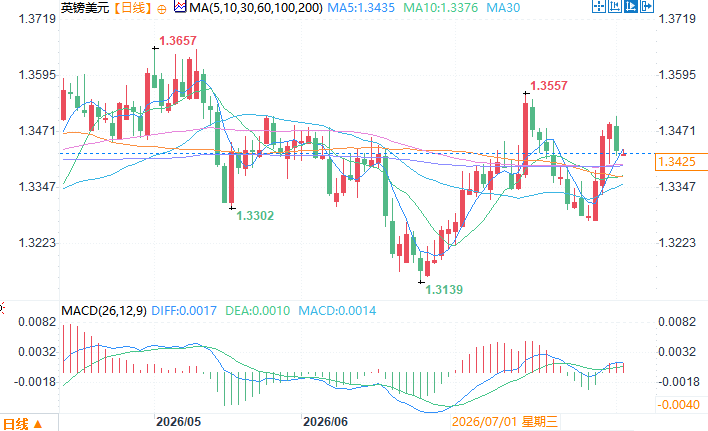 GBP/USD Daily Chart Source: FX678 At 13:16 Beijing time on August 4th, GBP/USD was trading at 1.3421/22.
Baseline expectations contain implicit premises; geopolitical disturbances will rewrite the economic outlook.
Ernst & Young has raised its baseline forecast for UK economic growth this year to 0.9%, suggesting that in an optimistic scenario, the UK economy may outperform earlier market predictions. However, this optimistic forecast rests on a core premise: the Strait of Hormuz must resume normal navigation. This waterway carries approximately one-fifth of the world's oil and gas supply and is a crucial route for transporting various key commodities from the Gulf region. Disruptions to shipping would directly pressure the global energy trade system. Ernst & Young analysts stated that prolonged energy price volatility could cause UK economic growth to stagnate in 2027. The institution specifically designed a pessimistic scenario: if shipping disruptions continue until mid-2027, UK economic growth this year would fall to 0.5%, and GDP would shrink by 0.2% in 2027. Inflation is equally concerning. In the baseline scenario, year-end inflation is still close to 3.5%; if the energy crisis escalates, inflation could surge to 6.4% in just a few months, significantly increasing the burden on people's lives. On Sunday morning (August 2), President Trump signaled that the market anticipated a swift new peace agreement between the US and Iran, with many hoping the global economy would avoid the extreme downside risks caused by the conflict. However, investors and policymakers remain rational and cautious, not readily accepting statements from various parties. Historical experience shows that previous US-Iran memorandums of understanding quickly expired, with both sides launching military strikes that broke the 60-day ceasefire, leading to a volatile situation and high uncertainty surrounding peace negotiations.The UK economy faces a major test, with policy relief measures showing clear limitations.
Ernst & Young's pessimistic forecast casts a shadow over Andy Burnham's optimistic economic outlook and increases the difficulty for the government to alleviate the cost of living pressures on businesses and households. On Sunday, Chancellor of the Exchequer John Healey admitted that the government would find it difficult to fully resolve the cost squeeze on businesses and ordinary households in the coming months. Peter Arnold, Ernst & Young's chief UK economist, stated that although the UK's economic growth in the first half of the year was better than expected, recent volatility in oil and gas prices and a new round of external shocks are testing the UK economy's resilience. He further analyzed that future UK economic growth will mainly rely on the technology industry and some business services ; the construction industry's development remains worrying, with industry costs rising by more than 30% since 2019, continuously increasing operational pressure. Employment data also reflects the divergence in industry patterns. Statistical analysis shows that recruitment demand in manufacturing and services continues to cool, and the number of positions is decreasing. The construction industry is the only private sector where job vacancies have consistently exceeded pre-pandemic levels, indirectly reflecting the supply-demand imbalance caused by high industry costs. At the same time, the organization suggested that independent artificial intelligence technology is expected to become a breakthrough, helping the entire industry improve production efficiency and becoming a potential driving force for long-term economic growth.External risks cannot be ignored, and the weaknesses of the British economy have been fully exposed.
As an economy heavily reliant on energy imports, the UK is extremely vulnerable to fluctuations in international oil and gas prices. Its domestic energy self-sufficiency is limited, and its supply chain is highly dependent on ocean shipping. If the Strait of Hormuz remains blocked for an extended period, the increased cost of energy imports will be cascaded through the supply chain, pushing up prices across the board. Even with various government support policies, their effectiveness is limited in the face of external geopolitical risks. In summary , baseline growth expectations cannot mask potential crises. Whether the US-Iran situation can be eased and whether the Strait of Hormuz can be reopened are key variables influencing the UK's economic trajectory over the next two years. If the Strait remains blocked for an extended period, the UK's heavy reliance on energy imports will lead to rising oil prices, worsening the trade balance and creating stagflation that could cripple the Bank of England. Interest rate hikes to combat inflation would further damage the economy, while loose monetary policy would push up prices. Simultaneously, geopolitical risks will fuel safe-haven buying of the US dollar, and coupled with the widening gap in economic fundamentals between the UK and the US, funds will tend to withdraw from sterling assets, putting downward pressure on the pound against the dollar. Only a significant, unexpected interest rate hike by the Bank of England would trigger a brief rebound. Before geopolitical conflicts have fully subsided, markets need to abandon one-sided optimism and continuously monitor energy shipping lanes and inflation data. If the conflict continues to escalate, the dual pressures of slowing growth and rebounding inflation will become a severe challenge that the UK economy must confront. GBP/USD Daily Chart Source: FX678 At 13:16 Beijing time on August 4th, GBP/USD was trading at 1.3421/22.
- Risk Warning and Disclaimer
- The market involves risk, and trading may not be suitable for all investors. This article is for reference only and does not constitute personal investment advice, nor does it take into account certain users’ specific investment objectives, financial situation, or other needs. Any investment decisions made based on this information are at your own risk.