Spot silver is being "supported" by geopolitical risks and "suppressed" by expectations of interest rate hikes. In this tug-of-war, who will let go first?
2026-08-04 13:38:52
On Tuesday (August 4) during Asian trading hours, spot silver fluctuated higher, currently trading around $59 per ounce. Silver prices are currently supported by two main factors: firstly, the continued uncertainty surrounding US-Iran negotiations is injecting safe-haven buying into silver, a non-interest-bearing asset; secondly, the market's repricing of expectations for a Fed rate hike in September is also continuously adding volatility to silver prices. 
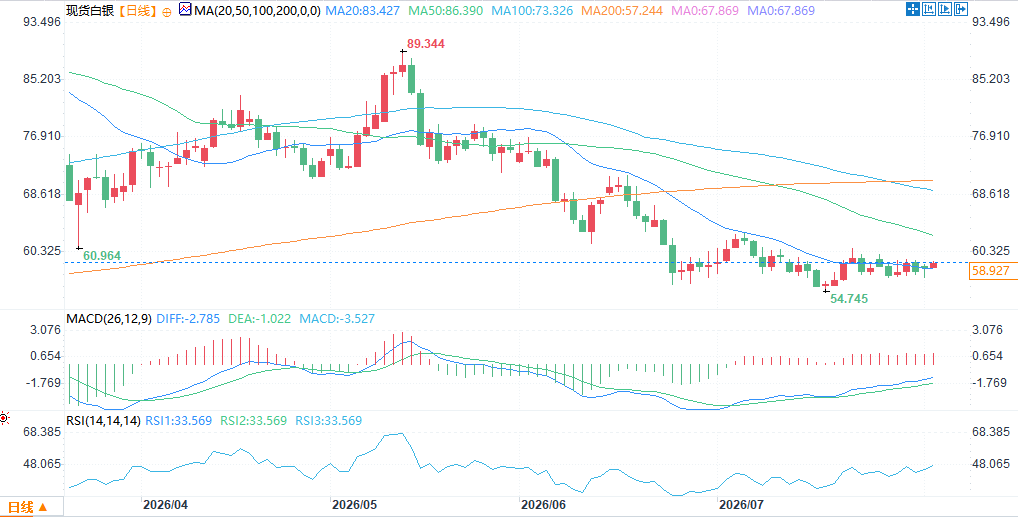 (Spot silver daily chart, source: EasyTrade) At 13:37 Beijing time on August 4, spot silver was trading at $58.88 per ounce.
US-Iran negotiations: Trump's "last chance" cools, geopolitical risk premium rises.
The core driver of this round of silver price increases stems from the renewed escalation of geopolitical tensions between the US and Iran. After cancelling a large-scale military strike against Iran, US President Trump described his latest proposed negotiations as Iran's "last chance," anticipating that formal talks would soon begin to ensure navigational safety in the Strait of Hormuz and address long-standing US concerns about Iran's nuclear program. However, Iran's response was unusually strong. General Mohsen Rezaei, a senior advisor to Iran's Supreme Leader, categorically rejected the US conditions, explicitly declaring that Iran would never allow a second passage through the Strait of Hormuz and warning that any foreign warships or military forces deployed in the region would be targets. This statement went far beyond the market's expectation of "denying negotiations," directly escalating to a threat of military confrontation, rapidly escalating geopolitical risks in the Middle East. Trump's "negotiation rhetoric" and Iran's "hard rejection" created a stark contrast in expectations—the market had previously priced in a geopolitical premium for US-Iran reconciliation and the reopening of the Strait of Hormuz, but Iran's strong response means that Middle East supply risks have not only not been resolved but may have further escalated. This expectation gap directly fueled safe-haven buying of silver, as silver combines the safe-haven attributes of precious metals with the commodity attributes of industrial metals, and is often more resilient than gold during periods of heightened geopolitical risks.Fed Policy: 67% probability of a September rate hike; Williams signals a "steady hawk" stance.
On the monetary policy front, market participants are continuously recalibrating their expectations for Federal Reserve interest rates. Following the decision to keep rates unchanged at the July policy meeting, the CME FedWatch tool estimates the market currently prices a 67% probability of a 25 basis point rate hike at the September meeting. This probability level suggests that a rate hike has become the market's baseline scenario, rather than an alternative. Recent remarks by New York Fed President Williams provided further guidance on this expectation. Williams reiterated that current interest rate policy is "well-positioned" to achieve the 2% inflation target and emphasized that the Fed will not hesitate to act if inflation deviates from the 2% path. However, Williams also expressed optimism that inflation will gradually decline and the inflation-boosting effect of the Middle East conflict will gradually cool. He acknowledged that market pricing is "valuable information" but not binding, and downplayed the financial stability risks posed by artificial intelligence investments—a series of statements collectively conveying a "steady hawk" rather than aggressive rate hike signal: maintaining policy patience within a firm anti-inflation framework.Silver's dual drivers: the tug-of-war between safe-haven demand and interest rates
Silver is currently at the intersection of two lines of reasoning: First, the geopolitical safe-haven logic. The stalemate between the US and Iran over the Strait of Hormuz, and Iran's clear threat of military confrontation, provide sustained risk premium support for silver. As long as the situation in the Middle East does not truly ease, safe-haven buying of silver will be difficult to subside. Second, the interest rate expectation logic. The probability of a September rate hike approaching 65% means that the medium-term upside risk for the US dollar and US Treasury yields still exists, which puts pressure on silver, a zero-yield asset. However, Williams' "steady hawk" rather than "rapid hawk" stance, and the decline in the FXS sentiment index, indicate that the market has fully priced in expectations of further hawkish escalation, and the room for marginal hawkishness in the short term is limited. The interaction of these two lines of reasoning explains the recent resilience of silver – geopolitical risks provide bottom support, while the expectation of rate hikes, although constituting upward pressure, has a diminishing marginal impact.Institutional Views
A Citigroup report at the end of July stated that silver possesses both industrial and investment attributes, and the tight physical supply situation is unlikely to ease quickly, supported by demand from clean energy and advanced manufacturing. Despite the recent sharp price correction, the global supply shortage pattern, which has persisted for many years, remains unchanged, and inventory depletion and potential investor inflows continue to drive upward movement. Citigroup pointed out that once the Federal Reserve's policy shifts or gold prices strengthen again, silver is expected to outperform due to its greater elasticity. The current gold-silver ratio is near historical highs, also providing room for silver prices to catch up with gold. UBS's latest forecast shows that silver is expected to rebound to $65 by September 2026, reach $70 by the end of the year, and rise to $75 by mid-2027. UBS believes that the current correction is more driven by macroeconomic factors than a complete shift in fundamentals. As expectations for a Federal Reserve rate cut gradually rise, the dollar retreats from its highs, and industrial demand stabilizes, silver will experience a gradual rebound.Market Outlook
Looking ahead, silver's short-term trend will depend on the evolution of two major variables: first, whether the US-Iran situation will escalate from verbal confrontation to substantive military conflict—if Iran further intensifies its blockade of the Strait of Hormuz, or if the US takes retaliatory action, silver will experience strong upward momentum; second, this Friday's US employment data will further recalibrate the probability of a September rate hike—if the job market remains strong, the probability of a rate hike may exceed 70%, putting short-term pressure on silver; if the data weakens, it may trigger a revision of rate hike expectations, opening up upward space for silver. Against the backdrop of intertwined geopolitical risk premiums and interest rate expectations, silver is expected to maintain a slightly bullish oscillating pattern in the short term. $58.50 has become an important psychological support level, and the upside focus is on whether it can break through the resistance zone of $59.50-$60.00. (Spot silver daily chart, source: EasyTrade) At 13:37 Beijing time on August 4, spot silver was trading at $58.88 per ounce.
- Risk Warning and Disclaimer
- The market involves risk, and trading may not be suitable for all investors. This article is for reference only and does not constitute personal investment advice, nor does it take into account certain users’ specific investment objectives, financial situation, or other needs. Any investment decisions made based on this information are at your own risk.