Iran's hardening stance expands strategic space; gold prices retreat to consolidate.
2026-08-04 19:24:52
On Tuesday (August 4th) during the European and American trading sessions, spot gold saw weak buying interest, with prices remaining below $4100. Although Trump continued to signal smooth negotiations and easing geopolitical tensions, gold prices failed to sustain an upward trend, quickly retreating after initial gains. The ongoing Rashomon-like situation surrounding US-Iran negotiations, coupled with internal power struggles and the advancement of Iran's foreign trade strategies, is reshaping the regional power dynamics. While gold, a traditional safe-haven asset, experienced a brief surge due to Trump's signals of easing tensions in the Middle East, it was ultimately pressured by Iranian personnel appointments, the signing of trade agreements, the return of the US dollar to safe-haven assets, rising oil prices pushing up inflation, and expectations of a Fed rate hike, resulting in a pullback after the initial surge. Spot gold traded around $4050, below $4100. 
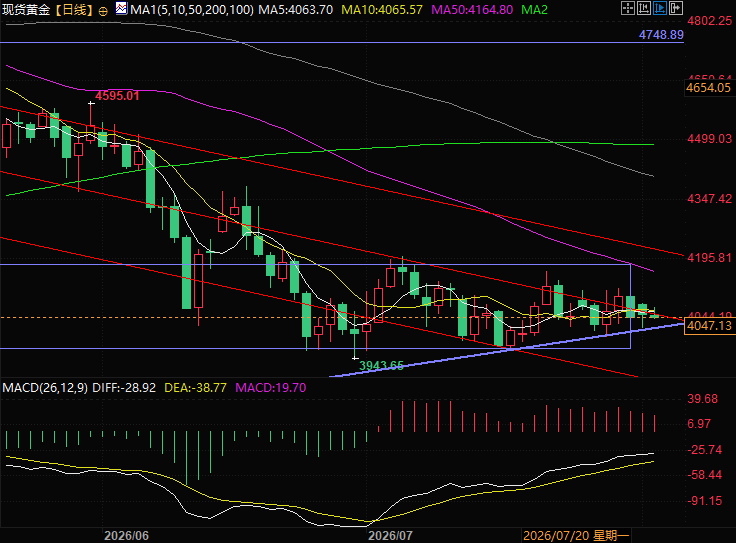 (Spot gold daily chart, source: FX678) At 19:21 Beijing time, spot gold is currently trading at $4057.26 per ounce.
Foreign strategic layout: The Iran-Pakistan Free Trade Agreement expands Iran's room for maneuver.
According to the Iranian news agency IRNA, Pakistan's Commerce Minister expressed his determination to finalize the Iran-Pakistan Free Trade Agreement (FTA). This statement came at the 10th meeting of the Pakistan-Iran Joint Trade Committee, where high-level officials from both sides met in Islamabad to finalize the FTA, aiming to push bilateral trade to $10 billion annually. A free trade agreement involves significant tariff reductions and simplified customs procedures between the two countries, allowing for lower-cost cross-border trade of agricultural products, industrial goods, and energy commodities. From the perspective of both sides' practical needs: Pakistan faces energy shortages and hopes to facilitate imports of Iranian oil, gas, and petrochemical products; its rice, meat, and other agricultural products can also access the Iranian market, boosting the economy of its border province of Balochistan and alleviating border tensions. For Iran, the agreement is particularly crucial: the risk of maritime conflict in the Strait of Hormuz remains high, and maritime trade is constantly threatened by disruption. Pakistan's land border crossings, Gwadar Port, and Karachi Port have become important alternative land-based import and export routes for Iran, circumventing the risk of maritime blockade. However, the agreement still faces practical obstacles, with secondary US sanctions being the biggest constraint; verbal statements do not guarantee immediate implementation. However, once substantial progress is made, Iran will have a land-based economic backup route, reducing its sole reliance on maritime transport through the Strait of Hormuz and significantly expanding its strategic maneuvering space. Even under maritime pressure, it will still retain the foundation for its external trade and economic operations. With hardliners dominating internally and gaining more room for maneuver externally, it means that in the short term, Iran will maintain a relatively tough stance in the US-Iran rivalry and will not easily make substantial concessions.Iran's internal power structure: The Revolutionary Guard holds the dominant position in the power struggle.
Early this morning, a significant personnel change was announced from the Iranian leadership: the Supreme Leader plans to appoint his trusted military aide, Mohsen Rezaei, to replace Zulghal, secretary of the Supreme National Security Council. This position oversees Iran's top-level strategy regarding its rivalry with the US and the Strait of Hormuz. Rezaei is a veteran of the Revolutionary Guard with a more hardline stance. If officially appointed, this would raise Iran's threshold for compromise, lead to a more resolute use of military deterrence tools in the Strait, and make it difficult for geopolitical risk premiums to subside quickly. This news is currently only an internal rumor and has not been officially announced. Meanwhile, Iranian President Pezechzian publicly denied resignation rumors on state television, stating his commitment to his post and emphasizing full coordination with the armed forces. Previously, senior cleric Kharrazi revealed that Pezechzian had repeatedly threatened to resign, only ceasing such actions after receiving warnings; this claim has been completely denied by the president. Pezechzian represents a pragmatic reformist civilian faction, prioritizing the easing of sanctions and the restoration of the domestic economy and people's livelihoods, and hoping to advance diplomatic mediation through Oman. However, under a wartime regime, core strategic powers such as military affairs, Straits control, and the rivalry with the United States are firmly held by the Revolutionary Guard and the Supreme National Security Council. The civilian government primarily handles domestic administrative affairs, making it difficult to push for large-scale foreign compromises. The so-called resignation rumors are essentially an external projection of the conflict between the pragmatic approach of the civilian government and the hardline approach of the Revolutionary Guard. A comprehensive analysis of personnel signals indicates that the initiative in Iran's foreign policy is currently in the hands of the hardline faction within the Revolutionary Guard, and the threshold for diplomatic compromise has been significantly raised.Market Recap: Geopolitical safe-haven buying triggered a surge followed by a pullback in gold prices.
The uncertain prospects of US-Iran negotiations and the escalating risk of conflict have fueled safe-haven buying of the US dollar, directly suppressing the upside potential of gold, a non-interest-bearing asset. On Monday, Iran denied engaging in any negotiations with the US, directly provoking a fierce backlash from Trump. Trump had previously used the resumption of US-Iran talks as grounds for canceling the high-intensity military strikes over the weekend. Further reports of the Iranian Revolutionary Guard's drone strikes on US military bases in Kuwait have further reduced the success rate of diplomatic mediation, strengthening the safe-haven dollar and pressuring gold prices. A senior Iranian advisor publicly refuted Trump's statements regarding navigation in the Strait of Hormuz, warning that the waterway would only allow passage along routes designated by Iran. Simultaneously, the Houthi rebels imposed a naval blockade on Saudi Arabia, reigniting concerns about global energy supply, and causing crude oil prices to recover some losses.Key factors weighing on the economy: rising oil prices driving inflation, and persistent expectations of a Fed rate hike.
The rebound in oil prices reignited market concerns about inflation, and the market has not ruled out the possibility of the Federal Reserve restarting interest rate hikes. CME FedWatch shows that the probability of a rate hike in September has exceeded 60%, and the probability of a rate hike this year is above 85%. Monday's stronger US ISM Manufacturing PMI data further reinforced hawkish expectations, and the dollar completed its overnight recovery, moving away from its mid-June lows, further pressuring gold. Safe-haven buying driven by geopolitical conflicts could not withstand the bearish pressure from a stronger dollar and expectations of rate hikes, and the safe-haven rally in gold was short-lived.Market Outlook: Awaiting Directional Guidance from Non-Farm Payroll Data
Iran's civilian bureaucracy is largely influenced by the Revolutionary Guard, and the current personnel appointments have significantly altered this situation. Coupled with the trade agreement secured by Palestine, this gives Iran greater potential for maneuvering against the US military. Furthermore, this week's non-farm payroll data will directly guide the Federal Reserve's policy direction, driving dollar fluctuations and acting as a catalyst for gold price movements. Based on fundamental analysis, gold currently faces relatively less downward resistance. Technically, spot gold is still suppressed by the lower trendline of the descending channel, but the channel's compression of overall price volatility has allowed gold to complete a narrow consolidation phase. A clear breakout pattern is expected soon, with an upward bias (meaning a potential initial downward break followed by a rapid upward breakout is possible), requiring close attention. (Spot gold daily chart, source: FX678) At 19:21 Beijing time, spot gold is currently trading at $4057.26 per ounce.
- Risk Warning and Disclaimer
- The market involves risk, and trading may not be suitable for all investors. This article is for reference only and does not constitute personal investment advice, nor does it take into account certain users’ specific investment objectives, financial situation, or other needs. Any investment decisions made based on this information are at your own risk.