Following the release of the Qatar draft bill, oil prices plummeted by $1.80! Is the strait really about to open?
2026-08-04 19:20:58
On Tuesday, August 4th, international oil prices remained highly volatile. Brent crude oil briefly plunged $1.80 per barrel, hitting a low of $83.75 per barrel, after Qatar announced it had drafted a text for a possible US-Iran deal. The market initially interpreted this as a potential rapid resumption of navigation through the Straits of Hormuz, thus focusing on reducing the premium for supply disruptions. However, subsequent disagreements, news of ship attacks, and the lack of substantial restoration of shipping routes quickly cooled the previous optimistic pricing. The 5-minute chart shows Brent crude oil rapidly falling from $86.31 to $83.75, breaking below the Bollinger Band's middle band and briefly breaching the lower band. The MACD also turned negative, reflecting a concentrated exit of highly leveraged long positions in response to the news shock. 
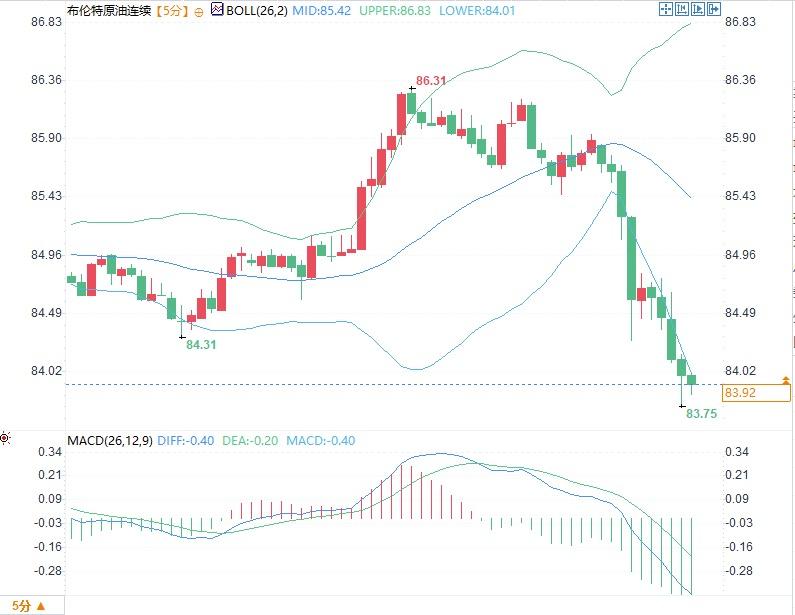 From a technical perspective, the $84 area has become a short-term sentiment testing zone, but this level alone cannot prove that supply risks have peaked. The pullback after the lower Bollinger Band was quickly broken reflects a liquidity shock and short covering, rather than a fundamental reversal. The MACD remains below the zero line, also indicating that the price recovery is temporarily outpacing the trend correction.
The draft agreement does not equate to a supply recovery; the core of pricing lies in the implementation mechanism.
The key to the current negotiations is not the existence of a text, but whether the rights of passage through the strait, vessel approval rights, channel demarcation, clearance arrangements, and fee mechanisms can be formulated into an enforceable solution. Existing proposals include Iran managing the northern route into the Gulf, Oman managing the southern route outwards, and providing information before vessel passage. Another proposal suggests charging service fees related to security and environmental protection. Previous proposals supported by multiple parties in the Gulf also involved voluntary strait usage fees. This means the market is not facing a simple opening or closing, but rather a distinction between limited opening, conditional opening, and continuously controlled passage. Even if a principled consensus is reached at the political level, mine clearance, insurance re-insurance, crew safety assessments, port queue clearing, and tanker redeployment will still take time. An agreement can only mitigate tail risks and cannot immediately restore spot cargo flows. The US opposes any arrangements granting Iran long-term approval or fee-collecting rights, while Iran emphasizes its leading role in managing near-shore routes and vessel safety. There are fundamental differences in the understanding of the strait governance structure between the two sides. Therefore, the draft text is closer to the starting point of negotiations than the endpoint of a full restoration of supply.What truly supports oil prices is not rhetoric, but the hampered flow of physical goods.
The Strait of Hormuz transported approximately 20 million barrels of oil per day in 2024, equivalent to about 20% of global liquid petroleum consumption, and traffic is expected to remain largely at a similar level in the first quarter of 2025. Due to limited alternative pipelines and bypass capabilities, the impact of strait obstruction on the spot market is far greater than that of ordinary port disruptions. As of August 4th, shipping through the Strait remained significantly restricted, with some tankers needing to navigate closer to specific coastlines and others opting to detour around Africa. Recent news also indicates that a cargo ship reported being struck by an unidentified object near Oman, suggesting that shipping safety risks have not disappeared despite the news of negotiations. Oil prices have thus formed a two-tiered structure. The first tier is the rapid contraction of the risk premium driven by the news of negotiations, manifested as a sharp drop within minutes; the second tier is the spot market support comprised of declining inventories, hindered exports, rising freight rates, and increased insurance costs. The latest estimates show that global oil inventories have recently decreased by approximately 6.3 million barrels per day, mainly related to declining exports from the Gulf and Russia and increased demand in Asia. Unless actual loading volumes and strait traffic volumes continue to improve, the supply premium for Brent crude will be difficult to completely disappear.Oil prices are shifting from one-way risk trading to event-driven two-way revaluation.
In the past few trading days, Brent crude oil fell 4.7% in a single day due to the suspension of further sanctions and expectations of negotiations, while WTI crude oil fell 5.1%. Subsequently, it rebounded rapidly due to doubts about the authenticity of the negotiations and shipping safety incidents. This trend indicates that the market has not formed a stable supply and demand conclusion, but rather is repeatedly switching between expectations of an agreement and logistical realities. From a term structure perspective, if near-month contracts continue to outperform far-month contracts, it means that refineries and traders are more focused on immediate delivery shortages; if the near-month premium narrows significantly, it indicates that the market is beginning to believe that shipping can gradually recover. More important indicators than simply observing news headlines include daily effective passage through the Strait of Hormuz, tanker freight rates, war risk premiums, loading volumes at Gulf ports, floating storage capacity, and official selling prices of major exporting countries. From a technical perspective, the $84 area has become a short-term sentiment testing zone, but this level alone cannot prove that supply risks have peaked. The pullback after the lower Bollinger Band was quickly broken reflects a liquidity shock and short covering, rather than a fundamental reversal. The MACD remains below the zero line, also indicating that the price recovery is temporarily outpacing the trend correction.
- Risk Warning and Disclaimer
- The market involves risk, and trading may not be suitable for all investors. This article is for reference only and does not constitute personal investment advice, nor does it take into account certain users’ specific investment objectives, financial situation, or other needs. Any investment decisions made based on this information are at your own risk.