Why is it more difficult for the European Central Bank to shift course despite a 0.3% drop in producer prices?
2026-08-05 17:50:51
On Wednesday, August 5th, the euro was trading around 1.1540 against the US dollar, slightly higher than yesterday's trading range. On the macro level, the Eurozone's producer price index fell 0.3% month-on-month in June, while the composite purchasing managers' index rose to 52.0 in July, forming a combination of "lagging cost declines and current demand recovery." However, what truly determines exchange rate pricing is not the direction of a single data point, but whether this combination can continue after the rebound in energy prices. 
 If energy price increases coincide with service sector expansion, the market may price in a longer period of high interest rates from the European Central Bank; conversely, if energy prices fall while new orders weaken again, the current rebound could be reinterpreted as a temporary correction. For trading, the key variable has shifted from the apparent decline in June producer prices to the correlation between energy and service inflation and real demand.
Producer prices have fallen, but inflation signals remain strong.
Eurozone producer prices fell 0.3% month-on-month in June, in line with market expectations and reversing the 0.2% increase in May. The breakdown shows that energy prices fell 1.5%, the core reason for the overall index turning negative; intermediate goods rose 0.3%, capital goods and durable consumer goods both rose 0.2%, and non-durable consumer goods remained flat. Excluding energy, producer prices actually rose 0.2% month-on-month. This structure suggests that the June data more closely reflects a statistical decline due to a pullback in energy costs, rather than a comprehensive easing of pricing pressures on businesses. The continued rise in intermediate goods prices indicates that the costs of raw materials, components, and semi-finished products in the manufacturing chain remain sticky. The rise in capital goods prices reflects that the pricing of equipment, machinery, and investment goods has not weakened in tandem. More importantly, the June producer price index corresponded to the earlier decline in the energy market, while energy prices have rebounded in July. Eurozone overall inflation rose to 2.9% in July from 2.8% in June, indicating that the energy shock is beginning to re-enter end-market price expectations. The European Central Bank (ECB) kept its three key interest rates unchanged on July 23 and explicitly stated that energy prices remain highly volatile, and the full impact of energy shocks on inflation has not yet materialized. Therefore, the decline in producer prices in June cannot be directly extrapolated to a continued cooling of inflation in the coming months.Purchasing Managers' Index rebounded, indicating a substantial improvement in the growth structure.
The final reading of the Eurozone services Purchasing Managers' Index (PMI) rose to 51.7 in July from 49.4, a five-month high; the composite index rose to 52.0 from 50.0, an eight-month high. An index above 50 indicates a renewed expansion in business activity, and this improvement is not entirely dependent on a single sector. The survey showed that output and new orders both grew at their fastest pace since November last year, with manufacturing output continuing its recovery and the services sector ending its previous contraction. German private sector output expanded for the first time since March, growth accelerated in Italy and Spain, while France remained in contraction territory, although the decline narrowed. Employment ended six consecutive months of decline, and business confidence rose to a five-month high. According to the survey model, the current index level corresponds to a quarterly economic growth rate of approximately 0.3%. The implication of this data is that Eurozone growth expectations have been revised from "near stagnation" to "moderate expansion." However, 52.0 does not necessarily represent high prosperity; it is closer to a recovery from a low base. Export orders remain weak, with the German services index at only 49.8, indicating that the recovery in manufacturing has not yet fully translated into domestic demand and service consumption.The European Central Bank is not facing a window for interest rate cuts, but rather a rebalancing of energy and demand.
Input cost growth in the July Purchasing Managers' Index (PMI) survey fell to a five-month low, and output cost growth also slowed to its lowest level since March. On the surface, this provides the European Central Bank (ECB) with room to observe. However, both price indicators remain above historical averages, while overall inflation has rebounded to 2.9%, services inflation to around 3.3%, and core inflation to around 2.5%. Price pressures are now being driven by a combination of energy, wage, and service costs, rather than a single energy variable. In June, the ECB projected average overall inflation of 3.0% and average inflation excluding energy and food to 2.5% for 2026, and revised its inflation forecast upward due to an upward shift in energy price paths. The July meeting maintained interest rates unchanged, indicating that the policy focus has shifted from simply judging the strength of demand to assessing the duration of energy shocks and whether businesses can pass on costs to end prices. Therefore, the decline in producer prices has not significantly weakened expectations of a tighter policy stance, and the rebound in the PMI has actually reduced the economy's sensitivity to high interest rates. As long as growth remains in expansionary territory, the ECB has a longer observation period and does not need to quickly change its policy stance due to a single month's decline in cost data.The euro is approaching the upper Bollinger Band, and the market is entering a zone where expectations have been confirmed.
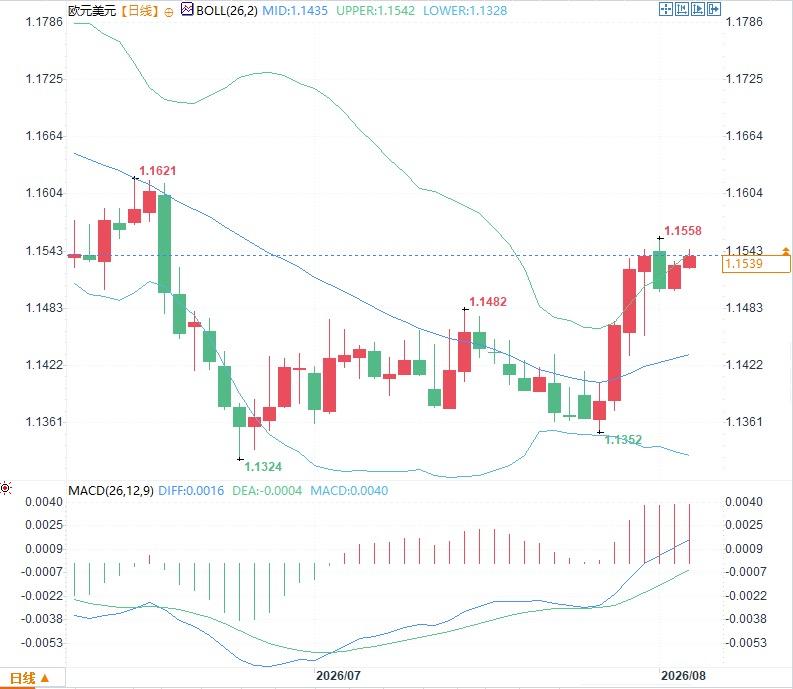
From a daily chart perspective, the euro/dollar pair formed a series of higher lows after finding support around 1.1324, and broke through the Bollinger Band middle line at 1.1435. The current price is approaching the upper Bollinger Band at 1.1542, with the recent high near 1.1558. The MACD fast line has crossed above the slow line, and the histogram has turned positive and expanded, indicating that the rebound momentum remains. However, the price is too close to the upper Bollinger Band, suggesting that short-term volatility may increase. If energy price increases coincide with service sector expansion, the market may price in a longer period of high interest rates from the European Central Bank; conversely, if energy prices fall while new orders weaken again, the current rebound could be reinterpreted as a temporary correction. For trading, the key variable has shifted from the apparent decline in June producer prices to the correlation between energy and service inflation and real demand.
- Risk Warning and Disclaimer
- The market involves risk, and trading may not be suitable for all investors. This article is for reference only and does not constitute personal investment advice, nor does it take into account certain users’ specific investment objectives, financial situation, or other needs. Any investment decisions made based on this information are at your own risk.