The real and virtual game in the cross-strait negotiations: Gold prices face a test before a breakthrough.
2026-08-05 21:54:53
Recently, with the mediation of Oman and Qatar, negotiations to restart navigation in the Strait of Hormuz have made substantial progress, resulting in an enforceable bilateral waterway control plan. Iran and Oman have finalized core navigation rules: a two-way separation control model will be implemented, with ships entering the Persian Gulf passing through Iranian-controlled channels and exiting through Oman-controlled channels. Both countries also plan to charge a special navigation service fee for passing vessels, with funds primarily used for waterway safety, security maintenance, and marine ecological protection, providing a safety net for normalized navigation. In addition, the parties are discussing establishing a 60-day temporary passage mechanism to ensure short-term shipping stability. Iranian officials have confirmed the progress of the negotiations. Iranian Foreign Ministry spokesman Bagheei stated that the bilateral negotiations between Iran and Oman have achieved positive breakthroughs at both the technical and political levels. The two countries are building a new standardized management mechanism, the core of which is to delineate safe navigation routes and balance the sovereign rights and national security demands of both countries. It is worth noting that Iran has repeatedly stated publicly that the Strait of Hormuz cannot be fully restored to its pre-war uncontrolled state, and the core demand of this round of negotiations is to gain greater management and control over this crucial shipping channel. Meanwhile, Iran has communicated with the Italian Foreign Minister regarding relevant negotiations, actively expanding diplomatic communication channels and promoting the implementation of the Straits of Hormuz cross-strait passage mechanism. Furthermore, Iran's core demands include lifting the US maritime blockade of Iranian ports, and it continues to send a strong signal that if the US continues to exert pressure, Iran will maintain the closure of the Straits in retaliation. 
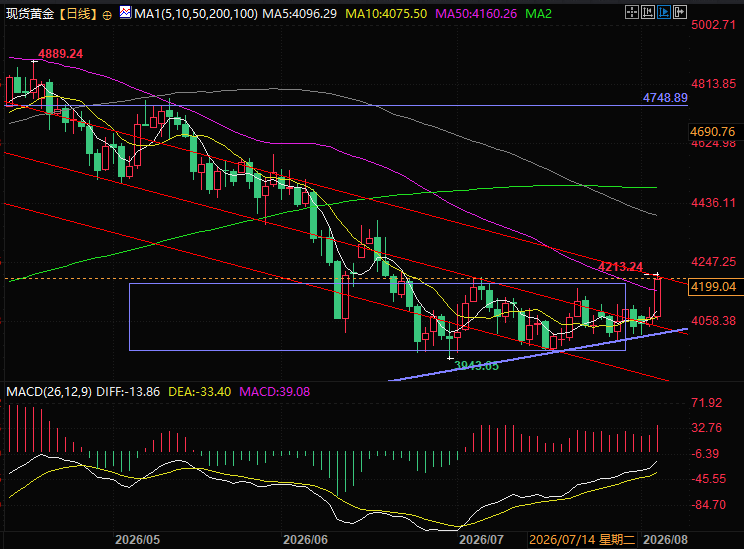 (Spot gold daily chart, source: FX678) At 21:45 Beijing time, spot gold is currently trading at $4196 per ounce.
The US is eager to create momentum to push for a deal, but there are no direct negotiations between the US and Iran, and their core differences remain unresolved.
Compared to the pragmatic bilateral consultations in Iraq and Oman, the United States has become the most eager party in this round of negotiations, with multiple parties simultaneously releasing optimistic signals about the agreement's implementation. US President Trump publicly stated that the Strait of Hormuz navigation agreement is expected to be officially announced within the next day or two, potentially paving the way for a resumption of dialogue between the US and Iran. The US Secretary of State and Treasury Secretary have also confirmed substantial progress in the negotiations. At the same time, the US has taken a hard line, firmly rejecting Iran's claim to dominant control over the Strait and publicly stating that Iran will not be allowed to collect any navigation service fees. The US has even threatened to retaliate by charging fees if Iran initiates such a mechanism, further escalating the power struggle between the two sides. Trump also warned Iran that if the negotiations fail to reach a conclusion, Iran will face a "heavy blow." US Secretary of State Rubio also confirmed progress in the negotiations but cautiously stated that a final agreement has not yet been finalized, leaving room for uncertainty. Behind this seemingly optimistic progress lies the core, irreconcilable difference between the US and Iran, which is also the biggest source of uncertainty in this round of negotiations. The most critical contradiction lies in the fact that the US has consistently tied itself to the Straits negotiation system, attempting to dictate the course of the situation, while Iran has explicitly denied engaging in any direct negotiations with the US, drawing a clear line in the bilateral game. Qatar's mediation also corroborates this situation, confirming that there are currently no direct negotiation arrangements between the US and Iran, and all navigation consultations revolve around the Iran-Oman bilateral mechanism. Furthermore, the negotiation demands of the US and Iran are completely unequal, and their core differences are deeply rooted. Iran's core demands are to establish sovereignty over the Straits, build an independent and controllable regional shipping mechanism, and strive for control over the waterways and the right to legally collect service fees, while simultaneously pressuring the US to lift its port blockade. The US, however, has never limited itself to navigation in the Straits; rather, it aims to use this opportunity to promote the complete denuclearization of Iran's nuclear program, resolutely rejecting Iran's demands for control over the Straits and the collection of service fees, attempting to maintain its absolute dominance over Middle Eastern shipping lanes. This long-term demand is impossible to achieve in the short term, and it sows the seeds for future recurring tensions. Even after months of standoff, Iran retains its long-range missile and drone strike capabilities, posing a continued deterrent to US targets, regional allies, and commercial vessels at sea. The root causes of regional conflict have not been eliminated. Furthermore, the current negotiations are only in the preliminary stages; even if an agreement is initially reached, it does not mean the Strait will be quickly and fully reopened. The old and new navigation rules and the contradictions in the US-Iran rivalry will require a long period of adjustment.Key variable in the situation: Iran may use the Lebanon issue to assert its strength against the US.
The current market is generally trading on expectations of geopolitical easing, but it easily overlooks a key variable: Iran's diplomatic strategy. The core focus of future market observation is whether Iran will use the Lebanese ceasefire issue to create a diplomatic stepping stone, thereby circumventing US negotiating pressure and refusing any form of compromise agreement with the US. From Iran's diplomatic perspective, it consistently upholds its sovereignty and independence, rejects US coercion, and will not accept unequal agreements from the US that include nuclear issues and geopolitical constraints. Given the substantial progress made in the Iran-Oman air traffic control negotiations and the ability to independently normalize air traffic across the Strait, Iran has no need to rely on US approval. If Iran focuses on the Lebanese ceasefire issue, shifting the focus of geopolitical maneuvering, it can maintain air traffic control while completely rejecting US negotiating demands, leading to a prolonged stalemate in the US-Iran standoff. This also means that the so-called "air traffic improvement" is only a temporary and localized easing, not a substantial resolution to the US-Iran conflict. The core opposing demands and the root causes of geopolitical conflict remain, and the situation in the Middle East could escalate again at any time, making it difficult to completely clear the geopolitical risk premium.The market priced in the positive news in advance, and international oil prices fell as geopolitical risks were mitigated.
Capital markets have already reacted to expectations of the resumption of navigation in the Strait of Hormuz, with energy stocks pricing in a de-escalation of geopolitical risks. Stimulated by the anticipated return to normal shipping in the Strait of Hormuz, international benchmark Brent crude oil prices fell 1.2% to $78.43 per barrel, with the risk premium accumulated due to previous geopolitical conflicts rapidly receding. However, this oil price decline is largely driven by short-term sentiment; the market's over-optimistic pricing of a easing situation has not fully priced in subsequent geopolitical uncertainties and the core differences between the US and Iran. On the one hand, the fundamental conflict between the US and Iran over the Strait's management and toll collection rights remains unresolved; on the other hand, Iran's insistence on not restoring pre-war navigation status, the US's strong countermeasures against toll collection mechanisms, coupled with the expiration of historical memorandums and mutual distrust, make the risk of a recurring situation extremely high. If Iran rejects the US's demands for negotiations, the US-Iran rivalry escalates again, or localized conflicts in the Middle East reignite, oil prices will rebound rapidly, geopolitical inflationary pressures will return to the market, and this will influence the overall trend of major asset classes.Geopolitical tensions are driving asset price movements; the US-Iran stalemate will determine the future direction of gold prices.
Gold, as a core geopolitical safe-haven asset and inflation hedge, is currently dictated by the final outcome of the Strait of Hormuz negotiations and the trajectory of the US-Iran rivalry. The subsequent market divergence will be very clear. If the short-term negotiations proceed smoothly, with stable navigation through the Strait and a continued de-escalation of Middle East geopolitical tensions, oil prices will further decline, easing global imported inflationary pressures. Market expectations for tightening global monetary policy will cool, putting downward pressure on real interest rates and providing overall support for gold prices, which are expected to maintain a slightly bullish trend. Conversely, if Iran uses the Lebanon ceasefire issue to refuse negotiations with the US, the current expectation of easing navigation tensions will be completely disproven, and Middle East geopolitical risks will quickly return. A rebound in oil prices will reignite inflation expectations. Coupled with the continued US-Iran standoff and renewed regional conflict risks, market risk aversion and interest rate hike expectations will rise simultaneously. Increased real interest rates will directly suppress gold prices, and gold is likely to experience a rapid correction. Overall, the current gold price trend is not one-sided; the core anchor is not whether the Strait of Hormuz will be open for navigation in the short term, but whether the core contradictions between the US and Iran will be truly resolved. The recent gold price surge driven by geopolitical easing is clearly overvalued. If diplomatic expectations fail to materialize and tensions escalate again, gold prices will likely experience a rapid valuation correction. Geopolitical maneuvering will become the core driver of short-term gold price movements. Technically, gold prices have reached the upper trendline of a descending channel, which also represents short-term resistance. Without positive news, this could become a recent high; otherwise, it's highly likely to break through and then oscillate around this descending trendline. (Spot gold daily chart, source: FX678) At 21:45 Beijing time, spot gold is currently trading at $4196 per ounce.
- Risk Warning and Disclaimer
- The market involves risk, and trading may not be suitable for all investors. This article is for reference only and does not constitute personal investment advice, nor does it take into account certain users’ specific investment objectives, financial situation, or other needs. Any investment decisions made based on this information are at your own risk.