One chart: The Baltic Dry Index rebounded strongly to a two-month high, with dry bulk shipping rates strengthening across the board.
2026-08-05 22:30:53
Latest data shows that the Baltic Dry Index (BDI) reached 3063 points on August 5, 2026, a new high since June 3, 2026, up 4.33% month-on-month, the largest increase since July 8, 2026, and marking the fifth consecutive day of increase (including zero growth). Looking at the short-term charts, the recent 11 BDI data points show: 8 positive increases, 3 negative increases, and 0 zero increases. Specifically, the Panamax Freight Index (BPI) was 2236 points, up 2.24% from the previous value; the Capesize Freight Index (BCI) was 5094 points, up 6.61%; and the Supramax Freight Index (BSI) was 1612 points, down 0.06%. For detailed 720-day and 10-year trend charts of the Baltic Dry Index and its three main sub-indices, please refer to the charts specially created by FX678. 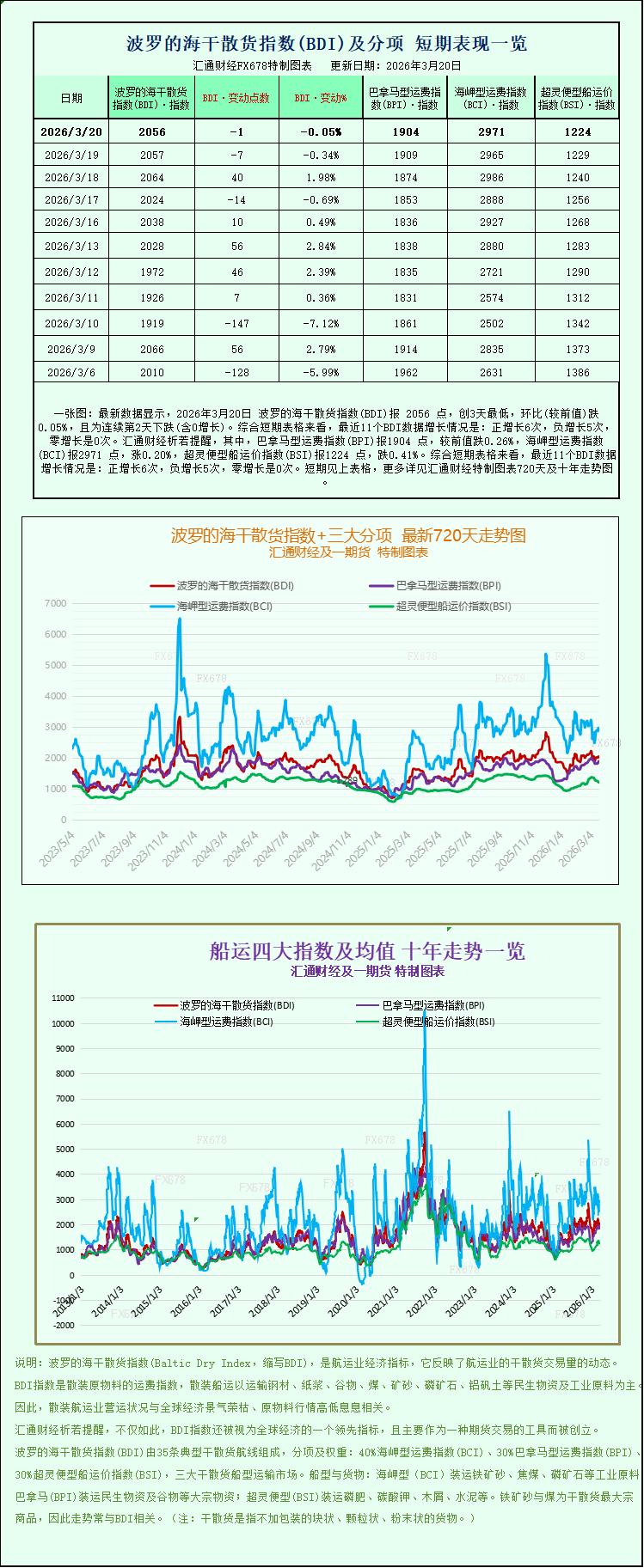 On August 5, 2026, the latest shipping market data showed a significant recovery in the international dry bulk shipping market, with the core benchmark Baltic Dry Index (BDI) surging to a new high in over two months. This price increase was driven by a combined rise in freight rates for large Capesize and medium-sized Panamax vessels. Multiple positive factors, including increased activity in commodity trading, anticipated strikes at overseas ports, and the approaching traditional peak shipping season, have completely reversed the previous market's volatile and sluggish trend, sending a clear signal of a steady recovery in global demand for industrial raw materials and bulk cargo shipping. Data shows that as of Wednesday's close on August 5, the Baltic Dry Index, which tracks freight rates for the three major dry bulk vessel types—Capesize, Panamax, and Supramax—rose sharply by 127 points, a 4.3% increase, closing at 3063 points, a two-month high since June 3. This surge was not a structural trend specific to a single ship type, but rather a general increase across mainstream vessel types, with only minor adjustments to freight rates for smaller vessels. Overall market sentiment improved significantly, and the industry recovery trend is clear. As the core driver of the market rise, Capesize vessels, which transport large industrial raw materials, saw the most impressive gains in this round. The corresponding sub-index surged 316 points in a single day, a gain of 6.6%, closing at 5094 points, also setting a new high since June 3rd, becoming the core force driving the overall market index higher. Capesize vessels have a deadweight tonnage of approximately 150,000 tons and primarily handle the transoceanic transport of core raw materials for heavy industries such as iron ore, thermal coal, and metallurgical coal. Their freight rate fluctuations are highly correlated with global industrial production and steel industry operating rates, making them a "weathervane" for the dry bulk market. Specific profit data directly confirms the increased market activity. On that day, the average daily revenue of Capesize vessels (BATCA) increased significantly by $2,867, climbing to $42,698, demonstrating a significant increase in daily profits and a continued recovery in shipowner operating income. Industry analysts point out that the recent surge in Capesize vessel freight rates is primarily driven by disruptions to the Australian iron ore supply chain. A strike is imminent at BHP Billiton's Port Hedland operations in Australia, the world's largest iron ore export hub and a key source of iron ore imports for steel companies in China, Southeast Asia, and other countries. The anticipated strike has fueled market concerns about short-term iron ore supply shortages, directly driving up international iron ore futures prices. Downstream traders have been locking in inventory and booking space in advance, significantly increasing transoceanic iron ore shipping demand and driving up freight rates for large bulk carriers. In addition to large vessels, Panamax vessels, which handle mid-range bulk cargo transportation, have also strengthened, contributing to the steady rise of the overall market index. Data shows that the Panamax index rose 49 points, or 2.2%, to 2236 points, a near one-month high since July 17th. This vessel type has a deadweight tonnage concentrated between 60,000 and 70,000 tons, mainly transporting bulk commodities such as thermal coal, grain, and cereals, as well as energy-related goods. Its routes cover major trade routes in the Atlantic and Pacific Oceans, making it suitable for transporting essential goods between regions. Profitability data improved simultaneously, with the average daily revenue of Panamax vessels (BPWT) rising by $442 to $20,128, further expanding shipowner profit margins. The increase in Panamax freight rates is due to two main factors: firstly, the arrival of the peak season for global grain trade, with accelerated grain harvesting and exports in both the Northern and Southern Hemispheres, leading to a continuous increase in ocean-going grain transport orders; secondly, rising global energy restocking demand, with many countries initiating coal reserve replenishment programs, and a recovery in seaborne coal import demand in Southeast Asia and Europe, continuously supporting the stabilization and rebound of medium-sized vessel freight rates. Market differentiation was also reflected in the small vessel sector, with the Supramax vessel index falling slightly by 1 point, a mere 0.06%, closing at 1612 points, maintaining an overall stable and basically flat trend. Industry insiders explain that Supramax vessels, with their smaller tonnage, primarily handle short-haul, regional, and fragmented bulk cargo transportation. They are less affected by transoceanic bulk commodity trade trends, and the current supply of small vessels is relatively ample. Therefore, despite the surge in freight rates for large and medium-sized vessels, Supramax vessels exhibit a slightly independent trend with minimal overall fluctuations, resulting in a relatively stable market. From an industry cycle perspective, July to October is traditionally the peak season for international dry bulk shipping. Downstream steel companies resume production, global grain exports surge, and energy restocking demand is released, historically creating a favorable window for the dry bulk market. Entering August, global bulk commodity trade activity continued to increase, coupled with short-term supply chain disruptions caused by the Australian port strike and longer ocean shipping distances, further optimizing the supply and demand dynamics of the dry bulk market. Meanwhile, the increase in global dry bulk freight volume this year has been mainly driven by demand from the Chinese market. The steady recovery of domestic infrastructure and manufacturing has boosted demand for imported iron ore and coal via sea, providing solid fundamental support for the current index rebound. Overall, the recent rebound in the Baltic Dry Index is based on a solid supply and demand foundation, and is not merely a short-term speculative move. Capesize vessels benefited from iron ore supply and demand disruptions, while Panamax vessels benefited from essential energy and food transportation needs; the simultaneous rise in these two major vessel types signifies that the dry bulk shipping market has officially emerged from its previous adjustment phase. Looking ahead, with the traditional peak shipping season continuing, coupled with the ongoing recovery in global commodity trade and the escalating port disruptions, dry bulk freight rates are expected to maintain a strong upward trend in the short term. Shipping company profitability will continue to recover, and the industry's overall prosperity is expected to further improve.
On August 5, 2026, the latest shipping market data showed a significant recovery in the international dry bulk shipping market, with the core benchmark Baltic Dry Index (BDI) surging to a new high in over two months. This price increase was driven by a combined rise in freight rates for large Capesize and medium-sized Panamax vessels. Multiple positive factors, including increased activity in commodity trading, anticipated strikes at overseas ports, and the approaching traditional peak shipping season, have completely reversed the previous market's volatile and sluggish trend, sending a clear signal of a steady recovery in global demand for industrial raw materials and bulk cargo shipping. Data shows that as of Wednesday's close on August 5, the Baltic Dry Index, which tracks freight rates for the three major dry bulk vessel types—Capesize, Panamax, and Supramax—rose sharply by 127 points, a 4.3% increase, closing at 3063 points, a two-month high since June 3. This surge was not a structural trend specific to a single ship type, but rather a general increase across mainstream vessel types, with only minor adjustments to freight rates for smaller vessels. Overall market sentiment improved significantly, and the industry recovery trend is clear. As the core driver of the market rise, Capesize vessels, which transport large industrial raw materials, saw the most impressive gains in this round. The corresponding sub-index surged 316 points in a single day, a gain of 6.6%, closing at 5094 points, also setting a new high since June 3rd, becoming the core force driving the overall market index higher. Capesize vessels have a deadweight tonnage of approximately 150,000 tons and primarily handle the transoceanic transport of core raw materials for heavy industries such as iron ore, thermal coal, and metallurgical coal. Their freight rate fluctuations are highly correlated with global industrial production and steel industry operating rates, making them a "weathervane" for the dry bulk market. Specific profit data directly confirms the increased market activity. On that day, the average daily revenue of Capesize vessels (BATCA) increased significantly by $2,867, climbing to $42,698, demonstrating a significant increase in daily profits and a continued recovery in shipowner operating income. Industry analysts point out that the recent surge in Capesize vessel freight rates is primarily driven by disruptions to the Australian iron ore supply chain. A strike is imminent at BHP Billiton's Port Hedland operations in Australia, the world's largest iron ore export hub and a key source of iron ore imports for steel companies in China, Southeast Asia, and other countries. The anticipated strike has fueled market concerns about short-term iron ore supply shortages, directly driving up international iron ore futures prices. Downstream traders have been locking in inventory and booking space in advance, significantly increasing transoceanic iron ore shipping demand and driving up freight rates for large bulk carriers. In addition to large vessels, Panamax vessels, which handle mid-range bulk cargo transportation, have also strengthened, contributing to the steady rise of the overall market index. Data shows that the Panamax index rose 49 points, or 2.2%, to 2236 points, a near one-month high since July 17th. This vessel type has a deadweight tonnage concentrated between 60,000 and 70,000 tons, mainly transporting bulk commodities such as thermal coal, grain, and cereals, as well as energy-related goods. Its routes cover major trade routes in the Atlantic and Pacific Oceans, making it suitable for transporting essential goods between regions. Profitability data improved simultaneously, with the average daily revenue of Panamax vessels (BPWT) rising by $442 to $20,128, further expanding shipowner profit margins. The increase in Panamax freight rates is due to two main factors: firstly, the arrival of the peak season for global grain trade, with accelerated grain harvesting and exports in both the Northern and Southern Hemispheres, leading to a continuous increase in ocean-going grain transport orders; secondly, rising global energy restocking demand, with many countries initiating coal reserve replenishment programs, and a recovery in seaborne coal import demand in Southeast Asia and Europe, continuously supporting the stabilization and rebound of medium-sized vessel freight rates. Market differentiation was also reflected in the small vessel sector, with the Supramax vessel index falling slightly by 1 point, a mere 0.06%, closing at 1612 points, maintaining an overall stable and basically flat trend. Industry insiders explain that Supramax vessels, with their smaller tonnage, primarily handle short-haul, regional, and fragmented bulk cargo transportation. They are less affected by transoceanic bulk commodity trade trends, and the current supply of small vessels is relatively ample. Therefore, despite the surge in freight rates for large and medium-sized vessels, Supramax vessels exhibit a slightly independent trend with minimal overall fluctuations, resulting in a relatively stable market. From an industry cycle perspective, July to October is traditionally the peak season for international dry bulk shipping. Downstream steel companies resume production, global grain exports surge, and energy restocking demand is released, historically creating a favorable window for the dry bulk market. Entering August, global bulk commodity trade activity continued to increase, coupled with short-term supply chain disruptions caused by the Australian port strike and longer ocean shipping distances, further optimizing the supply and demand dynamics of the dry bulk market. Meanwhile, the increase in global dry bulk freight volume this year has been mainly driven by demand from the Chinese market. The steady recovery of domestic infrastructure and manufacturing has boosted demand for imported iron ore and coal via sea, providing solid fundamental support for the current index rebound. Overall, the recent rebound in the Baltic Dry Index is based on a solid supply and demand foundation, and is not merely a short-term speculative move. Capesize vessels benefited from iron ore supply and demand disruptions, while Panamax vessels benefited from essential energy and food transportation needs; the simultaneous rise in these two major vessel types signifies that the dry bulk shipping market has officially emerged from its previous adjustment phase. Looking ahead, with the traditional peak shipping season continuing, coupled with the ongoing recovery in global commodity trade and the escalating port disruptions, dry bulk freight rates are expected to maintain a strong upward trend in the short term. Shipping company profitability will continue to recover, and the industry's overall prosperity is expected to further improve.- Risk Warning and Disclaimer
- The market involves risk, and trading may not be suitable for all investors. This article is for reference only and does not constitute personal investment advice, nor does it take into account certain users’ specific investment objectives, financial situation, or other needs. Any investment decisions made based on this information are at your own risk.