Gold Trading Alert: Gold prices surged 4% in a single day to a near seven-week high, fueled by cooling interest rate hike expectations and a "pause signal" from the Hormuz. Has the bull market restarted?
2026-08-06 07:22:52
On Wednesday (August 5), the global gold market suddenly released a strong signal. Spot gold prices surged more than 4% in a single day, breaking through a near seven-week high, reaching a high of $4,267.55 per ounce during the session, and closing at $4,246.79. This not only broke through the technical support of the 50-day moving average, but also recorded the largest single-day gain since February. This strong rebound was the result of lower US Treasury yields, a significantly weaker dollar, and optimistic market expectations for the resumption of Iranian nuclear negotiations and shipping in the Strait of Hormuz. After a long correction of about 24% from the record high of $5,595 in January and a cumulative decline of about 19% since the outbreak of the Iran-Iraq War, gold seems to be attracting funds back. Independent precious metals trader Tai Wong bluntly stated that with the possibility of interest rate hikes clearly decreasing since last week, early investors are returning to the precious metals market, while the sharp decline in the dollar provided direct support, and the "pause" signal in the Iranian situation also provided additional help. On Thursday (August 6) in early Asian trading, spot gold fluctuated at high levels and is currently trading around $4,260 per ounce, up about 0.25%. 
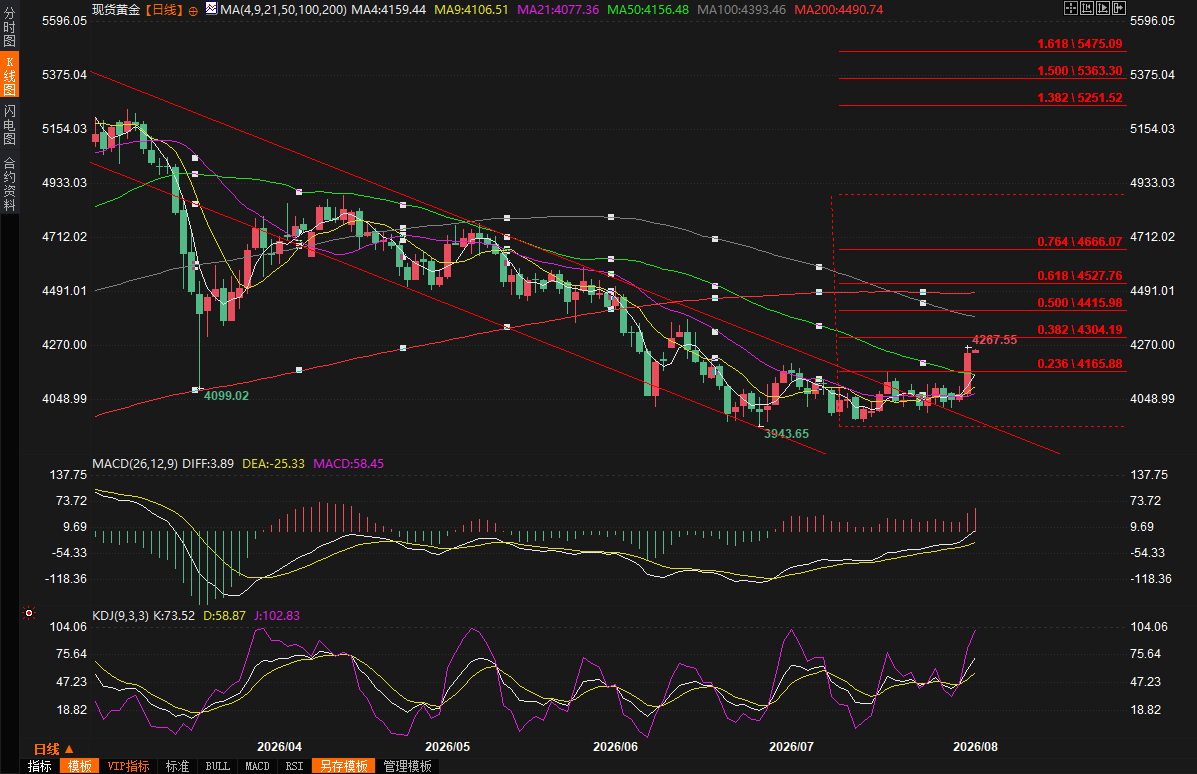 (Spot gold daily chart, source: FX678) At 07:18 Beijing time, spot gold is currently trading at $4259.83 per ounce.
Macroeconomic and geopolitical factors converge: Declining yields and a weaker dollar open up opportunities for gold.
The core driving force behind this round of gold price surge comes first from the improved interest rate and dollar environment. The yield on the 10-year US Treasury note hovered near a one-week low, and the 2-year yield also hit a new low since July 20th. Federal funds futures indicate that the market's probability of a Fed rate hike in September has fallen from nearly 70% at the beginning of the week to slightly below 60%, with some traders even lowering the probability to around 55%. This change directly reduces the opportunity cost of holding gold, a non-interest-bearing asset. Meanwhile, the dollar index continued to weaken slightly after hitting a six-week low on Monday, falling 0.16% to 99.70 on Wednesday. A weaker dollar makes gold cheaper for overseas buyers, further amplifying buying enthusiasm. Oil prices falling back to around $80 per barrel also reduced market concerns about runaway energy inflation, thus reducing demand for the dollar as a safe-haven asset. A deeper driving force comes from a subtle shift in geopolitics. US President Trump publicly stated that his administration had a "very good discussion" with Iran throughout the day and said the Strait of Hormuz would soon reopen. Iran has also released positive signals: Deputy Foreign Minister Gharibabadi stated that the agreement between Iran and Oman on the passage of commercial vessels through the Strait of Hormuz is nearing finalization. The new arrangement would close the traditional north and south shipping routes, replacing them with a temporary new route, allowing commercial vessels to pass through Iranian territorial waters for part of their journeys in and out of the strait, expected to be usable for two to four months. Although the US has repeatedly emphasized that it will never accept Iran controlling the passage through this most important global energy route, regional sources revealed that the proposed agreement may grant Tehran some control over vessels entering the Gulf via the Strait of Hormuz, considered one of the biggest concessions made to Iran to date. Iran wants to charge vessels a fee equivalent to 5% to 7% of the cargo value, Oman is discussing a rate of approximately 3%, while the US insists on no charge. Setting the fee as "voluntary payment" may be a potential way to break the deadlock, but in practice, shipowners may still choose to pay to ensure safe passage. This signal of a "suspension" rather than a complete end is enough to temporarily ease market sentiment from months of risk aversion and inflation fears. Oil prices fluctuated, with Brent crude rising slightly and U.S. crude falling slightly, reflecting investors' cautious assessment of the possibility of a shipping recovery. Meanwhile, attacks by Yemen's Houthi rebels on Saudi oil tankers and risks in the Red Sea continued to limit further price declines, indicating that geopolitical risks have not completely subsided.Gold's fundamentals remain uncertain: central bank gold purchases slowdown and the return of ETF dominance.
Despite the sharp short-term rally, the medium- to long-term fundamentals for gold are far from fully improving. Data from the World Gold Council shows that central bank gold demand in the first half of 2026 will reach its lowest level since 2022. In the second quarter, gold-backed exchange-traded funds (ETFs) saw outflows of 45 tons, while gold prices fell 14% during the same period, the largest quarterly decline since 2013. A report by JPMorgan Chase points out that against the backdrop of slowing central bank buying, retail investor focus shifting to other sectors, and weak physical demand in Asia, interest rate-sensitive ETF flows have once again become the dominant force determining the marginal trend of gold prices. This means that gold has partially returned to the more traditional logic of interest rate-sensitive assets, moving away from a "central bank + geopolitical safe-haven" driven model. Tai Wong cautions that for the precious metals sector to truly gain further momentum, the market must factor in expectations of interest rate cuts, but this is unlikely to happen until 2027 at the earliest. In other words, the current rebound is more a result of short covering and short-term expectation correction than a confirmation of a trend-driven bull market. From a technical perspective, gold prices found support after breaking through the 50-day moving average (around $4,160), but are still significantly lower than the January high. If the Hormuz negotiations falter, or if Friday's US July jobs report is stronger than expected, thereby increasing the probability of an interest rate hike, the upward momentum in gold prices could quickly fade.Policy and data intertwine: The Federal Reserve remains in a sensitive period of "wait-and-see but ready to act."
The macroeconomic policy front is also fraught with uncertainty. Federal Reserve Governor Tim Cook stated clearly on Wednesday that she is prepared to support interest rate hikes if necessary if inflation does not begin to cool. She emphasized that the risks to inflation outweigh the risks to the labor market, noting that inflation may gradually solidify in corporate pricing and wage-setting behavior, creating more persistent pressure. Kansas City Fed President Schmid also believes that monetary policy needs to be tightened to some extent to bring the excessively high inflation rate back to the 2% target. On the other hand, the latest data releases complex signals. The July ISM Services PMI came in at 54.1, indicating continued strong expansion in the service sector with a significant increase in new orders, but the input cost price index rose to 70.3, supplier delivery times lengthened, and shortages of aluminum, electronic components, and steel persist. The ADP report showed that private sector employment increased by only 44,000 in July, lower than expected, suggesting that the labor market may have slowed from its spring acceleration. Friday's non-farm payroll report will be a key test in the next phase, with the market generally expecting an increase of about 80,000 jobs and the unemployment rate remaining at 4.2%. The U.S. Treasury Department, however, released a relatively dovish signal, indicating that it will maintain a stable issuance of fixed-coupon and floating-rate bonds for at least the next few quarters, alleviating market concerns about an increase in the supply of long-term Treasury bonds. This is beneficial to the interest rate market and indirectly provides some breathing room for gold.In conclusion, whether the current rebound in gold prices can continue hinges on whether this "pause" can turn into a "turning point."
In summary, the surge in gold prices on August 5th was the result of a confluence of positive factors: lower yields and a weaker dollar reduced holding costs; progress in the Strait of Hormuz negotiations eased energy inflation and geopolitical anxieties; and a technical breakout attracted short-term capital inflows. However, this appears more like a technical rebound and sentiment correction within a prolonged period of adjustment, rather than a fundamental reversal. Gold still faces pressure from weakening central bank gold purchases, sluggish physical demand in Asia, and the possibility that the Federal Reserve may maintain high interest rates or even raise them. If the agreement between Iran and Oman is ultimately implemented and shipping resumes, further declines in oil prices will help cool inflation, thus opening a window for interest rate cuts. Conversely, if negotiations break down or geopolitical conflicts escalate again, while safe-haven buying may provide short-term support for gold prices, a rebound in energy inflation could strengthen expectations of interest rate hikes, creating a double squeeze on gold. Investors need to closely monitor Friday's employment data, subsequent progress in US-Iran negotiations, and further statements from Federal Reserve officials. Only when interest rate cut expectations are truly priced in and geopolitical risks move from a "pause" to a substantial easing will gold be able to shake off the gloom of the past six months and find new upward potential. Prior to this, any single-day surge was more like a correction of the previous oversold condition than the start of a new bull market. (Spot gold daily chart, source: FX678) At 07:18 Beijing time, spot gold is currently trading at $4259.83 per ounce.
- Risk Warning and Disclaimer
- The market involves risk, and trading may not be suitable for all investors. This article is for reference only and does not constitute personal investment advice, nor does it take into account certain users’ specific investment objectives, financial situation, or other needs. Any investment decisions made based on this information are at your own risk.