Is the Federal Reserve "reducing communication" and the market "increasing volatility"?
2026-08-06 08:18:52
The US dollar index traded in a narrow range in early Asian trading on Thursday (August 6), currently hovering around 100. Behind this movement, a structural change is brewing within the Federal Reserve that could impact the dollar's medium-term pricing logic. Federal Reserve Chairman Kevin Warsh is considering reducing the number of annual policy meetings of the Federal Open Market Committee from the current eight, a move that would further extend his strategy of reducing central bank communication with financial markets. Since taking office in May, Warsh has implemented several measures reversing the Fed's decades-long culture of proactive and transparent communication. Experts warn that decreased transparency could exacerbate market volatility, but it could also create opportunities for investors. 
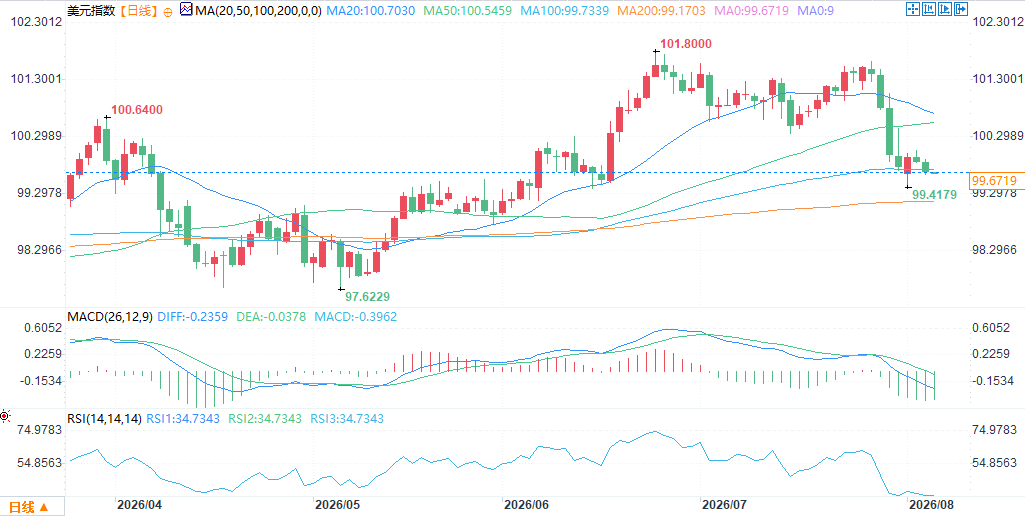 (US Dollar Index Daily Chart, Source: FX678) At 8:10 AM Beijing time on August 6, the US Dollar Index was at 99.67.
Number of meetings reduced: from 8 to 6?
According to sources within the Federal Reserve, discussions about reducing the frequency of its meetings are currently largely hypothetical, but have already attracted market attention. The Fed has discretion in scheduling its meetings and has historically employed different strategies: until the early 1980s, the Fed met almost monthly, later switching to eight times a year under then-Chairman Paul Volcker. It's worth noting that the Fed can convene an emergency meeting at any time, but this sends a strong signal to the market and is therefore usually considered a major event. Minneapolis Fed President Neal Kashkari said on Wednesday that he is open to reconsidering the meeting schedule: "I don't think there's any magic number in eight, ten, or six. We can hold an emergency meeting whenever the situation requires, but that's a major event. When the Federal Open Market Committee holds an emergency meeting, it does signal that we are concerned about something." Philadelphia Fed President Anna Paulson expressed a similar view on Tuesday, saying, "It's healthy to have a full discussion on this."Walsh's Communication "Slimming" Strategy
Since taking office in May, Warsh has implemented a series of communication strategies drastically different from those of his predecessor, Jerome Powell: eliminating forward guidance and ceasing to provide clear signals to the market about the future path of interest rates; significantly shortening post-meeting statements to make policy communication more concise and implicit; and providing veiled and often evasive answers to personal views at press conferences to avoid market over-interpretation. Bill English, former head of monetary policy at the Federal Reserve and now a professor at Yale University, said, “There’s nothing magical about eight meetings. Holding more meetings has costs, but on the other hand, you don’t want too few meetings to be able to act in a timely manner.” English had previously proposed six meetings per year, but each meeting included a press conference and an update to the summary of economic projections. Overall, he believes eight meetings are “close to the right number,” but is more concerned about other aspects of Warsh’s strategy: “I really don’t like this effort to drastically reduce communication. Explaining more why you’re doing what you’re doing helps the public understand it, helps the public anticipate it, makes monetary policy more effective, and it’s also appropriate to hold the Fed accountable.”Market reaction and volatility risk
Warsh's discussions about reducing the frequency of meetings are part of a larger strategy to reduce the central bank's "footprint" in financial markets. "This will certainly increase volatility," said George Catlonbonne, head of fixed income for the Americas at Deutsche Bank. "Less transparency forces market participants to hedge or face a wider distribution of outcomes." This means that in an environment of reduced policy signals, investors may face greater uncertainty and more volatile prices. However, the market's reaction so far has been relatively mild. Since Warsh succeeded Powell on May 22, the Dow Jones Industrial Average has risen by about 3,500 points, or about 7%. Bond yields have generally risen, but to a limited extent—the yield on the policy-sensitive 2-year Treasury note has risen by about 8 basis points, while the benchmark 10-year yield has risen by roughly the same amount. This may be because the market is willing to give Warsh "room for doubt," or simply because it is too focused on geopolitics to pay attention to the Fed's internal changes.Policy uncertainty has increased, but the market has not yet priced it in.
From a broader perspective, the Federal Reserve's communication strategy is undergoing a structural shift. Warsh's core logic seems to be that reducing communication is itself a form of communication—by reducing the central bank's predictability, the market will rely less on the Fed's signals and more on its own judgment of economic data. However, the risk of this strategy lies in the fact that the Fed's policy rate is currently at a high level of 3.50%-3.75%, three policymakers opposed maintaining the current rate at the most recent meeting, and there is no pricing in a rate cut at any meeting in 2026. Given the already high uncertainty surrounding the interest rate path, further reducing communication could amplify the market's non-linear reaction.The volatility of the US dollar index faces upside risks.
What does the discussion surrounding Federal Reserve Chairman Warsh's consideration of reducing the frequency of meetings mean for the US dollar index? Reduced transparency often means increased "noise" in policy signals—the market will find it harder to extract clear directional information from the Fed's statements, making the dollar's trading logic more reliant on data itself rather than forward guidance from the central bank. With policy rates at a high of 3.50%-3.75% and three members opposing maintaining rates unchanged, narrowing communication channels could amplify the dollar's sensitivity to unexpected economic data fluctuations. Furthermore, reduced meeting frequency also means the Fed has limited room to adjust policy in the event of sudden economic changes—while the option of emergency meetings remains, these meetings themselves send strong signals of policy anxiety, making their practical use very difficult. This structural change could lead to more drastic short-term fluctuations in the dollar index when faced with unexpected shocks. So far, the market's reaction to this change has been relatively mild, with the dollar index still trading around 100.00. However, if Friday's US non-farm payroll data is unexpected, coupled with the reduced Fed communication, the dollar index's volatility could exceed market expectations. The market is facing a more "unpredictable" Federal Reserve, which poses a new challenge to the medium-term pricing logic of the dollar index.Summarize
Federal Reserve Chairman Warsh is considering reducing the number of annual policy meetings from eight to six, continuing his strategy of minimizing central bank communication with financial markets. Experts warn that decreased transparency could exacerbate market volatility, forcing investors to hedge more; however, others believe that reducing the frequency of meetings itself will have a limited impact on the market. Since Warsh took office, market reactions have been relatively mild, but the increased policy uncertainty means that any adjustment to the communication strategy could amplify the market's non-linear reactions. Investors are watching to see if this "communication slimming" strategy will trigger more significant market volatility at some point. (US Dollar Index Daily Chart, Source: FX678) At 8:10 AM Beijing time on August 6, the US Dollar Index was at 99.67.
- Risk Warning and Disclaimer
- The market involves risk, and trading may not be suitable for all investors. This article is for reference only and does not constitute personal investment advice, nor does it take into account certain users’ specific investment objectives, financial situation, or other needs. Any investment decisions made based on this information are at your own risk.