Record-breaking intervention pulled the USD/JPY exchange rate back to mid-May levels, but the interest rate differential remained unchanged. What will drive the market next?
2026-08-06 08:20:52
The dollar edged lower against the yen in early Asian trading on Thursday (August 6), currently trading around 157.60. After its sharpest decline in nearly two years, it is now trading at levels not seen since mid-May, signifying the largest coordinated intervention on record to buy back approximately eleven weeks of yen depreciation. 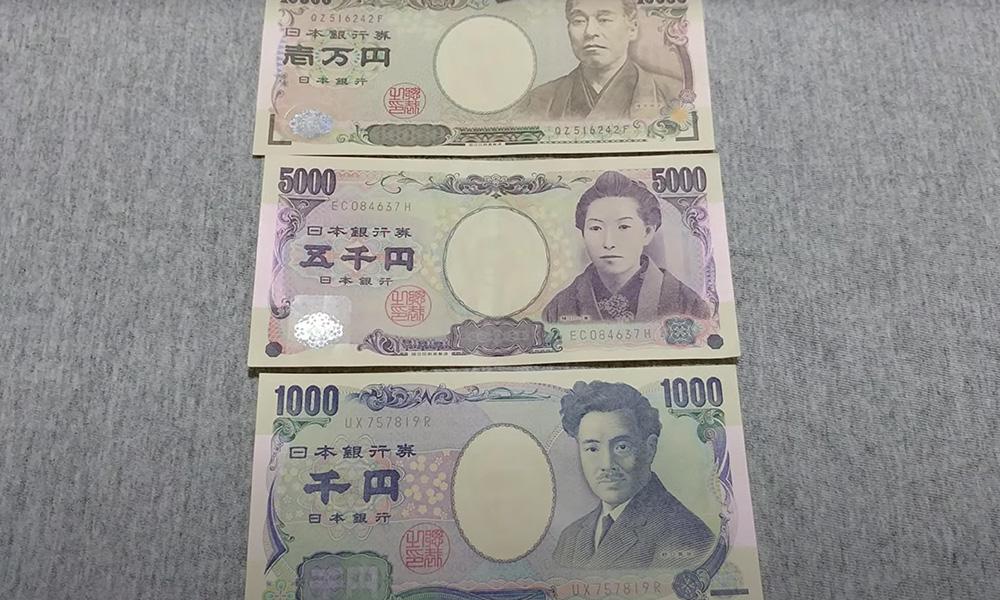
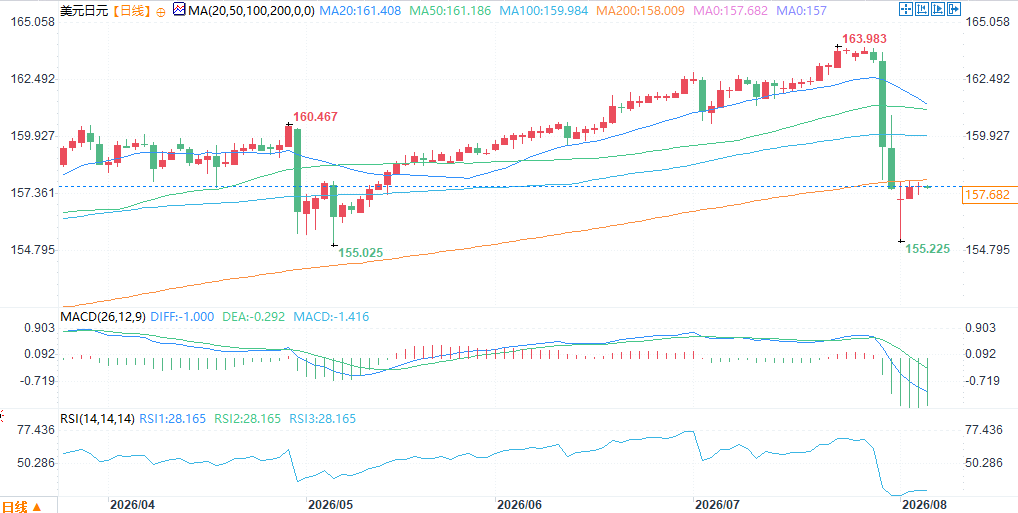 (USD/JPY daily chart, source: FX678) At 8:15 AM Beijing time on August 6, the USD/JPY exchange rate was 157.68/69.
Record-breaking intervention: What did the 14 trillion yen buy?
Reports indicate that Japan's Ministry of Finance injected 8.45 trillion yen in a single day, the largest single operation on record, followed by approximately 5.3 trillion yen the next day. The US Treasury joined the yen-buying effort for the first time since 2011, but financed the purchases by selling euros instead of dollars—a move suggesting that the intervention was designed to consider the government bond market, not just the exchange rate itself. The result: the moment the buying stopped, the currency's decline also stopped. Prices remained in a narrow range near the 200-day exponential moving average for three trading days, with neither bulls nor bears exerting significant pressure. This is typical of a market that has "found the level the authorities are defending and is watching to see if they will intervene again." The intervention established the price, but not the reason.Root cause: Interest rate spread remained unchanged.
The engine driving the yen's depreciation is the interest rate differential between the Federal Reserve and the Bank of Japan. The Fed's current interest rate is 3.50% to 3.75%, and three policymakers opposed maintaining the rate at their most recent meeting, with no rate cut priced in at any meeting in 2026. The Bank of Japan raised its rate to a 31-year high of 1.00% in June by a 7-1 vote. This interest rate differential is the engine driving the yen lower, and foreign exchange intervention cannot reach it. The minutes of the June meeting released Wednesday showed that the central bank is moving towards the only real solution—further rate hikes: several members expect consumer inflation to rise significantly in the second half of the fiscal year, two members advocate for a faster move towards a neutral interest rate, and one member warned that inflationary pressures will persist even after the Middle East conflict ends. The July meeting focused future discussions on upside inflation risks, which the market interpreted as a September rate hike being an "immediate option. " A backup plan yet to be voted on: the FIMA repurchase facility. The Foreign and International Monetary Authorities Repurchase Facility allows approved foreign authorities to borrow dollars against their holdings of U.S. Treasury securities, rather than directly selling U.S. Treasury securities, with a cap of $60 billion per institution. Japan, holding approximately $1.1 trillion in U.S. Treasury bonds, is the world's largest foreign holder, and Tokyo has indicated its intention to use the tool. Selling these bonds to finance yen purchases would push up U.S. Treasury yields—something Washington does not want to see. The U.S. Treasury Secretary has publicly called for an increase in the ceiling and pledged to repeat coordinated intervention operations. The Federal Reserve declined to comment, stating that any expanded arrangement would require a majority vote from the committee, which split by three votes nine days ago. Traders are treating the expanded "backstop" as already in place, but it is currently only a request made on social media, and the institution that needs to approve it has spent two months insisting it will not be guided by market prices.Key data before Friday
US weekly initial jobless claims will be released on Thursday, with the market expecting 202,000, compared to 197,000 previously. Friday's non-farm payrolls report is expected to show an increase of 80,000, compared to 57,000 previously, and the unemployment rate is expected to rise to 4.2%. Wednesday's ADP private sector employment data significantly missed expectations, adding only 44,000 (expected 70,000), and the services employment index fell to 47.4. Weak US labor market data will narrow the interest rate differential without Japan spending a single penny more—exactly the result the Japanese authorities need but cannot produce. Strong data would widen the interest rate differential again, prompting the Ministry of Finance to immediately return to buying yen, this time defensively at a level the market has already anticipated.Summarize
A record-breaking coordinated intervention pulled the USD/JPY pair back from 164.00 to 157.50, buying back approximately eleven weeks of depreciation, but the fundamental driver of interest rate differentials remained unchanged. The Bank of Japan's meeting minutes indicated a shift towards further interest rate hikes, with the FIMA repo facility, while a potential backup, yet to be formally approved. The market is awaiting US employment data—weak data would narrow interest rate differentials, allowing the yen to benefit without further intervention; strong data might force the Ministry of Finance to intervene again. (USD/JPY daily chart, source: FX678) At 8:15 AM Beijing time on August 6, the USD/JPY exchange rate was 157.68/69.
- Risk Warning and Disclaimer
- The market involves risk, and trading may not be suitable for all investors. This article is for reference only and does not constitute personal investment advice, nor does it take into account certain users’ specific investment objectives, financial situation, or other needs. Any investment decisions made based on this information are at your own risk.