Will the Fed raise rates three more times this year? Can the market trust the Bank of America CEO's "timetable"?
2026-08-06 10:32:59
The US dollar index traded in a narrow range during Asian trading hours on Thursday (August 6), currently hovering around 99.60. The market lacks clear short-term drivers, while recent statements from banking executives have provided new trading clues regarding the Federal Reserve's interest rate path. Bank of America CEO Brian Moynihan stated on Wednesday that he expects the Fed to raise interest rates three more times this year, in September, November, and December. This specific timeline prediction is more indicative than the cautious rhetoric typically used by Fed officials. Moynihan anticipates inflation will fall to the "mid-2% range" by the end of 2027, subsequently gradually returning to the long-term 2% target. He also stated that further rate hikes will not substantially impact short-term financing for artificial intelligence infrastructure construction. 
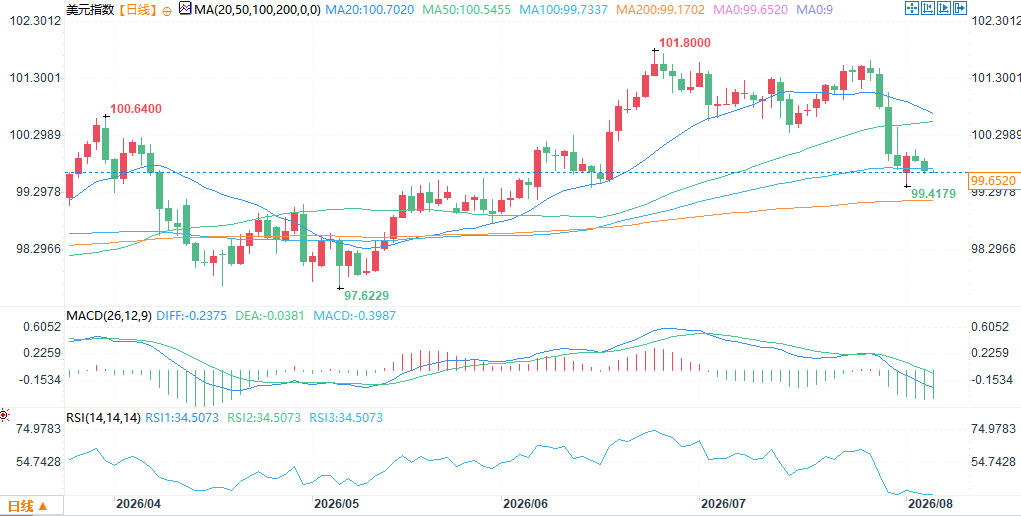 (US Dollar Index Daily Chart, Source: FX678) At 10:29 AM Beijing time on August 6, the US Dollar Index was at 99.66.
A clear path of three interest rate hikes
Moynihan stated that he expects the Federal Reserve to raise interest rates once each in September, November, and December, adding that policymakers currently believe three rate hikes are sufficient to control inflation. He noted that this expectation could change if inflation data continues to be better than expected: "If things get better, like last month, and inflation falls more than people expected, I believe they will change that expectation. But for now, they believe three rate hikes will put the Fed in a position to control inflation." Moynihan's view is noteworthy for its clarity—a major bank CEO has given specific timing and number of rate hikes, rather than the typical vague wording of Fed officials. This statement could be interpreted by the market as a consensus signal on rate hike expectations at the institutional level. If the market accepts this expectation, it could push up short-term yields and suppress expectations of rate cuts.Inflation Outlook: Expected to reach the "mid-range of 2%" by the end of 2027
Regarding the overall trend of inflation, Moynihan predicts that price growth will stabilize in the "middle of the 2% range" by the end of 2027, before gradually falling back to the Fed's long-term target range of 2%. He attributes the recent rebound in inflation to the impact of tariffs and trade tensions, as well as geopolitical conflicts, and believes that these factors' upward pressure on prices is waning. "If you look at how inflation evolves across the economy, it used to ease, then it rebounded due to the impact of tariffs on prices, the impact of geopolitical conflicts on prices, and now those effects are fading." This prediction implies that inflation may return to the target more slowly than the market is currently pricing in. If the market adopts this assessment, it may further delay expectations of interest rate cuts, putting upward pressure on short-term interest rates. Moynihan's remarks followed data released last week by the US Department of Commerce—June PCE annualized growth was 3.7%, core PCE annualized growth was 3.3%, and it rose 0.1% month-on-month, indicating that underlying price pressures remain far above the 2% target.AI infrastructure investment remains unaffected.
Moynihan also discussed the impact of higher interest rates on AI infrastructure development, an area where large tech companies invest heavily. He stated that he does not expect further rate hikes to substantially affect companies' short-term financing for data center and AI infrastructure projects. He added that the returns on data center investments are strong enough to allow companies to afford the higher borrowing costs of long-term bonds—meaning that even if the Fed raises rates three more times this year, the AI investment cycle is unlikely to be significantly disrupted. This view supports market sentiment for AI infrastructure and semiconductor-related assets, suggesting that the capital expenditure cycle will remain strong even in a higher-interest-rate environment.Summarize
Bank of America CEO Robert Moynihan explicitly predicts three more Federal Reserve rate hikes this year, in September, November, and December. He believes inflation will fall to the midpoint of the 2% range by the end of 2027, before gradually returning to the 2% target—a timeline slower than the market is likely pricing in. His view, combined with the recent reality that core PCE remains high at 3.3%, reinforces the narrative of "sticky inflation until 2027." Meanwhile, Moynihan is optimistic about investment in AI infrastructure, believing that even with further interest rate increases, the returns on data centers will be sufficient to absorb higher financing costs. The market will be watching to see if his views reflect broader institutional consensus and the potential impact of this expectation on interest rate pricing and risk assets. (US Dollar Index Daily Chart, Source: FX678) At 10:29 AM Beijing time on August 6, the US Dollar Index was at 99.66.
- Risk Warning and Disclaimer
- The market involves risk, and trading may not be suitable for all investors. This article is for reference only and does not constitute personal investment advice, nor does it take into account certain users’ specific investment objectives, financial situation, or other needs. Any investment decisions made based on this information are at your own risk.