USD/JPY may have a hidden ceiling; a review of 2022 history warns of the risk of a deep correction.
2026-08-06 11:06:52
It's rare for US Treasury Secretaries to publicly comment on exchange rates, but Scott Bessent has repeatedly signaled his reluctance to see the USD/JPY exchange rate continue its sharp rise. While official statements cannot directly reverse the interest rate landscape of the two largest economies, the US and Japan, they do theoretically impose upward constraints on market movements. If subsequent US economic data weakens, a large number of long positions may be forced to exit. Reviewing the market experience of the fourth quarter of 2022 can provide important insights for current trading.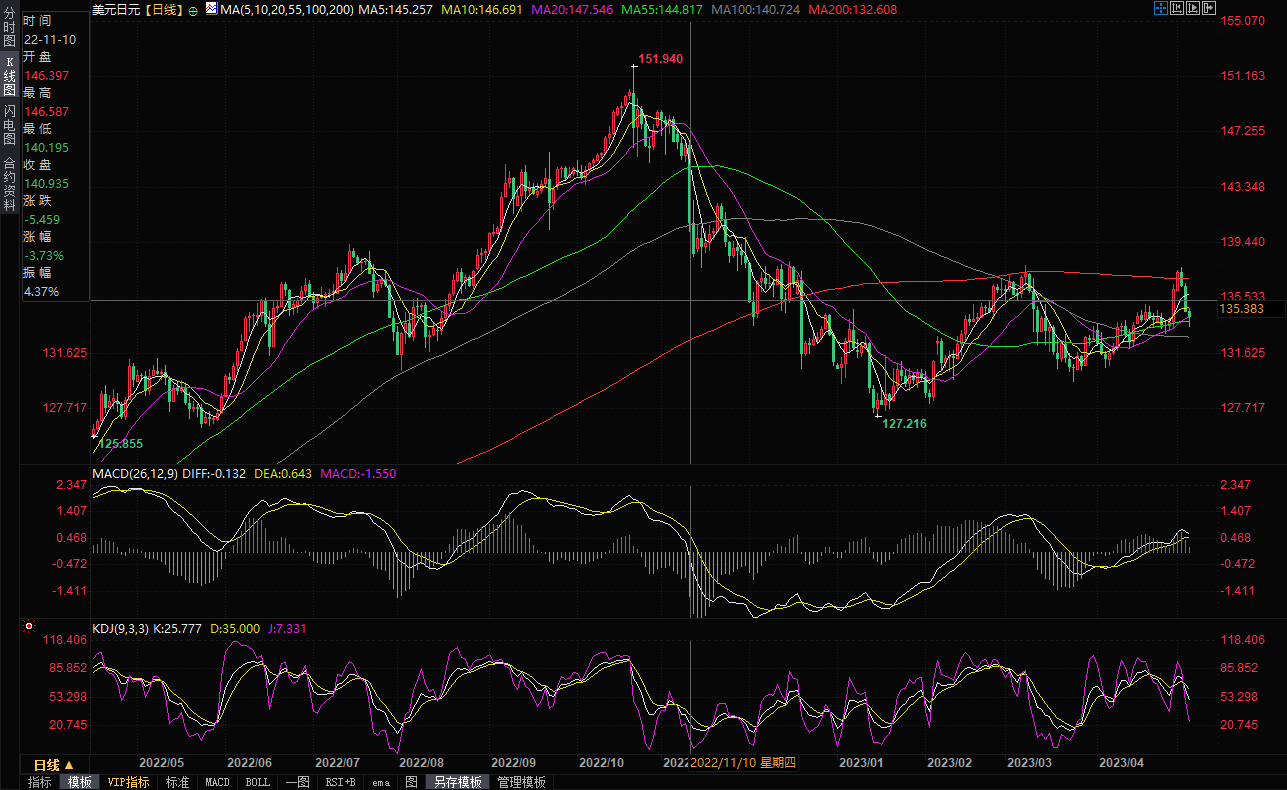 (USD/JPY daily chart around November 10, 2022, source: EasyForex) Over the past five years, there have been numerous instances of Japan intervening in its own currency markets, but coordinated interventions by the US and Japan are extremely rare. However, when such interventions occur, their impact on the market is significantly amplified. Neither the US nor Japan wants their exchange rates to reach new 40-year highs. Continued yen depreciation would exacerbate Japan's imported inflation; an excessively strong dollar would disrupt US trade and capital flows. With the yen accounting for 13.6% of the dollar index currency basket, both countries prefer a relatively stable exchange rate.
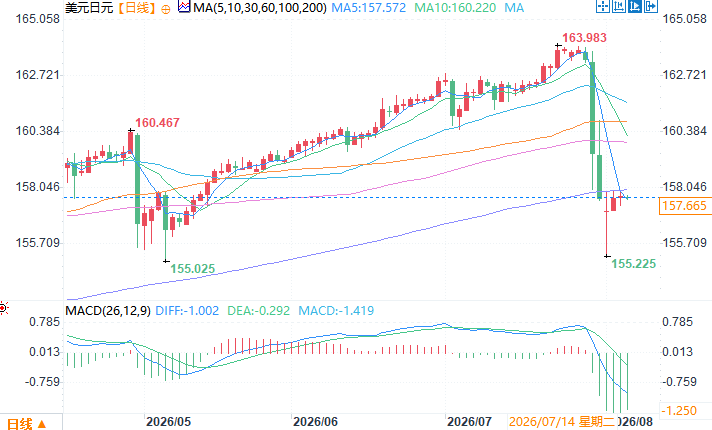 USD/JPY Daily Chart Source: FX678 At 11:05 AM Beijing Time on August 6, the USD/JPY exchange rate was 157.70/71.
A Retrospective of 2022: Intervention Combined with Cooling Data Triggers a Major Currency Reversal
The market environment in 2022 shared many similarities with the current situation. At that time, the US initiated an aggressive interest rate hike cycle, while Japan maintained its loose monetary policy, leading to a widening interest rate differential between the US and Japan and a surge in the USD/JPY exchange rate. In late October 2022, the yen experienced a rapid depreciation, with the USD/JPY exchange rate reaching a high of 151.95. The Bank of Japan intervened to defend the 150 level, briefly curbing the upward momentum and causing some long positions to be stopped out. However, the bulls did not completely retreat, and the exchange rate found support at the 145 level and rebounded, although the upward momentum had clearly weakened. Official intervention placed an invisible constraint on the market's upward movement, and the market entered a wait-and-see mode. On the evening of November 10, 2022, the US released inflation data. While overall CPI and core CPI remained high, they were both lower than market expectations and declined compared to the previous month. The market quickly repriced its expectations for interest rate hikes. Long positions that had held on after intervention and correction were liquidated, triggering a deep correction that lasted for two months. The USD/JPY pair fell by nearly 2,000 points, with more than half of its previous upward trend being reversed. (USD/JPY daily chart around November 10, 2022, source: EasyForex) Over the past five years, there have been numerous instances of Japan intervening in its own currency markets, but coordinated interventions by the US and Japan are extremely rare. However, when such interventions occur, their impact on the market is significantly amplified. Neither the US nor Japan wants their exchange rates to reach new 40-year highs. Continued yen depreciation would exacerbate Japan's imported inflation; an excessively strong dollar would disrupt US trade and capital flows. With the yen accounting for 13.6% of the dollar index currency basket, both countries prefer a relatively stable exchange rate. Current market logic: A game between carry trades and policy constraints.
The market is currently still trading on the USD/JPY interest rate differential, with widespread expectations of further US interest rate hikes and Japanese inflation remaining below 2%. Federal Reserve Chairman Kevin Warsh's policy stance leans towards verbal emphasis on combating inflation, but the actual tightening actions remain uncertain, and changes in policy rhetoric directly impact the foreign exchange market. Carry trade is a significant driver of the USD/JPY exchange rate's rise; investors borrow low-interest yen, allocate to high-yield overseas assets, and buy dollars by selling yen, which reduces the reference value of overbought indicators during upward movements. However, this logic can also be reversed: when official signals are clearly released to suppress further exchange rate increases, the market is likely to have peaked, and traders will choose to close long positions and realize profits, quickly dissipating the upward momentum. The 160 level is a crucial psychological barrier. If the exchange rate remains below 155, the motivation for policy intervention is relatively limited. Once prices rise, the possibility of coordinated intervention increases, making 160 and 164 strong resistance levels in reality, significantly reducing the cost-effectiveness of continuing to chase higher levels. Currently, the price has stabilized above the 155 support level on the weekly chart, and the pattern remains bullish. However, if the ascending triangle pattern on the four-hour chart is broken, a reversal trading opportunity will emerge. US economic data is the core variable. If inflation cools and expectations of interest rate hikes decline, coupled with the upward ceiling imposed by policy, it could easily trigger carry traders to close their positions, leading to a rapid pullback. In summary , the official stances of the US and Japan are putting upward constraints on the USD/JPY pair. Historical data shows that even if fundamentals support the trend, weak policy signals combined with weakening data can trigger large-scale long position liquidation. Investors should not rely solely on the interest rate differential logic to be bullish; they need to closely monitor US inflation data and US-Japan policy statements to guard against sudden trend reversals. USD/JPY Daily Chart Source: FX678 At 11:05 AM Beijing Time on August 6, the USD/JPY exchange rate was 157.70/71.
- Risk Warning and Disclaimer
- The market involves risk, and trading may not be suitable for all investors. This article is for reference only and does not constitute personal investment advice, nor does it take into account certain users’ specific investment objectives, financial situation, or other needs. Any investment decisions made based on this information are at your own risk.