The Fed's FIMA tool activation and sharp correction in US stocks have prompted senior analysts to significantly increase their gold holdings, but they predict it will be difficult to reach new highs this year.
2026-08-06 10:28:57
The global precious metals market has seen a sharp rebound, with gold bucking the trend and strengthening despite signals of interest rate hikes from the Federal Reserve. Florian Grummes, founder and managing director of Midas Touchpoint Consulting, a firm with 25 years of experience in the financial markets, ended a six-month wait-and-see period by increasing his investment allocation from 50% to 80%. However, he remains rational about the market outlook, not expecting gold to reach a new all-time high in 2026, and is instead focusing his investments on small-cap mining assets.
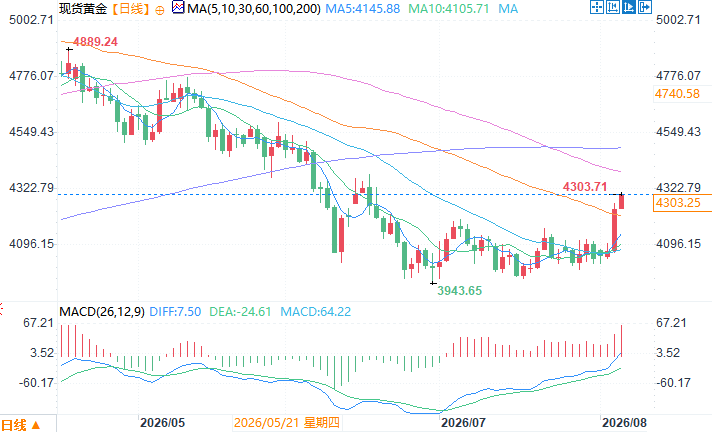 Spot gold daily chart source: FX678. At 10:26 AM Beijing time on August 6th, spot gold was trading at $4292.75 per ounce.
Macroeconomic policy shift triggers gold repositioning
Gromes stated that he had maintained a bullish stance on gold for the past six months, but chose to remain on the sidelines. What truly prompted his re-entry was not the volatility of gold prices themselves, but rather the significant change in Japan's exchange rate policy. On August 3rd, Japan's Ministry of Finance announced that subsequent exchange rate intervention would utilize the Federal Reserve's Foreign and International Monetary Authority Repurchase Facility (FIMA), allowing foreign central banks to pledge US Treasury bonds to obtain dollar liquidity without directly selling US Treasury bonds in the secondary market, with a daily limit of $60 billion for a single institution. US Treasury Secretary Scott Bessent stated that the US was considering expanding the scale of this tool, viewing it as an important safety net mechanism. Gromes believes that this seemingly technical adjustment to the tool is essentially a policy choice aimed at easing monetary policy, similar in logic to the dollar swap facility introduced during the bailout of Credit Suisse. Although many market analysts have pointed out that the tool is subject to dual constraints related to quotas and US Treasury bond holdings, he does not believe that these restrictions can completely offset the market impact. Meanwhile, US stocks experienced a sharp correction in the early hours of July 24th Beijing time, with the market capitalization of the seven major US tech giants evaporating by $797 billion in a single day. Compared to the high point at the end of May, the overall market capitalization shrank by approximately $2 trillion. The S&P 500 index recorded its first monthly decline in July since 2014, and market pressure began to spread within the financial system. Under the combined influence of multiple macroeconomic factors, precious metals staged a strong rebound. Spot gold surged from $4,020 to $4,300 in just over two trading days, a fluctuation of $280, while silver, platinum, and palladium also rose. It is worth noting that this round of gains was achieved under multiple negative factors. Minneapolis Fed President Neel Kashkari publicly stated that inflation remained high and the Fed should immediately begin raising interest rates. Oil prices also saw a slight decline. Despite these multiple pressures, gold still managed to exhibit independent price action.There is a ceiling to the market's potential; do not blindly chase high prices.
Regarding price predictions, Grommes' views differ from those of most bullish market participants. He analyzes that gold is expected to challenge $4,500 this summer, a level close to the 200-day moving average of $4,490. If it can break through effectively, the next target range is $4,800-$4,900, with a target price of $70 for silver. However, he explicitly states that gold is unlikely to reach a new historical high in 2026, and he cannot even confirm whether the final low of this round of correction has been fully reached. Reflecting on his own position building strategy, he admits that his entry timing was slightly early, and he did not insist on waiting for the absolute bottom, choosing to build positions in batches on dips, adding to his positions in batches near $4,400, $4,100, and $4,000. In terms of stock selection, he abandons the common market strategy of buying the dip in heavily sold-off stocks, prioritizing new funds for small mining companies whose performance has already outperformed gold prices, rather than large, established mining companies, focusing on Silver Tiger Metals and First Mining Gold. He explained that these strong performers have already demonstrated their resilience, and if gold prices continue to rise, the upward momentum of their stock prices will be even stronger. Looking ahead one to three years, large mining companies will still be able to generate ample cash flow even if gold prices remain at $4,000, and a wave of mergers and acquisitions will gradually begin, with smaller mining companies becoming the focus of acquisitions. For investors in smaller mining companies with unrealized losses of 30% to 60%, he suggested that if their position allows, they can average down their cost basis, but strict stop-loss orders must be set during the trading process, and proper money management is essential.Evolution of the Precious Metals Market Landscape and Investment Choices
Besides gold and silver, Grommes also allocates to platinum assets. He suggests that prices below $2,000 are worthwhile, while $1,500-$1,700 is a high-quality investment range. Compared to his early days in the industry, the price ratio between platinum and gold has changed dramatically. He observes that the global center of gravity for physical precious metals trading is shifting eastward, with the Asian market's influence continuing to rise, gradually becoming an important market capable of counterbalancing London and New York. Several major US banks suspended retail wealth management products linked to Asian gold exchanges after settlement on July 24th. Physical gold, gold ETFs, and institutional exchange-traded products were unaffected, further confirming a shift in demand-side policy direction. Twenty-five years of market observation have led him to conclude that many key price movements in precious metals occur during Asian trading hours, while selling pressure is more likely to occur during European and American trading hours. Regarding asset allocation, he avoids short selling, viewing it as an emotional game, and also avoids semiconductor and artificial intelligence stocks, as the semiconductor sector saw a pullback of approximately 22% in July. In summary , the FIMA tool's liquidity expectations, coupled with a US stock market correction, fueled a rebound in gold prices. However, fundamental constraints remain, and the upside potential is not unlimited. Even with positive macroeconomic factors, investors should not be blindly optimistic and need to consider price levels, asset quality, and risk management, while continuously monitoring demand changes in the Asian physical market. Spot gold daily chart source: FX678. At 10:26 AM Beijing time on August 6th, spot gold was trading at $4292.75 per ounce.
- Risk Warning and Disclaimer
- The market involves risk, and trading may not be suitable for all investors. This article is for reference only and does not constitute personal investment advice, nor does it take into account certain users’ specific investment objectives, financial situation, or other needs. Any investment decisions made based on this information are at your own risk.