With growing divisions within the Federal Reserve, where is the dollar headed?
2026-08-06 11:42:52
On Thursday (August 6) during the Asian session, the US dollar index fluctuated narrowly, currently trading around 99.70. The dollar index is temporarily locked in a sideways trading pattern, exacerbated by the sharply contrasting policy signals released yesterday by two senior Federal Reserve officials. On Wednesday (August 5), two Fed officials shared their latest views on the policy path, reflecting the widening divisions within the Federal Open Market Committee. San Francisco Fed President Daly expressed "full support" for last week's decision to keep interest rates unchanged, advocating for collecting more data before the September meeting to assess the inflation outlook; while Fed Governor Cook clearly stated that she would support raising interest rates if inflation remains too high. These statements, coupled with the previous votes of three policymakers advocating for rate hikes, have further complicated market expectations regarding the Fed's interest rate path. 
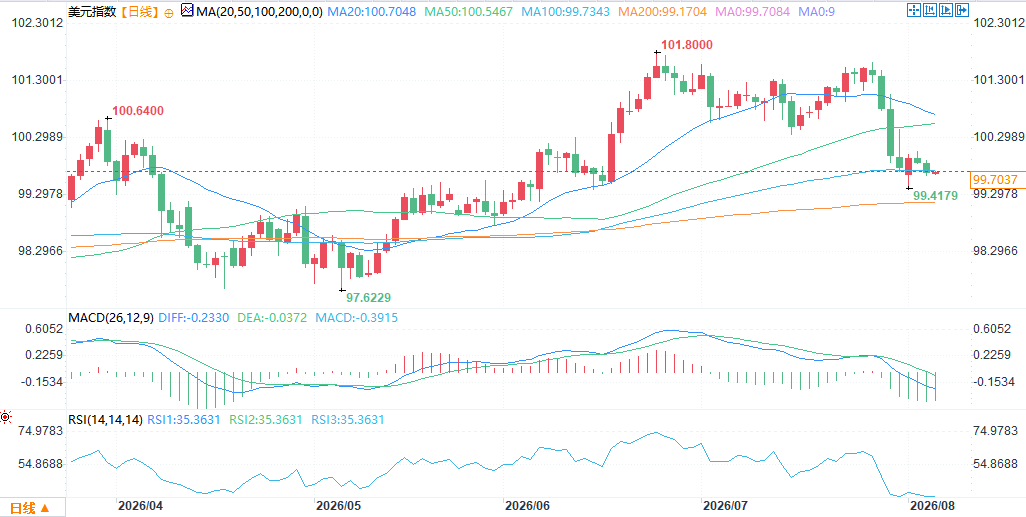 (US Dollar Index Daily Chart, Source: FX678) At 11:41 AM Beijing time on August 6, the US Dollar Index was at 99.72.
Daly: I support a wait-and-see approach; more data is needed before September.
Speaking at an economic conference in Tokyo on Wednesday, Daly said she “fully supports” last week’s decision to keep interest rates unchanged at 3.50%-3.75%. She noted that “we still have a lot of information to gather” before the September monetary policy meeting to determine whether current inflationary pressures are driven by a fading supply-side shock or a more persistent inflationary situation. Daly emphasized that the Federal Reserve should “remain vigilant, closely monitor new data, and be fully prepared to act if necessary.” She stated that there are “good reasons” to believe that the supply-side shocks affecting the U.S. economy will not have a lasting impact on inflation, as businesses currently have limited pricing power and are unlikely to pass on higher input costs. Meanwhile, consumers are highly focused on oil prices, and the end of the Middle East wars should weaken this factor’s contribution to inflation. In her remarks, Daly expressed concern about how the public will cope with a new round of inflationary shocks and pointed out that if inflationary momentum strengthens again, the Federal Reserve may need to take aggressive measures. Daly is not currently a voting member of the Federal Open Market Committee.Cook: I'm prepared to support interest rate hikes if inflation doesn't fall.
In contrast to Daly's wait-and-see approach, Federal Reserve Governor Cook expressed a more hawkish stance in a speech in Alaska. She explicitly stated that she would support raising the short-term interest rate target if U.S. inflation remained too high. "If inflation doesn't start to cool, I'm prepared to act if necessary, addressing it with interest rate hikes," Cook noted. She pointed out that, regarding the Fed's dual mandate, the risks to inflation outweigh those to the job market. She stated that she would support raising interest rates if necessary to bring inflation down, but emphasized that "it may not be necessary." She further warned that with inflation persistently above the 2% target for some time, the Fed's policy space for dealing with inflation is shrinking. Inflation may gradually solidify in corporate pricing and wage-setting behavior, creating more persistent pressures that will be more difficult to manage. "In a different environment, we might be able to wait longer, but we don't have that luxury right now." Cook was also one of the officials who supported keeping interest rates unchanged last week, but she stated that maintaining the current rate was "appropriate" while observing how inflation develops. She pointed out that factors driving inflation, such as tariffs, the Middle East situation, and AI-related investments, may ease in the future, but stressed that "I am firmly committed to restoring price stability."Policy Background: Three Opponents and Widening Divide
Last week, the FOMC voted 9-3 to maintain the target range for the policy rate at 3.50%-3.75%, with all three policymakers advocating for an immediate rate hike to curb inflation. In recent days, officials including New York Fed President Williams and Philadelphia Fed President Paulson have indicated their willingness to support a rate hike if necessary. Against this backdrop, Fed Chairman Warsh has consistently refused to provide guidance on the future path of interest rate policy and has rarely commented on how monetary policy decisions are made. This pattern of "the chairman's silence and officials' pronouncements" is exacerbating market uncertainty regarding the Fed's internal policy direction.Internal divisions coupled with the chairman's silence have left the dollar without a clear direction.
The widening divisions within the Federal Reserve are adding uncertainty to the short-term direction of the US dollar index. With Chairman Warsh remaining silent, the market is unable to obtain clear directional guidance from the Fed, making the dollar's trading logic more reliant on economic data itself. If subsequent data shows inflation continuing to exceed the target and employment remaining strong, the hawkish logic will prevail, providing upward support for the dollar; conversely, if inflation moderately declines, the wait-and-see approach will be validated, and the dollar may face mild downward pressure. Currently, the dollar index is trading around 99.70, lacking the momentum for a directional breakout. The market is awaiting clearer inflation signals or geopolitical developments to break the deadlock. In the short term, the dollar index is expected to continue its range-bound trading pattern, with each key data release before the September FOMC meeting potentially acting as a catalyst for a directional choice for the dollar.Summarize
The latest statements from San Francisco Fed President Daly and Fed Governor Cook reveal the divergence within the FOMC regarding the policy path: Daly advocates for patience and observation, gathering more data before September to assess whether inflation is a supply-side shock or a persistent problem; Cook, on the other hand, warned that he is prepared to support a rate hike if inflation does not fall. Previously, three policymakers had voted against maintaining the current interest rate, and coupled with recent hawkish statements from New York Fed President Williams and Philadelphia Fed President Paulson, the Fed's policy balance is becoming increasingly complex. With Chairman Warsh remaining silent, market expectations regarding whether the September meeting will result in a rate hike, a rate cut, or no change will heavily depend on inflation and employment data in the coming weeks. The tension between Daly's "fully prepared to act" and Cook's "rate hike if necessary" stance is the core suspense surrounding the Fed's current policy path. (US Dollar Index Daily Chart, Source: FX678) At 11:41 AM Beijing time on August 6, the US Dollar Index was at 99.72.- Risk Warning and Disclaimer
- The market involves risk, and trading may not be suitable for all investors. This article is for reference only and does not constitute personal investment advice, nor does it take into account certain users’ specific investment objectives, financial situation, or other needs. Any investment decisions made based on this information are at your own risk.