On the surface, it's about saving the yen, but behind the scenes it's affecting the massive US Treasury market.
2026-08-06 15:52:52
On Thursday, August 6th, the USD/JPY pair hovered around 157.7 after experiencing unusually rapid fluctuations. The exchange rate had previously risen to around 164 before quickly falling back to around 155.2 following news of joint US-Japan intervention, with daily volatility significantly exceeding normal levels. This movement was not solely driven by interest rate differentials. The US provided dollar liquidity to Japan through the Federal Reserve's repurchase agreements with foreign official institutions, allowing Japan to reduce its need to directly sell US Treasury bonds to raise funds for intervention. While this financing method avoids impacting the US Treasury market, it also complicates the boundaries between foreign exchange intervention, balance sheet management, and monetary policy. 
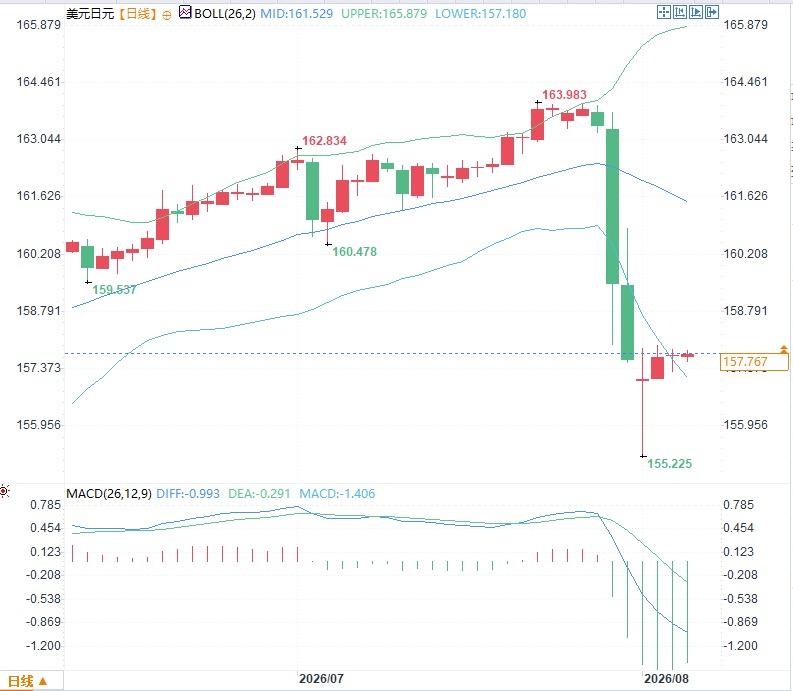 In the MACD indicator, the DIFF is approximately -0.993, the DEA is approximately -0.291, and the histogram value is approximately -1.406, indicating that the previous rapid decline is still dragging down the trend indicators. The key factors to observe in the future are whether three variables will re-establish a stable relationship: the USD/JPY short-term interest rate differential, exchange rate volatility, and speculative positions. If the exchange rate continues to deviate from the interest rate differential, it indicates that the market is still assessing the credibility of policy and the sustainability of intervention. If volatility remains high for an extended period, the risk-reward ratio of carry trade strategies will fundamentally change. At 15:48 Beijing time, the USD/JPY exchange rate was 157.87.
Why is the method of intervention in financing receiving more attention than the intervention itself?
Traditional yen intervention typically requires Japan to sell some of its dollar assets and then convert the proceeds back into yen. If the funds mainly come from the sale of US Treasury bonds, a concentrated sell-off could push up Treasury yields and amplify already high financing costs. This time, the use of repurchase agreements (repo financing) is equivalent to obtaining short-term dollars using US Treasury bonds as collateral, and then using those dollars to buy yen, thus reducing the immediate impact on the secondary market for Treasury bonds. The problem is that repo operations will periodically expand the Federal Reserve's balance sheet and inject dollar liquidity into the financial system. Its legal and operational attributes differ from quantitative easing, but they share some similarities in terms of liquidity transmission. Currently, the Federal Reserve still faces inflationary constraints, and the market is also pricing in the possibility of an interest rate hike this year. The balance sheet expansion resulting from foreign exchange intervention may not align with the direction of signals indicating monetary policy tightening. Federal Reserve Chairman Kevin Warsh will officially take office on May 22, 2026, and has repeatedly emphasized balance sheet discipline. Therefore, the Treasury Department hopes to expand the upper limit of the use of related tools, which involves not only technical arrangements but also the coordination of fiscal policy, foreign exchange policy, and central bank independence.Why did the narrowing interest rate differential fail to prevent the yen from weakening?
Over the past two years, the Bank of Japan has raised interest rates five times, while the Federal Reserve has cut rates six times, narrowing the policy rate differential between the two countries from approximately 5.6 percentage points to 2.75 percentage points. Simultaneously, the spread between 10-year government bond yields has also fallen from a high of over 4 percentage points in 2023 to less than 2 percentage points. According to general interest rate differential logic, rising yen funding costs and declining yield advantages of dollar assets should weaken the attractiveness of carry trades. However, market pricing has gradually shifted towards the 2-year yield. Due to the Bank of Japan's cautious stance on further tightening, and the stickiness of US inflation causing the market to re-induce the possibility of rate hikes, short-term interest rate differentials have not narrowed as continuously as long-term differentials. Furthermore, the yen's previous low volatility and one-sided depreciation allowed investors to continuously profit from interest rate differentials while bearing relatively limited volatility risk, leading to a rapid accumulation of short positions. This means that the yen issue has evolved from simply weak valuations to a market structure problem influenced by interest rate differentials, volatility, and crowded positions. Intervention can force some short positions to close in the short term, but it cannot automatically change the interest rate environment upon which carry trades depend.The technical structure reflects deleveraging, rather than a one-way conclusion.
From a daily chart perspective, the USD/JPY pair quickly retreated from around 163.9, reaching a low of 155.225, before consolidating in a narrow range around 157. The Bollinger Band middle line is approximately 161.529, and the lower line is approximately 157.180. The price rapidly crossed the middle line from the upper band and approached the lower band, causing a significant widening of the channel. In the MACD indicator, the DIFF is approximately -0.993, the DEA is approximately -0.291, and the histogram value is approximately -1.406, indicating that the previous rapid decline is still dragging down the trend indicators. The key factors to observe in the future are whether three variables will re-establish a stable relationship: the USD/JPY short-term interest rate differential, exchange rate volatility, and speculative positions. If the exchange rate continues to deviate from the interest rate differential, it indicates that the market is still assessing the credibility of policy and the sustainability of intervention. If volatility remains high for an extended period, the risk-reward ratio of carry trade strategies will fundamentally change. At 15:48 Beijing time, the USD/JPY exchange rate was 157.87.
- Risk Warning and Disclaimer
- The market involves risk, and trading may not be suitable for all investors. This article is for reference only and does not constitute personal investment advice, nor does it take into account certain users’ specific investment objectives, financial situation, or other needs. Any investment decisions made based on this information are at your own risk.