The US and Iran are entering a window of détente, with the Hormuz interim agreement nearing its implementation.
2026-08-06 15:52:55
On Thursday (August 6), spot gold prices saw a slight rise followed by a pullback during the Asian and European sessions, retaining almost all of Wednesday's gains and demonstrating strength. This also broke the previous downtrend in gold prices, which are currently trading at $4261 per ounce. Since the US-led military action against Iran on February 28, the geopolitical situation in the Middle East has remained tense. The US's core strategic goals of overthrowing the current Iranian regime and dismantling Iran's nuclear program have all failed, and the focus of the battle has shifted to the struggle for control of the Strait of Hormuz. This crucial waterway, carrying one-fifth of global oil and gas trade, has been brought to a near standstill, directly pushing up global energy and basic consumer goods prices and continuously disrupting the macroeconomic landscape. With the US congressional elections approaching, low domestic public opinion has increased pressure on the Trump administration due to the war, and both the US and Iran have shown a willingness to de-escalate. The temporary agreement on navigation in the Strait of Hormuz is approaching its implementation, and a long-term standoff may be coming to a temporary end. 
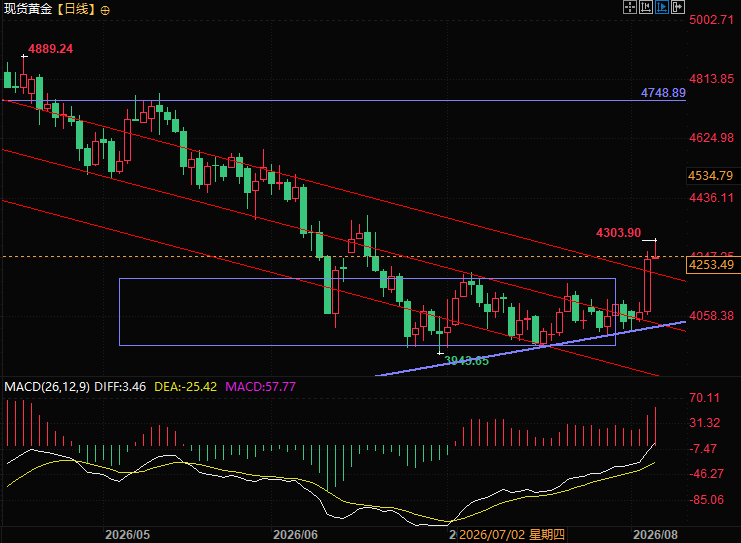 (Spot gold daily chart, source: EasyTrade) At 15:46 Beijing time, spot gold is currently trading at $4255 per ounce.
Negotiations have entered their final stage, and the framework for a temporary air traffic agreement has been finalized.
The current US-Iran standoff is characterized by a clear pattern of "fighting while negotiating, with mutual compromises," and the negotiation process has entered a crucial final stage. This round of mediation, with Oman and Qatar as the core third-party mediators, saw Iran take the lead in releasing clear signals of progress. Iranian Foreign Ministry spokesman Esmail Bagae confirmed that the drafting of the agreement between Iran and Oman on navigation through the Strait of Hormuz has entered its final stage, with only a few external obstacles remaining to overcome. Several informed regional officials told the Associated Press that the two sides have finalized a complete draft agreement, and the final text is being simultaneously submitted to the United States, Gulf states, and Iran's top leadership, awaiting approval from Supreme Leader Khamenei. The US has also expressed optimism, with Trump publicly stating that the Straits navigation agreement is highly likely to be officially announced this week, indicating substantial progress in the negotiations. US Vice President Vance also acknowledged that this round of diplomatic mediation is complex and slow-moving, with Iran's negotiating stance being extremely tough. He added that if the US wants to end the conflict, it may need to take a step back to move forward. It is worth noting that this proposed agreement is a temporary arrangement with a validity period of 60 days, building upon the framework consensus reached after the breakdown of US-Iran negotiations in June this year. Its core objective is to resolve the Strait of Hormuz dispute in phases and pave the way for subsequent in-depth negotiations. According to the new navigation rules outlined in the draft, the Strait of Hormuz will implement a separate control model. Ships entering the Persian Gulf will need to pass through the Iranian-controlled channel and be subject to Iranian scheduling and supervision, while ships leaving the Persian Gulf will pass through the Omani-controlled channel and be coordinated and managed by Oman. At the same time, the draft explicitly prohibits Iran from forcibly charging merchant ships passage fees, but allows Iran to collect voluntary donations for channel security and maintenance, maritime search and rescue, and marine ecological protection.Core disagreements remain, and the implementation of the agreement is fraught with uncertainty.
Although the basic framework of the text has been finalized, the core differences between the US and Iran have not been completely resolved, and the implementation of the agreement remains uncertain. The US has maintained a hardline stance, resolutely opposing any clauses that would strengthen Iran's control over the Strait of Hormuz, arguing that such arrangements would result in a major geopolitical setback for the US and violate international navigational norms. The US also explicitly opposes any proposed fees from Iran. Iran, on the other hand, remains steadfast, refusing to allow the Strait to return to its pre-war state of complete openness and insisting on retaining some control over the waterways. Furthermore, Iranian Deputy Foreign Minister Gharibabadi clearly stated that even if Iran and Afghanistan reach an agreement, the smooth resumption of navigation in the Strait ultimately depends on whether the US meets several undisclosed preconditions, with the lifting of the US blockade of Iranian ports being a core prerequisite for the agreement's implementation. Meanwhile, hardline forces within Iran, such as the Islamic Revolutionary Guard Corps (IRGC), remain potential obstacles. Previous diplomatic attempts have failed due to internal resistance, and the IRGC's attitude, as the de facto controller of the Strait, directly impacts the agreement's effectiveness.Key shipping lanes have seen a sharp decline in traffic as conflicts continue to escalate in multiple parts of the Middle East.
The geopolitical tug-of-war is directly reflected in the shipping data of the two key energy shipping routes, with traffic volume plummeting compared to pre-war levels. Maritime data agency Kpler reported that only two ships passed through the Strait of Hormuz on Wednesday, far below the pre-war daily average of 130 to 140 ships. The situation in the Bab el-Mandeb Strait is even worse due to the Houthi blockade, with only one cargo ship passing through that day, a near standstill compared to the previous daily average of 41 ships. Since July, the Houthi rebels in Yemen, supported by Iran, have intensified their blockade of the Red Sea and the Bab el-Mandeb Strait, frequently attacking Saudi oil tankers and passing merchant ships. Although some attacks lack concrete evidence and Saudi Arabia has not yet responded, the ongoing conflict has completely disrupted alternative routes for Red Sea oil exports, further exacerbating pressure on global shipping and energy supply chains. Moreover, conflicts are escalating simultaneously in many parts of the Middle East, the ceasefire between Lebanon and Israel is rapidly weakening, the Israeli military recently issued an evacuation warning to residents in southern Lebanon and launched precision strikes, the Rome negotiations between Lebanon and Israel were forced to be temporarily suspended, and the overall situation in the region still harbors multiple risks.Institutional assessment: The easing is a temporary situation; long-term risks remain.
Regarding the impact of this interim agreement, various authoritative institutions and regional officials have offered cautious assessments. Ellen Wald, a senior fellow at the Atlantic Council's Global Energy Center, warned that the new navigation rules effectively transfer control of the Strait of Hormuz to Iran. Once Gulf oil-producing countries adapt to this shipping system, Iran's control over this vital regional economic artery will be firmly established. Gulf states are generally concerned, fearing that the short-term interim agreement will become a springboard for Iran to seek permanent control of the strait, continuing to exert pressure on the economic lifelines of regional countries. However, they also acknowledge that, given the Iranian Revolutionary Guard's hardline stance of escalating conflict and raising the cost of war, reaching a temporary reconciliation is the best option at this stage. Sanam Wakir, head of the Middle East program at Chatham House in London, analyzed that this agreement will likely achieve a temporary ceasefire and restore navigation, but it is still far from a formal peace treaty between the US and Iran. Both sides are using this opportunity to observe the situation and gain strategic time. There is a possibility that the conflict could resurge around the time of the US presidential election in November.Market pricing in advance eased expectations, putting downward pressure on oil prices and benefiting gold.
Energy and financial markets have already priced in expectations of a de-escalation in the Middle East, with oil and gold prices moving in tandem. In the crude oil market, Brent crude prices stabilized around $80 per barrel, a significant drop from the highs during the height of the conflict. After a brief decline in early trading on Wednesday, oil prices rebounded slightly, as the market generally digested the geopolitical risk premium. Meanwhile, the gold market benefited from both expectations of a de-escalation and looser monetary policy, resulting in a positive market performance. IG market analysts pointed out that the rising expectations of a Strait of Hormuz agreement are likely to continue easing global energy supply pressures, reduce the risk of rising inflation, and lessen the pressure on central banks to raise interest rates, providing core support for gold prices.Macroeconomic Logic Review: Monetary Policy and Non-Farm Payroll Data Dominate Gold Price Movements
From a macro-financial perspective, after the outbreak of the US-Iran conflict in February, the market was initially concerned that soaring energy inflation would force a tightening of monetary policy, causing spot gold to retreat by 19%. Currently, with the progress of the Taiwan Strait reconciliation process, the market's expectation of a Fed rate hike in September has fallen from 67% to 55%, and the US dollar index continues to weaken. On the one hand, the cooling of rate hike expectations has lowered the opportunity cost of holding non-interest-bearing gold; on the other hand, the weakening dollar has reduced the cost of purchasing gold for holders of non-US dollar currencies, further boosting gold demand. Currently, the market is in a wait-and-see state, awaiting the release of the US July non-farm payroll report. If the employment data is weak, it will further solidify expectations of monetary policy easing, pushing gold prices higher. Currently, the July ADP employment report, as well as the June non-farm payroll and CPI data, all suggest that the labor market is contracting. If the data significantly exceeds expectations, the market may reprice the rate hike path, and gold prices will face short-term downward pressure. Overall, the easing pace of the US-Iran geopolitical game will become the core geopolitical driver of subsequent oil and gold price fluctuations.Viewpoints and Technical Analysis:
Currently, none of the Gulf states want the conflict to escalate. Meanwhile, the pressure of the midterm elections and limited ammunition in the US provide a backdrop for peace talks. The talks between Iran and Oman are expected to bring the US and Iran back to the framework of the previous 60-day ceasefire memorandum, while the Straits of Hormuz and Bab el-Mandeb remain open. However, Israel bombed Lebanon again yesterday, making Iran's statement today extremely important, as it can reveal Iran's attitude towards the ceasefire. At the same time, US data continues to suggest a one-off inflationary shock and a weakening labor market. The previous US interest rate decision was based on a resilient labor market; if this premise wavers, market expectations for rate hikes will reverse, which is one of the important reasons for the recent turning point in gold prices. Technically, spot gold has broken through the recent consolidation range and the downtrend line. If the price can maintain this level, the decline in gold will be confirmed as broken, with current support around 4160. (Spot gold daily chart, source: EasyTrade) At 15:46 Beijing time, spot gold is currently trading at $4255 per ounce.
- Risk Warning and Disclaimer
- The market involves risk, and trading may not be suitable for all investors. This article is for reference only and does not constitute personal investment advice, nor does it take into account certain users’ specific investment objectives, financial situation, or other needs. Any investment decisions made based on this information are at your own risk.