The US dollar strengthened slightly, with the "temperature difference" in US-Iran negotiations providing some support.
2026-08-06 16:10:53
On Thursday (August 6), during the European session, the US dollar index traded around 99.75, showing a slight upward trend. High uncertainty surrounding US-Iran negotiations provided safe-haven buying support for the dollar, while hawkish comments from Federal Reserve officials also contributed to its strength. 
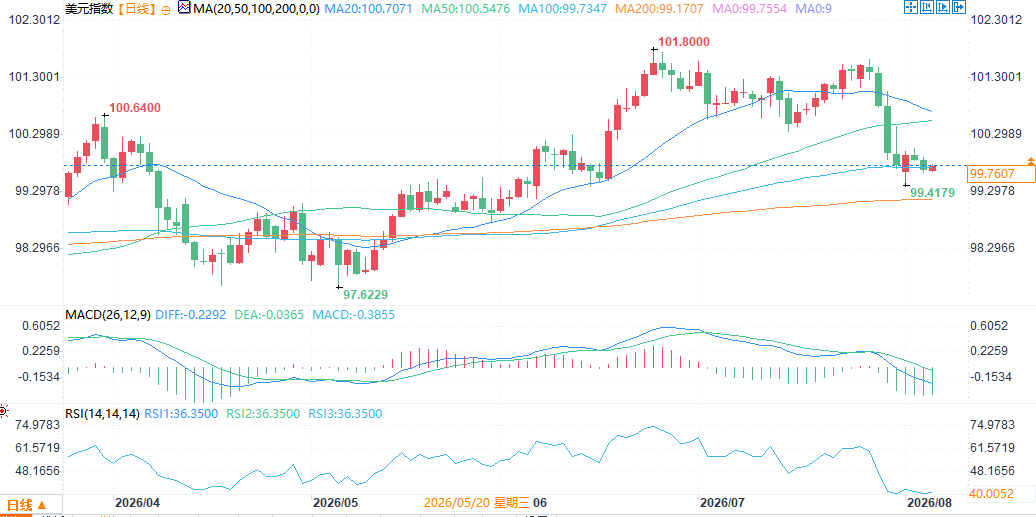 (US Dollar Index Daily Chart, Source: FX678) At 16:06 Beijing time on August 6, the US Dollar Index was at 99.76.
Geopolitical uncertainty increases demand for safe-haven assets
Conflicting signals from the US-Iran negotiations are providing intermittent support for the US dollar. Iranian Deputy Foreign Minister Gharibabadi stated that Iran and Oman are close to finalizing a framework agreement for commercial shipping in the Strait of Hormuz, but emphasized that the agreement will not automatically reopen this crucial waterway. This contrasts sharply with Trump's previous optimistic statements that the negotiations were "very productive." The conflicting statements between US and Iranian officials have exacerbated market concerns about the prospects of the agreement, prompting safe-haven funds to flow back into the US dollar. The CME FedWatch tool shows that the market is currently pricing in a 54.7% probability of a 25 basis point rate hike by the Federal Reserve in September, a slight decrease from 66% a week ago, but still exceeding 50%.ADP data sends mixed signals: weak employment but firm wages.
Analysts at Danske Bank point out that the US labor market data presents a complex picture. July's ADP employment growth was only 44,000, far below expectations, and there was a clear divergence between industries—education and healthcare saw job growth, while leisure and hospitality experienced declines. However, it is noteworthy that wage growth among those changing jobs has increased, indicating that labor market conditions are still tightening and workers' bargaining power is improving. Danske Bank believes that "marginally, this is a hawkish signal to the Fed," as the slowdown in job growth has not alleviated wage pressures, which may make the Fed cautious in assessing the inflation outlook.Schmidt sends hawkish signals, emphasizing that AI investment is driving up inflation.
Kansas City Fed President Schmid's speech on Wednesday delivered a clearly hawkish tone. His speech received a slightly above-average rating, consistent with a firm policy bias. Schmid emphasized that current Fed policy is "not tight," that AI-related investments are exacerbating inflation, and that further monetary tightening is needed to bring PCE inflation back to the 2% target. He noted that inflation remains "too high" and "worrying," and that recent deleveraging and easing of energy costs may be temporary, while supply-side price pressures should not be ignored. Following Schmid's speech, the FXS Fed Sentiment Index, while slightly declining, remained at a high of 145.80, indicating that Fed communication remains firmly in hawkish territory. Schmid's hawkish stance is consistent with the overall environment—even with slight marginal easing, the overall policy stance remains tight.Summarize
The US dollar index is currently trading around 99.75, supported by safe-haven buying driven by geopolitical uncertainty and hawkish comments from Federal Reserve officials. However, weak ADP employment data coupled with hawkish wage signals, and Schmidt's emphasis on AI investment driving inflation, suggest the Fed still faces a complex situation in balancing inflation and employment. Market pricing in a September rate hike has fallen to around 55%, making Friday's non-farm payroll report a key variable in breaking the current range-bound stalemate. (US Dollar Index Daily Chart, Source: FX678) At 16:06 Beijing time on August 6, the US Dollar Index was at 99.76.
- Risk Warning and Disclaimer
- The market involves risk, and trading may not be suitable for all investors. This article is for reference only and does not constitute personal investment advice, nor does it take into account certain users’ specific investment objectives, financial situation, or other needs. Any investment decisions made based on this information are at your own risk.