Diplomatic news pressured oil prices, but the market revealed a different logic.
2026-08-06 19:32:54
On Thursday, August 6th, Brent crude oil entered a narrow consolidation phase after a recent sharp decline. The current price is around $80 per barrel, with a daily increase of approximately 1.15%. Previously, negotiations regarding shipping arrangements in the Strait of Hormuz showed signs of progress, rapidly narrowing the supply disruption premium. However, issues such as the Red Sea tanker safety incident, the incomplete recovery of Gulf crude oil exports, and the unclear conditions for the implementation of the agreement remain. 
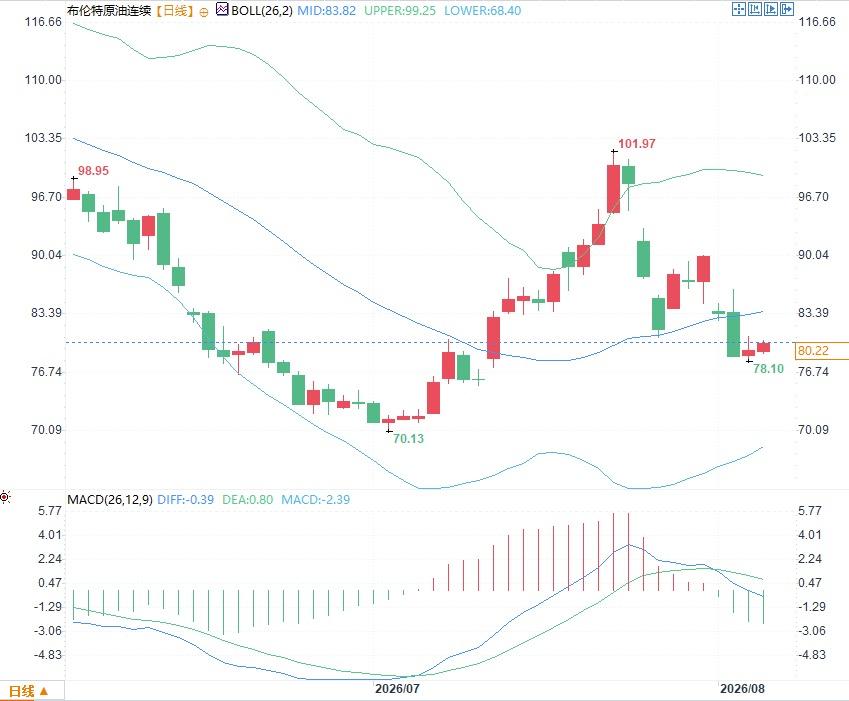 Three technical characteristics are worth noting. First, the price has fallen back below the Bollinger Band's middle line, indicating that the short-term moving average structure formed by the previous rapid rebound has been broken. Second, the Bollinger Bands remain wide, suggesting that historical volatility has not been fully digested, and the current narrow range trading cannot be simply equated with a low-volatility environment. Third, the MACD indicator shows the DIFF at approximately -0.39, the DEA at approximately 0.80, and the histogram at approximately -2.39, reflecting that after the decline in upward momentum, the price is still in the process of re-establishing equilibrium. In addition, the US July non-farm payroll report will be released on August 7th. June's non-farm payrolls increased by 57,000, lower than previous market expectations; the latest market consensus is approximately 88,000. This data may affect the financial pricing of crude oil through the dollar, real interest rates, and expectations of Fed policy, but in the current environment, its impact may still be weaker than the recovery of shipping and changes in geopolitical supply. At 19:28 Beijing time, Brent crude oil was trading at $80.28 per barrel.
The core issue behind the sharp drop in oil prices is not demand, but rather the repricing of tail risks.
This round of adjustments primarily reflects a decline in geopolitical supply risk premiums, rather than a similar deterioration in global oil demand in a short period. Iran and Oman have reached a preliminary consensus on the coordinates of shipping lanes in the Strait of Hormuz and are preparing a joint statement. The proposed plan involves the division of shipping lanes, monitoring of passage, and port restrictions, but the final text, implementing bodies, and additional conditions have not yet been fully determined. This change has triggered a typical risk premium clearing. Previously, oil prices included three layers of pricing: actual export losses, potential shipping disruptions, and the tail risk of further conflict escalation. When diplomatic news improves, the third layer is the first to be reduced, not the existing supply gap. Therefore, a single-day drop of over 5% reflects more concentrated position unwinding and options hedging adjustments, and does not necessarily mean that spot supply and demand have immediately eased. On August 4, Brent crude oil fell by about 5% due to news of progress in negotiations, indicating that the current market is significantly more sensitive to shipping news than usual. It is worth noting that Gulf oil exports are still about 40% lower than pre-conflict levels, and the safety risks for tankers in the Red Sea and the Gulf of Aden have not been completely eliminated. There is a time lag between the expectation of supply recovery and the actual transportation capacity, which is why a unilateral expansion did not continue after the sharp drop in oil prices.What truly affects pricing is whether the agreement can translate into verifiable logistical recovery.
Traders are focusing not only on whether a joint statement has been issued, but also on whether the agreement can improve actual loading, insurance, freight rates, and vessel passage efficiency. First, determining channel coordinates only addresses the technical framework and cannot automatically eliminate safety risks. Second, shipowners and insurance companies typically need to wait for clear rules of passage, escort arrangements, liability delineation, and risk ratings before restoring capacity. Third, even if the strait reopens, port operations, backlogged schedules, and refinery procurement plans will need to be recalibrated. Therefore, the subsequent verification chain includes the average daily number of vessels passing through the strait, loading volumes at major Gulf ports, tanker insurance surcharges, spot freight rates, and the Brent near-month spread. If the situation in the strait improves but logistical indicators do not recover simultaneously, the risk premium may simply shift from an overtly high level to a more subtle volatility pricing. Inventory levels also pose a constraint. The latest weekly data shows that US commercial crude oil inventories increased by approximately 2.5 million barrels, weakening the narrative of short-term supply tightness. Meanwhile, Saudi Arabia slightly lowered its official selling price for September Arab Light crude oil to Asian customers, reflecting a cautious balance between demand absorption capacity and market share.The technical structure indicates a contraction in volatility, but the trend correction is not yet complete.
From the daily chart, Brent crude oil previously rose rapidly from around $70.13 to $101.97, before experiencing a sharp pullback. The current price is approximately $80.20, with the Bollinger Band middle line at $83.82, the upper band at $99.25, and the lower band at $68.40. Three technical characteristics are worth noting. First, the price has fallen back below the Bollinger Band's middle line, indicating that the short-term moving average structure formed by the previous rapid rebound has been broken. Second, the Bollinger Bands remain wide, suggesting that historical volatility has not been fully digested, and the current narrow range trading cannot be simply equated with a low-volatility environment. Third, the MACD indicator shows the DIFF at approximately -0.39, the DEA at approximately 0.80, and the histogram at approximately -2.39, reflecting that after the decline in upward momentum, the price is still in the process of re-establishing equilibrium. In addition, the US July non-farm payroll report will be released on August 7th. June's non-farm payrolls increased by 57,000, lower than previous market expectations; the latest market consensus is approximately 88,000. This data may affect the financial pricing of crude oil through the dollar, real interest rates, and expectations of Fed policy, but in the current environment, its impact may still be weaker than the recovery of shipping and changes in geopolitical supply. At 19:28 Beijing time, Brent crude oil was trading at $80.28 per barrel.
- Risk Warning and Disclaimer
- The market involves risk, and trading may not be suitable for all investors. This article is for reference only and does not constitute personal investment advice, nor does it take into account certain users’ specific investment objectives, financial situation, or other needs. Any investment decisions made based on this information are at your own risk.