US labor market data in tug-of-war ahead of non-farm payrolls
2026-08-06 21:50:54
ADP private sector employment weakened significantly, but initial jobless claims remained low, revealing a clear divergence in the US job market: private sector hiring intentions are cooling, while corporate layoffs have not worsened. The market is awaiting Friday's non-farm payroll report to confirm the true direction of the labor market. 
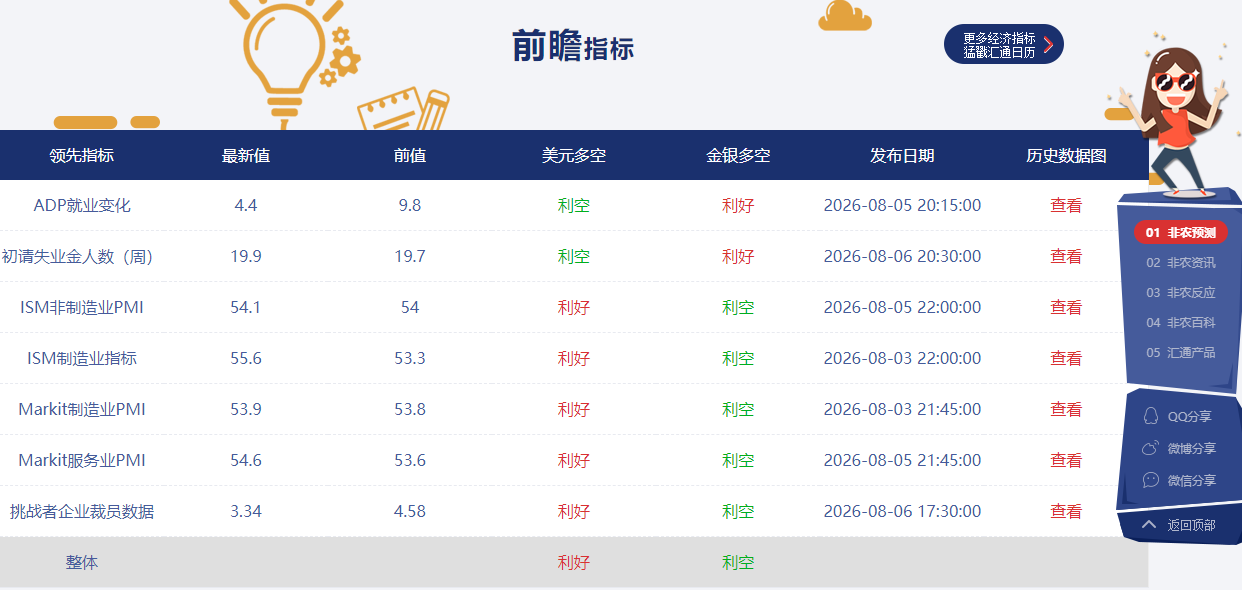 (A summary of recent forward-looking data, source: EasyForex)
The ADP data cooled significantly, dampening expectations of a hawkish stance from the Federal Reserve.
The ADP report released Wednesday showed that private sector employment increased by only 44,000 in July, indicating a significant slowdown in corporate hiring momentum. Following this sharp decline, market expectations for further tightening by the Federal Reserve cooled rapidly, and the money market's pricing in subsequent interest rate hikes (or the maintenance of high interest rates) has decreased, with discussions beginning to focus on downside risks to the economy. However, the ADP report largely reflects the hiring intentions of private enterprises (especially small and medium-sized enterprises) and does not necessarily indicate an impending wave of layoffs; it still needs to be cross-validated with data such as initial jobless claims from the Department of Labor.Initial jobless claims: Layoffs have not significantly worsened the situation.
Data from the U.S. Department of Labor shows that initial jobless claims for the week ending August 1 were approximately 199,000, lower than expected and remaining at a historically low level below 200,000; the four-week moving average also fell to 199,000, indicating that the pressure on businesses to lay off workers has not increased significantly. Continuing jobless claims for the week ending July 25 were approximately 1.801 million, slightly higher than expected. This combination of low initial claims and rising continuing claims suggests that while businesses have not laid off workers on a large scale (no one has been laid off), the time it takes for unemployed individuals to find new jobs is lengthening (job hunting is slower). This further confirms the current core pattern of the job market: "low-hire, low-fire."In-depth analysis of the employment structure: the coexistence of AI-driven substitution and a recovery in traditional recruitment.
Looking at the Challenger layoff data, the job market is not weakening overall, but rather exhibiting a strong structural divergence: Layoffs are slowing and concentrated on AI transformation: In July, US employers announced approximately 33,000 layoffs, a decrease of nearly 30% from June. Although the tech sector remains the hardest hit by layoffs, "AI technology replacement and architecture optimization" has been the primary trigger for several consecutive months. This type of layoff is a structural adjustment driven by industry technological iteration, rather than a recessionary layoff. No spread to non-tech sectors, with active hiring in the real economy offsetting the trend: There are no signs of widespread layoffs in the real economy. On the contrary, the number of planned hires by companies in July increased significantly by nearly 50% month-on-month, with demand mainly concentrated in the aerospace, energy, and high-end manufacturing sectors. Overall, the tech industry is structurally contracting due to AI transformation, while employment in the real economy is recovering, together creating a picture of "a shift in power and structural divergence."Data contradictions remain unresolved: a weaker ADP figure does not necessarily mean a disappointing non-farm payrolls report.
The ADP private sector employment report set a pessimistic benchmark for the market, but initial jobless claims and Challenger layoffs data remained strong. This discrepancy stems from the differences in their statistical methods and samples: the ADP report is more biased towards small and medium-sized enterprises and technology jobs, making it highly susceptible to disruptions from AI layoffs and hiring contraction in the tech industry. Therefore, a weaker ADP report does not necessarily mean that the official non-farm payrolls (NFP) report will be significantly disappointing.Institutional Viewpoint:
Regarding the current "split" in data, major overseas investment banks and research institutions have generally offered highly consistent interpretations. Goldman Sachs and Barclays pointed out that ADP data has weak predictive power for official non-farm payrolls and is easily affected by noise from small and medium-sized enterprise samples; while the persistently low initial jobless claims data confirms that companies, after experiencing labor shortages, still tend to "hoard labor," and the market is in a typical "low-hire, low-fire" equilibrium period. As for the wave of layoffs in the technology industry, Morgan Stanley and JPMorgan believe this is not a signal of a cyclical recession, but rather a "restructuring of capital expenditure" under the disruptive influence of AI technology—tech giants are shifting their budgets from traditional positions to computing infrastructure, representing a structural replacement; as long as the employment base in real industries such as healthcare, energy, and high-end manufacturing remains robust, it is insufficient to trigger a trend of unemployment. Regarding the tone of the non-farm payrolls report, Bank of America Merrill Lynch and Citi cautioned that the weak ADP data had already lowered market expectations. If the non-farm payrolls report shows a "mild cooling," it will actually strengthen the expectation of a "soft landing." However, it is still necessary to closely monitor the impact of average hourly wage growth on inflation stickiness.A brief preview of the non-farm payrolls report (to be released on Friday).
Based on current clues, the focus is on scenario projections for the three-dimensional indicators of new job creation, unemployment rate, and average hourly earnings (wage inflation): Baseline Scenario (Highest Probability): New job creation declines moderately, the unemployment rate remains low, and wage growth is stable. The pattern of "fewer hires, fewer layoffs" continues. This scenario will solidify expectations of a Fed policy shift (pausing rate hikes/initiating rate cuts), lowering US Treasury yields and the dollar, and benefiting gold and risk assets. Mild Scenario (Recession Narrative): New job creation is significantly lower than expected, accompanied by an unexpectedly high unemployment rate. The market will quickly shift to "economic growth concerns," lowering interest rate expectations and potentially causing short-term safe-haven disturbances for risk assets such as US stocks. Overheated Scenario (Inflation Stickiness): New job creation rebounds more than expected, or average hourly earnings growth unexpectedly surges. Even with modest new job creation, if wage growth exceeds expectations, it will reignite market concerns about a "wage-inflation spiral," thereby pushing up US Treasury yields and the dollar, and suppressing technology stocks and gold prices. In summary, the initial jobless claims and layoff data confirm that the US economy is not at risk of large-scale unemployment and that employment resilience remains. However, the weak ADP report and AI layoffs reflect a contraction in hiring intentions. Friday's non-farm payrolls will be the key to unlocking this contradiction, and market volatility will be significantly amplified at that time. (A summary of recent forward-looking data, source: EasyForex)
- Risk Warning and Disclaimer
- The market involves risk, and trading may not be suitable for all investors. This article is for reference only and does not constitute personal investment advice, nor does it take into account certain users’ specific investment objectives, financial situation, or other needs. Any investment decisions made based on this information are at your own risk.