Soaring oil prices exacerbate inflation concerns, and the probability of a Fed rate hike in September is over 50%. What's next for the Australian dollar?
2026-08-07 11:10:52
The Australian dollar traded in a narrow range against the US dollar during Asian trading hours on Friday (August 7), currently down slightly to around 0.7020, continuing its weak trend from the previous night. The Australian dollar fell 0.35% against the US dollar on Thursday, pressured by a strengthening US dollar and a resurgence in safe-haven demand. Escalating geopolitical risks provided safe-haven buying support for the US dollar, while a rebound in oil prices reignited inflation concerns, reinforcing expectations of a Federal Reserve rate hike. The market awaits Friday's US non-farm payroll report for clearer direction, while the Reserve Bank of Australia's policy meeting next week is also a key focus. 
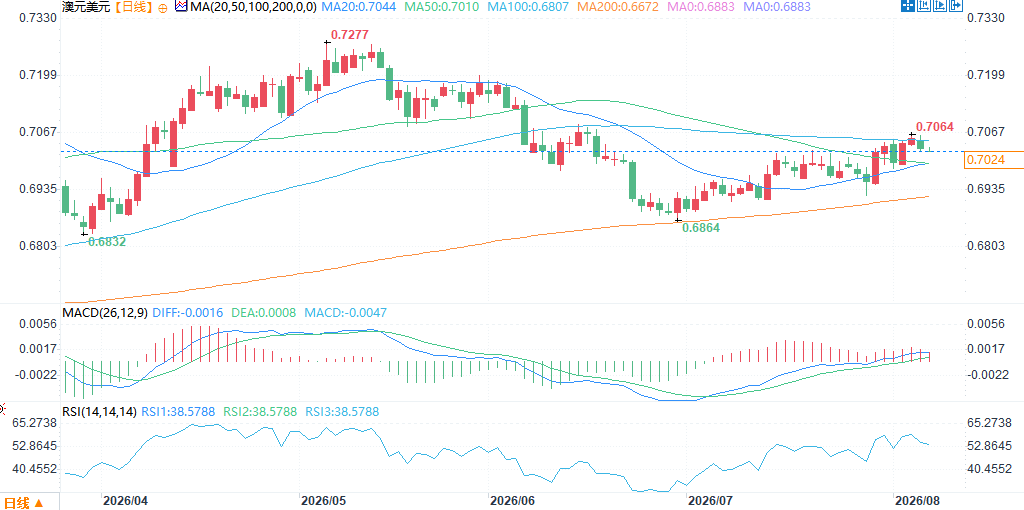 (Australian dollar against US dollar daily chart, source: EasyForex) At 10:52 Beijing time on August 7, the Australian dollar was trading at 0.7025/26 against the US dollar.
Escalating geopolitical risks support safe-haven dollar
Previous market optimism regarding a US-Iran peace agreement is fading. Reports indicate that Iran is reviewing a draft bill to ban US and Israeli ships from passing through the Strait of Hormuz and impose restrictions on ships from other countries that have caused damage to Iran until compensation is paid. This news prompted traders to repric the geopolitical risk premium, leading to a return of safe-haven funds to the US dollar. Meanwhile, the Houthi attack on a Saudi oil tanker in the Red Sea further exacerbated market concerns about energy supply disruptions. The spread of geopolitical risks from the Strait of Hormuz to the Red Sea fueled a sharp rebound in oil prices and provided additional support for the safe-haven US dollar.Oil price rebound fuels inflation concerns, supporting US Treasury yields.
Crude oil prices rebounded sharply by more than 3% on Thursday to above $82 per barrel, reversing a previous downward trend driven by expectations of easing geopolitical tensions. The rise in oil prices is reigniting market concerns about inflation, reinforcing expectations of further interest rate hikes by the Federal Reserve—the market is pricing in a September rate hike at around 54.5%, leading to higher US Treasury yields. For the Australian dollar, the dual pressures of a stronger US dollar and rising US Treasury yields are limiting its upside potential. The Australian dollar is expected to be under pressure for the second consecutive day and may close flat for the week.The market awaits the non-farm payroll data; the Reserve Bank of Australia's policy decision will be released next week.
Market focus has shifted to Friday's release of the US July non-farm payrolls report. This data will be a key indicator of the health of the labor market and, consequently, the Federal Reserve's policy path, directly impacting the short-term direction of the US dollar and the Australian dollar's exchange rate against the US dollar. Looking ahead to next week, the market is focused on the Reserve Bank of Australia's (RBA) policy meeting on August 11. Analysts at leading institutions expect the RBA to maintain the cash rate at 4.35%, noting that core inflation in the second quarter averaged 0.8%, lower than the RBA's previous forecast of 0.9%. The institution believes that this outcome, coupled with the recent pullback in oil prices, should alleviate pressure on the RBA to further tighten policy in the near term. The baseline scenario remains that the RBA has completed its rate hikes in the foreseeable future, but the risk is skewed towards another rate hike in the second half of the year if the central bank still does not believe that demand is slowing sufficiently to curb potential price pressures.Summarize
Iran's review of the draft Hormuz ban has increased geopolitical risk premiums, while Houthi attacks on Saudi oil tankers have further exacerbated supply concerns, leading to a safe-haven flow back to the US dollar. A rebound in oil prices has reignited inflation concerns, and rising US Treasury yields have strengthened expectations of a Federal Reserve rate hike. The market is awaiting the US non-farm payrolls report for clearer direction. Next week's Reserve Bank of Australia (RBA) policy meeting is expected to keep interest rates unchanged, with the market focusing on its assessment of inflation and demand. Against the backdrop of intertwined geopolitical risks, oil price volatility, and policy prospects, the Australian dollar is expected to remain range-bound in the short term, awaiting the non-farm payroll data and the RBA's decision to break the deadlock. (Australian dollar against US dollar daily chart, source: EasyForex) At 10:52 Beijing time on August 7, the Australian dollar was trading at 0.7025/26 against the US dollar.
- Risk Warning and Disclaimer
- The market involves risk, and trading may not be suitable for all investors. This article is for reference only and does not constitute personal investment advice, nor does it take into account certain users’ specific investment objectives, financial situation, or other needs. Any investment decisions made based on this information are at your own risk.