The US dollar index is hovering around the 100 mark. Will the non-farm payroll data be the "accelerator" or the "brake"?
2026-08-07 11:32:58
On Friday (August 7) during the Asian session, the US dollar index fluctuated narrowly, trading near the psychological level of 100.00. Escalating geopolitical risks provided safe-haven buying support for the dollar, while a rebound in oil prices reignited inflation concerns, reinforcing expectations of a Federal Reserve rate hike. However, ahead of Friday's US non-farm payroll report, bulls did not appear to be in a hurry to make large bets, and the market was awaiting this key data to confirm the next direction. 
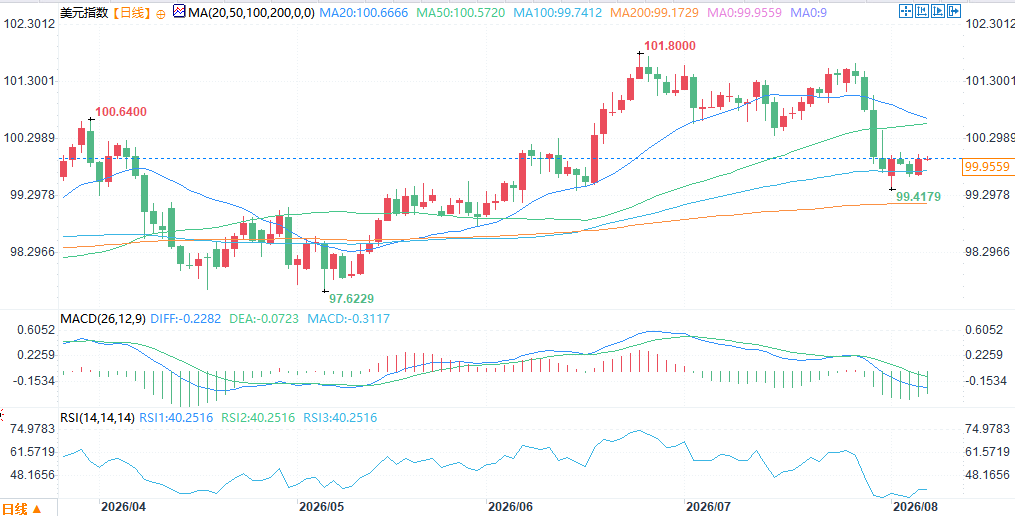 (US Dollar Index Daily Chart, Source: FX678) At 11:31 AM Beijing time on August 7, the US Dollar Index was at 99.96.
As geopolitical risks continue to escalate, the safe-haven US dollar receives support.
Recent developments in the Middle East continue to support the US dollar. A Saudi official reportedly stated that some Iraqi militia groups are coordinating with the Houthi rebels in Yemen, planning a coordinated attack on Saudi Arabia in the near future. This news exacerbated market concerns about the escalation of regional conflict, prompting traders to repric the geopolitical risk premium and leading to a return of safe-haven funds to the US dollar. Meanwhile, the Houthis claimed responsibility for the attack on a Saudi oil tanker in the Gulf of Aden. Iran is also considering a plan to ban US and Israeli ships from passing through the Strait of Hormuz. The spread of geopolitical risks from the Strait of Hormuz to the Red Sea further amplifies risk aversion in the market.Oil price rebound fuels inflation concerns and pushes up US Treasury yields.
Crude oil prices rebounded sharply by more than 3% on Thursday to above $82 a barrel, reversing a previous downward trend driven by expectations of easing geopolitical tensions. The rise in oil prices is reigniting market concerns about inflation, reinforcing expectations of further interest rate hikes by the Federal Reserve. This has kept US Treasury yields high, providing interest rate support for the dollar. Market pricing in a September rate hike by the Fed remains around 54.5%, a slight decrease from 63.4% a week ago, but still at a relatively high level.Institutional Views
In its August report, JPMorgan Chase noted that Federal Reserve Chairman Kevin Warsh's hawkish stance emphasizing price stability, coupled with the resilience of the US labor market, has "activated" the bullish logic for the US dollar. The US's relative growth advantage compared to the rest of the world has re-emerged, making it difficult for interest rate differentials to narrow rapidly, and other major central banks are unlikely to catch up simultaneously. JPMorgan Chase expects the US dollar index to maintain a moderate upward trend in the second half of 2026, by about 3%, consistent with historical interest rate hike cycles. The year-end target for the euro against the dollar has been revised down to around 1.14, while the dollar against the yen is expected to reach 164. JPMorgan Chase stated that although short-term positioning may trigger a technical correction, fundamentals still support the dollar's strength relative to low-interest currencies (especially the euro). The overall view has shifted from "bullish on risk assets and bearish on the dollar" to "bullish on risk assets and bullish on the dollar," with the core drivers remaining the US exceptionalism and the divergence in policy interest rate paths. Standard Chartered Bank believes that recent robust US growth, sticky core inflation, and widening real interest rate differentials continue to support the dollar. Strong corporate profits are driving inflows of equity and credit funds, and recurring conflicts in the Middle East are also providing trade conditions and a safe-haven floor for the dollar. Even with weak consumer inflation data, the asymmetric upward trend in the US dollar in the near term has not been broken. Looking further ahead, Standard Chartered expects interest rate differentials to narrow as other major central banks enter a rate hike cycle, and the dollar index is likely to fall moderately to 99. It also points out that the dollar is still overvalued by about 16% in terms of purchasing power parity, and the net international investment position has deteriorated. If foreign investors' interest in US stocks weakens, it could trigger a cyclical or even structural downturn.Market focus on non-farm payroll report; short-term direction of the US dollar remains uncertain.
Market focus has shifted to Friday's release of the US July non-farm payrolls report. This data will be a key indicator of the health of the labor market, and consequently, the Fed's policy path, directly impacting the short-term direction of the dollar. Ahead of the data release, bulls appear reluctant to make large bets, and the dollar index may see a modest rise this week, but a breakout from its weekly range is needed to confirm further upside potential. Geopolitical news will continue to influence the dollar's trajectory in conjunction with the employment data.Summarize
The US dollar index is currently trading near the 100.00 level. Escalating geopolitical risks are providing safe-haven support for the dollar, while a rebound in oil prices has reignited inflation concerns, and US Treasury yields remain high. Iran's review of the draft sanctions bill on the Hormuz and Houthi attacks on Saudi oil tankers have further fueled market risk aversion. The market is awaiting the US non-farm payroll report for clearer direction—weak data could put downward pressure on the dollar; strong data would reignite expectations of interest rate hikes, potentially pushing the dollar out of its current range. Until the data and geopolitical developments become clearer, the US dollar index is expected to remain range-bound. (US Dollar Index Daily Chart, Source: FX678) At 11:31 AM Beijing time on August 7, the US Dollar Index was at 99.96.
- Risk Warning and Disclaimer
- The market involves risk, and trading may not be suitable for all investors. This article is for reference only and does not constitute personal investment advice, nor does it take into account certain users’ specific investment objectives, financial situation, or other needs. Any investment decisions made based on this information are at your own risk.