Oil price rebound reignites stagflation fears, putting the Bank of England in a dilemma: can the pound withstand the pressure?
2026-08-07 15:10:56
On Friday (August 7) during the Asian session, the British pound traded in a narrow range against the US dollar, remaining almost flat for the day and currently hovering around 1.3450. However, the narrowing spread between UK and US Treasury yields is weakening the pound's fundamental support, while escalating geopolitical risks are driving safe-haven flows back to the US dollar, further pressuring the pound. The rebound in oil prices has reignited market concerns about "stagflation" in the UK – sticky inflation coupled with weak economic growth has created a policy dilemma for the Bank of England. 
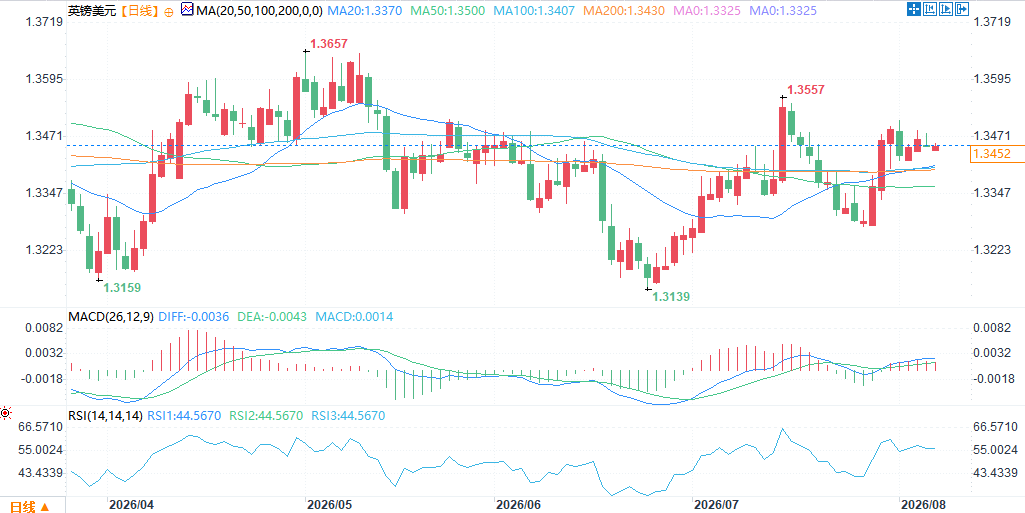 (GBP/USD daily chart, source: FX678) At 15:08 Beijing time on August 7, GBP/USD was trading at 1.3448/49.
Narrowing interest rate differentials weaken support for the pound.
Analysts from well-known institutions point out that "fundamentals seem to be providing less support for the pound," with the narrowing spread between UK and US Treasury yields directly weakening the pound's short-term outlook. A narrowing yield spread means a decrease in the relative attractiveness of holding pound assets, and capital flows may further favor the dollar. However, analysts also emphasize that "market sentiment is still improving." Market participants are gradually downplaying the uncertainty brought about by the recent political transition. New Prime Minister Burnham's commitment to fiscal responsibility "seems much stronger than expected," a signal that has to some extent offset the drag from the narrowing yield spread, providing sentiment-based support for the pound. If fiscal discipline continues to be implemented, the pound may maintain relative resilience despite fundamental pressures.The rebound in oil prices reignited concerns about stagflation.
Crude oil prices rebounded sharply by over 3% on Thursday, regaining ground above $82 per barrel, quickly reigniting market concerns about the coexistence of sticky inflation and weak growth in the UK, putting the Bank of England back in a classic "stagflation" predicament. This shift directly tests the Bank of England's stance at last week's monetary policy meeting. Governor Bailey downplayed the need for further interest rate hikes, stating that he remained confident in the UK's de-inflation process even amid rising geopolitical uncertainty. The rapid rebound in oil prices is challenging this assessment. If energy prices continue to rise, imported inflationary pressures could resurface, undermining recent gains in inflation. The Bank of England will face a deeper policy dilemma between "supporting fragile economic growth" and "curbing resurgent inflation," and the market's pricing of its future interest rate path may be readjusted accordingly.Geopolitical risks boost safe-haven dollar
The escalating tensions in the Strait of Hormuz have severely shaken global market stability expectations, prompting a rapid return of safe-haven funds to dollar assets. The Iranian parliament is assessing a key draft bill to ban US and Israeli vessels from passing through the strait and impose a 20% fine on cargo from vessels of so-called "hostile" countries, while maintaining the restrictions until the US lifts its blockade. If this draft bill makes substantial progress, global energy transport and trade routes will face greater uncertainty, with oil price volatility and supply chain risks rising simultaneously. Against this backdrop, market risk aversion has clearly intensified, with investors favoring the dollar as a traditional safe-haven currency, further strengthening the upward momentum of the dollar index. As a highly risk-sensitive currency, the pound sterling is unlikely to perform well in the short term due to the combined pressure of a stronger dollar and geopolitical premiums. If the situation in the strait deteriorates further, the pound sterling may continue to face pressure against the dollar, and exchange rate volatility will increase accordingly.Fed official's speech: Musslump sends hawkish signals
St. Louis Federal Reserve President Mossall gave a slightly hawkish signal on Thursday. His speech, rated slightly above historical averages, emphasized the risk of "de-anchoring" even though inflation expectations are currently aligned with the 2% target. Mossall focused on core inflation amid energy volatility, favored a gradual approach to rate hikes, and assessed core inflation as likely to be between 2.5% and 3%. He also stated that it is sometimes acceptable for central banks to act unexpectedly—implying a willingness to prioritize policy mandates over market expectations.Summarize
The narrowing spread between UK and US Treasury yields weakened the pound's fundamental support, while a rebound in oil prices reignited stagflation concerns, and escalating geopolitical risks drove safe-haven flows back to the US dollar. Iran's review of the draft ban on Hormuz further boosted market risk aversion. Moussalon's remarks released a hawkish signal, reinforcing expectations that the Federal Reserve would maintain its tightening stance. The market is awaiting the US non-farm payroll report for clearer direction. Under the triple pressure of narrowing yield spreads, stagflation concerns, and geopolitical risks, the pound still faces downside risks in the short term. The market is focused on whether the non-farm payroll data can provide a respite for the pound or further exacerbate its decline. (GBP/USD daily chart, source: FX678) At 15:08 Beijing time on August 7, GBP/USD was trading at 1.3448/49.
- Risk Warning and Disclaimer
- The market involves risk, and trading may not be suitable for all investors. This article is for reference only and does not constitute personal investment advice, nor does it take into account certain users’ specific investment objectives, financial situation, or other needs. Any investment decisions made based on this information are at your own risk.