With the trilateral defense agreement finalized, the gold market is now trading on an even bigger variable.
2026-08-07 20:28:53
On Friday, August 7th, spot gold continued its strong performance this week, rising to around $4330 per ounce at one point, and is on track for its strongest weekly performance since January. Meanwhile, Saudi Arabia, Turkey, and Pakistan signed a joint defense agreement in Mecca that day, explicitly stating that an armed attack against any one of them would be considered an attack against all three, further extending regional security cooperation from bilateral arrangements to multilateral mechanisms. 
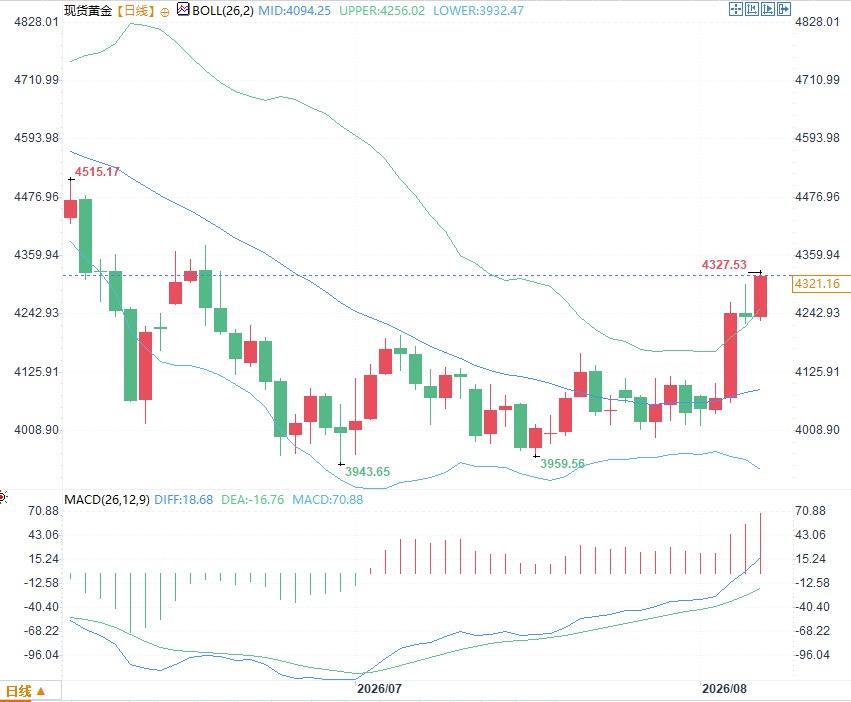 However, from a technical perspective, the increased volatility becomes significantly more important after the price deviates further from the Bollinger Middle Band. A break above the upper Bollinger Band only indicates that the recent price movement is faster than previously estimated; it doesn't independently determine the direction. A rapid expansion of the MACD histogram also signifies strengthening trend momentum and increased market sensitivity to news regarding employment, interest rates, and regional security.
With the trilateral defense agreement finalized, gold trading resumes with a regional security premium.
The signing of a joint defense agreement between Saudi Arabia, Turkey, and Pakistan is a notable event in the recent shifts in the Middle East's security structure. The core of the agreement is not simply an increase in military cooperation projects, but rather the inclusion of clauses with a collective defense nature. This means that any armed attack against one of the countries will be considered an attack against all three. Public reports indicate that this arrangement builds upon previous bilateral defense cooperation between Saudi Arabia and Pakistan, with Pakistani military forces already deployed to Saudi Arabia in April of this year according to the relevant agreement. The significance of this change for the gold market lies in the fact that regional risks are beginning to evolve from single conflict events to a restructuring of the security system. Short-term military events typically affect gold prices through safe-haven demand, while changes in defense alliances, shipping security, and energy infrastructure protection mechanisms can influence the market's repricing of the duration and probability of tail risks. Especially given the continued uncertainty surrounding Red Sea shipping, Saudi energy facilities, and surrounding military activities, the gold risk premium can no longer be simply explained by a single attack or ceasefire announcement. The market is more concerned about whether the conflict will affect energy transportation, insurance costs, shipping routes, and the pricing of regional asset risks.Gold breaks through 4300, with macro funds and safe-haven funds showing a convergence.
Spot gold has now broken through $4,300, a significant rise from earlier this week. The daily chart also shows that this price correction is not a simple one-day impulse. The Bollinger Band middle line is around 4094.25, and the upper Bollinger Band is around 4256.02; the price has already moved to the outside of the upper band. The MACD indicator shows a DIFF of approximately 18.68, a DEA of approximately -16.76, and a histogram value of approximately 70.88, reflecting a significant increase in recent price momentum. However, from a technical perspective, the increased volatility becomes significantly more important after the price deviates further from the Bollinger Middle Band. A break above the upper Bollinger Band only indicates that the recent price movement is faster than previously estimated; it doesn't independently determine the direction. A rapid expansion of the MACD histogram also signifies strengthening trend momentum and increased market sensitivity to news regarding employment, interest rates, and regional security.The Fed's expectations are still fluctuating.
The rise in gold prices is not entirely driven by regional news. Recent US labor market data has shown some divergence. There is no completely consistent signal among job growth, job openings, and private sector employment indicators, leaving interest rate expectations without a stable anchor. For gold, what truly matters is not a single non-farm payroll figure, but how the data alters real interest rate expectations. If the combination of employment, wages, and unemployment rates leads the market to readjust the Fed's policy path, the dollar and US Treasury yields may change in tandem, further impacting the cost of holding gold. Therefore, gold is currently effectively subject to two pricing systems simultaneously: one based on a safe-haven premium stemming from regional conflicts, shipping, and energy security; and the other based on financial pricing formed by employment data, inflation expectations, and real interest rates. When these two systems move in the same direction for a period, market volatility tends to amplify significantly.Market focus is shifting from event risk to the duration of risk.
What traders should pay more attention to in this trilateral defense agreement is that regional countries are establishing a more institutionalized security cooperation mechanism. If this cooperation continues to expand, its impact will extend beyond the military sphere, potentially encompassing Red Sea escort missions, energy infrastructure security, air defense systems, and military procurement. However, for the gold market, institutionalized security cooperation has a two-way meaning. On one hand, it indicates that regional participants remain highly vigilant about potential risks, thus providing a realistic basis for risk premiums. On the other hand, if the new security mechanism can reduce the probability of sustained shocks to key shipping lanes and energy facilities, some extreme risk premiums may be reassessed. At 20:25 Beijing time, spot gold was trading at $4311 per ounce.- Risk Warning and Disclaimer
- The market involves risk, and trading may not be suitable for all investors. This article is for reference only and does not constitute personal investment advice, nor does it take into account certain users’ specific investment objectives, financial situation, or other needs. Any investment decisions made based on this information are at your own risk.