Weekly Forex Review: A Historic Collaboration Shakes the Currency Market? The Yen Retraces After a Surge, Unexpectedly Weak Non-Farm Payrolls Data Sends the Dollar to a Seven-Week Low.
2026-08-08 11:58:53
The first week of August saw a rare storm in the global foreign exchange market. The USD/JPY pair rebounded sharply from near a 40-year low of 163 to 157.5 last week, supported by strong intervention from the US and Japan—the first such intervention since 1998. However, this intervention, described as "historic" by the market and involving over $100 billion, faced a severe test within a week—the yen gave back nearly half of its gains after rising to 155.22 on Monday and entered a period of volatility this week. The US dollar index, impacted by weak non-farm payroll data, fell for the second consecutive week, hitting a seven-week low of 7 points. Meanwhile, easing geopolitical tensions in the Middle East led to widespread gains in non-US currencies, with the euro, Australian dollar, and Canadian dollar all reaching higher levels than a month and a half ago. 
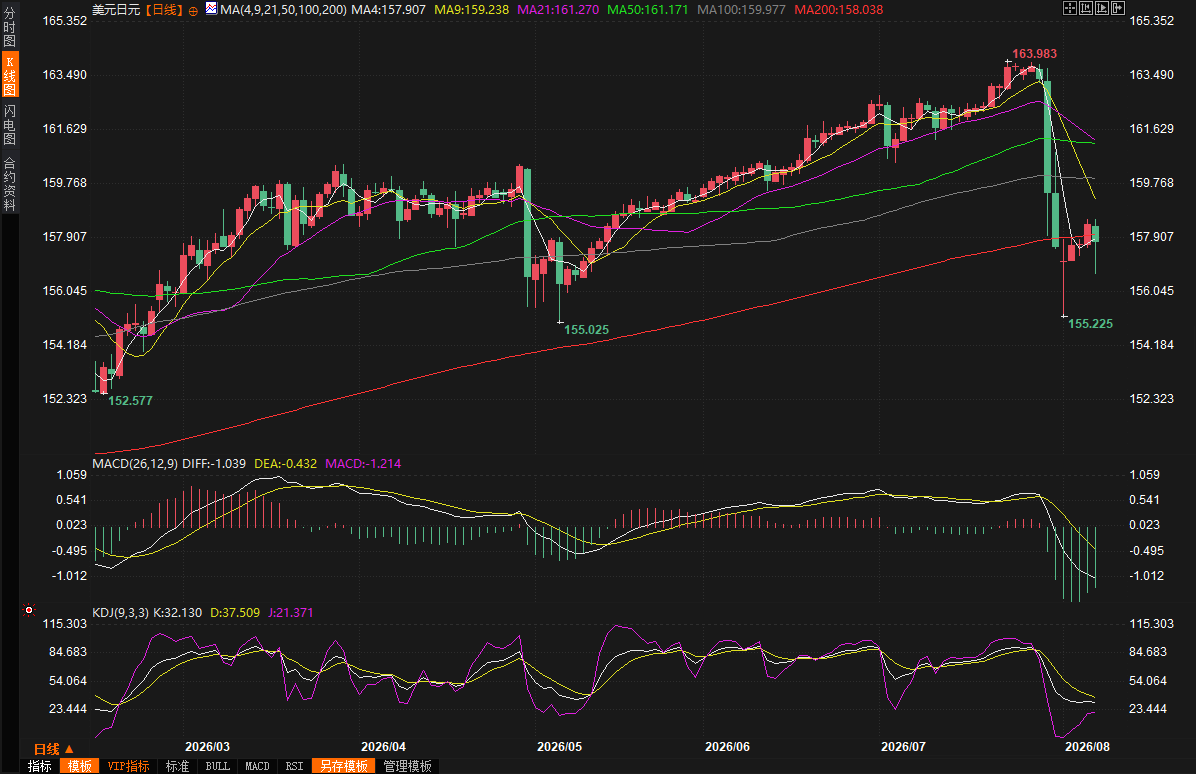 (USD/JPY daily chart, source: FX678)
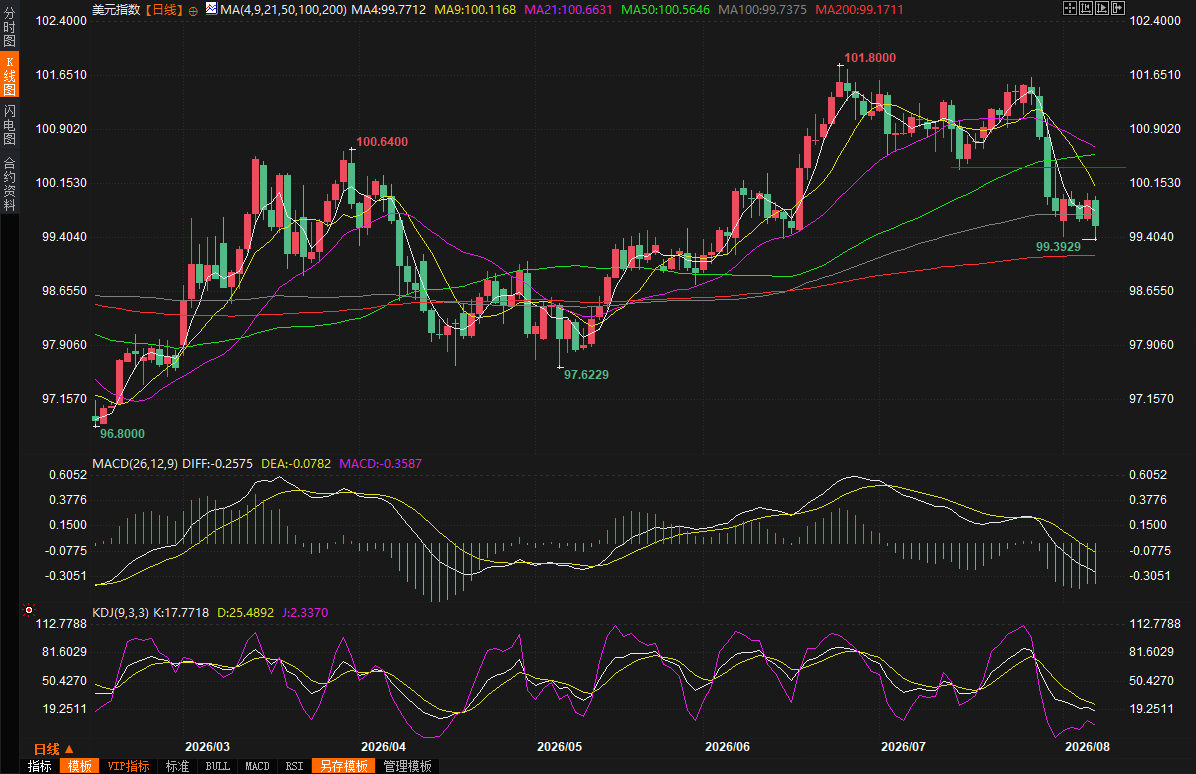 (US Dollar Index Daily Chart, Source: FX678)
I. A Historic Alliance: The US and Japan "Spare No Effort" to Support the Yen
The core theme of the foreign exchange market this week was undoubtedly the unfolding effects of the joint US-Japan intervention in the yen's exchange rate. The incident stemmed from the yen's continued collapse. Just a week before the intervention, the USD/JPY exchange rate touched a 40-year low of 163.8, and net short positions in the yen had increased nearly fourfold in five months. Faced with the disorderly depreciation of the yen, Japan's Ministry of Finance intervened first last Thursday (July 30th) before the release of US PCE data, using approximately 8.45 trillion yen to intervene in the market, causing the USD/JPY exchange rate to fall from 163.7 to below 158. Subsequently, the US Treasury Department unusually joined the fray. This Monday (August 3rd), Japan's Ministry of Finance officially confirmed that it had conducted a joint foreign exchange intervention with the US last Thursday and Friday, buying yen. Data released by the Bank of Japan shows that Japan may have spent as much as $36.58 billion to buy yen in the most recent intervention, bringing Japan's total expenditure on foreign exchange interventions this year to over $100 billion. Even more shocking to the market was the attitude of the United States. US Treasury Secretary Bessant not only confirmed the joint action but also stated in an interview that the Trump administration would support Japan's currency market stabilization "at all costs." This statement echoed former European Central Bank President Draghi's famous promise to "do everything possible," sending a strong policy signal. The intervention was also highly unusual in its operation. Unlike previous joint interventions, the US Treasury did not directly sell dollars but instead sold euros from its foreign exchange reserves to buy yen. This move surprised the market. Brooks, a senior fellow at the Peterson Institute for International Economics, pointed out that this "indirect approach" weakened the effectiveness of the US intervention because the market would question why the US didn't directly sell dollars to support the yen. Bessant explained that the sale of euros was merely a reallocation of reserve assets. Regardless of the motive, this operation objectively avoided sending a signal to the market that it "hoped for a broad weakening of the dollar."II. Doubts about the effectiveness of the intervention: Hundreds of billions invested, but the rebound was short-lived?
Driven by the strong intervention from the US and Japan, the yen did indeed experience a rapid rebound. The USD/JPY pair was pushed down from above 163 to a three-month high of 155.22. However, the market's "lack of enthusiasm" quickly became apparent. The impulsive rise brought about by the intervention failed to last. After reaching a high near 155.22 on Monday, the yen began to gradually decline. By Thursday, the USD/JPY had risen for the third consecutive trading day, closing at 158.40, recovering some of the losses recorded due to the intervention. However, with the release of dismal non-farm payroll data, the yen rebounded again on Friday. By the close of trading in New York on Friday, the USD/JPY closed at 157.78, a slight increase of about 0.10% for the week. Does the impact of the multi-billion dollar intervention seem to have ended? Analysts generally believe that the fundamental reason lies in the fact that the yen's weak fundamentals have not changed. The Bank of Japan is still maintaining the most accommodative monetary environment among developed economies, with negative real interest rates. UBS strategists pointed out that "Japan's current policy mix is unlikely to support a sustained strengthening of the yen; the yen's support comes more from intervention expectations than from domestic monetary fundamentals." HSBC also emphasized that the key to the continued strength of the yen lies in the structural shift in the Bank of Japan's policy framework. Jeremy Stretch, Head of G10 FX Strategy at CIBC, bluntly stated that the phrase "treating the symptoms, not the root cause" is very apt for this intervention. Unless the Bank of Japan raises interest rates more aggressively, the market lowers its expectations for Fed rate hikes, or oil prices fall sharply, intervention is unlikely to change the long-term trend. (USD/JPY daily chart, source: FX678)III. The US Dollar Under Pressure: From the Wounds of Intervention to the Pain of Non-Farm Payrolls
The US dollar's situation is equally precarious. This week, the dollar index has been hit by a double whammy – it has to withstand passive selling pressure from the intervention in the yen and also face the blow of weak domestic economic data. The intervention itself put pressure on the dollar. Due to the US buying yen by selling euros, coupled with market expectations of continued joint US-Japan intervention, the dollar index hit a one-and-a-half-month low on Monday. In the following days, although the dollar index stabilized somewhat, it failed to effectively return above the 100 mark. The real fatal blow to the dollar came from Friday's release of the US July non-farm payrolls report. The data showed that the US economy unexpectedly lost 23,000 jobs in July, while the market had expected an increase of 80,000. Even more worrying was the significant downward revision of the job growth data for the previous two months. Although the unemployment rate fell to 4.1%, the labor force participation rate fell to 61.4%, close to a five-and-a-half-year low. This far worse-than-expected report was described by Thierry Wizman, global foreign exchange strategist at Macquarie Group, as a major upset that "nobody really expected." After the data release, market expectations for a Fed rate hike cooled sharply. According to CME's FedWatch tool, the market's expectation that the Federal Reserve will keep interest rates unchanged in September jumped from 45% before the data release to 56%, while the probability of a rate hike fell to 44%. U.S. Treasury yields fell sharply in response, with the two-year Treasury yield dropping 4.2 basis points to 4.245%. The dollar index fell 0.36% to 99.59 on Friday, a cumulative decline of 0.21% for the week, marking its second consecutive week of weakness. It touched a low of 99.39 during Friday's session, hitting a new low in one and a half months. (US Dollar Index Daily Chart, Source: FX678)IV. Divergence among non-US dollar currencies: Euro strengthens, Pound fluctuates
Amid a generally weakening US dollar, non-US currencies showed mixed performance. The euro emerged as one of the winners this week. The euro closed at 1.1557 against the dollar on Friday, up 0.3%, and approximately 0.16% for the week. The euro briefly touched a one-and-a-half-month high of 1.1580 this week. The euro's strength benefited from both the weaker dollar and the easing of concerns about inflation in energy-dependent economies due to falling oil prices. However, the euro repeatedly encountered resistance near the 100-day moving average of 1.1568, and its short-term upside potential remains to be seen. The pound's performance was relatively flat. The pound traded within a narrow range of 1.3400 to 1.3500 against the dollar this week. It closed at 1.3490 on Friday, essentially unchanged from Friday's close. The market awaits further guidance from UK economic data and the US non-farm payroll report. In other currencies, the Australian dollar held above 0.7000 against the US dollar this week before trending higher, reaching a high of 0.7077 on Friday, a new high in nearly a month and a half, before closing at 0.7064, a weekly gain of approximately 0.36%. Geopolitically, the ongoing tensions between the US and Iran remain a potential source of disruption in the foreign exchange market. News that Iran planned to ban US and Israeli ships from passing through the Strait of Hormuz initially triggered market concerns, but the uncertainty surrounding the negotiation process kept investors cautious.V. Outlook for Next Week: Inflation Data to Follow, Intervention Uncertain
Looking ahead to next week, the focus of the foreign exchange market will shift to the US July CPI and PPI data. Following the unexpectedly weak non-farm payrolls data, inflation data will be a key piece of the puzzle in determining whether the Federal Reserve will raise interest rates in September. If inflation data also shows signs of cooling, market expectations for a Fed rate hike may weaken further, and the dollar index may face greater downward pressure. Conversely, if inflation remains stubborn, the suspense surrounding a Fed rate hike will continue, and the dollar may get a breather. Regarding the yen, the suspense surrounding intervention is far from over. Morgan Stanley's foreign exchange strategists have turned bearish on the yen, believing that the intervention's effect is short-lived, and unless further coordinated intervention measures are introduced, the USD/JPY will gradually rise. The market generally believes that the 155 level is a key watershed for determining whether this round of yen rebound can be sustained. Once the exchange rate falls below 155 again, the risk of a short squeeze on the yen will significantly increase. However, if the exchange rate repeatedly fluctuates in the 157-158 range and then chooses to break upwards, it means that this round of intervention may have ended temporarily, and the USD/JPY will retest 160 or even the previous high. In addition, the Reserve Bank of Australia will announce its interest rate decision, and the Norwegian central bank will also hold its policy meeting. Geopolitically, the progress of US-Iran negotiations will continue to affect market sentiment. For forex investors, at this critical juncture of policy intervention and fundamental competition, remaining vigilant and closely following data and policy signals may be the best strategy to navigate the current complex situation.Summarize
The first week of August in the foreign exchange market began with a historic joint intervention by the US and Japan, and ended with a surprising US non-farm payroll report. The yen's rebound, supported by hundreds of billions of dollars in funds, ultimately failed to escape the pull of fundamentals; the dollar, battered by both the intervention and the disappointing non-farm payroll data, weakened for the second consecutive week. This "yen rescue" operation once again confirms a simple truth: foreign exchange intervention can alter short-term rhythms, but it's difficult to reverse long-term trends. Next week's inflation data and statements from central banks will provide new directional clues for the market.- Risk Warning and Disclaimer
- The market involves risk, and trading may not be suitable for all investors. This article is for reference only and does not constitute personal investment advice, nor does it take into account certain users’ specific investment objectives, financial situation, or other needs. Any investment decisions made based on this information are at your own risk.