The Middle East situation is on a rollercoaster! Crude oil prices plummeted by over 10% in a week, with negotiations in the Strait of Hormuz becoming the biggest variable.
2026-08-08 13:34:53
International oil prices experienced a dramatic decline this week. Fueled by rising expectations of easing geopolitical tensions in the Middle East, oil prices initially plummeted, hitting a near three-week low mid-week. A strong rebound followed in the latter half of the week, but ultimately failed to recover lost ground. By Friday's (August 7) close, WTI crude oil had fallen 11.2% for the week, closing at $77.08 per barrel, after hitting a low of $74.24 per barrel on Wednesday, a new low since July 13. Brent crude oil fell 9.44% for the week, closing at $88.22 per barrel, after hitting a low of $78.10 per barrel on Wednesday, also a more than three-week low. Throughout the trading week, market sentiment oscillated between hopes for diplomatic progress and fears of renewed conflict, causing significant price fluctuations and fully demonstrating the current high sensitivity of the international oil market to the situation in the Strait of Hormuz. 
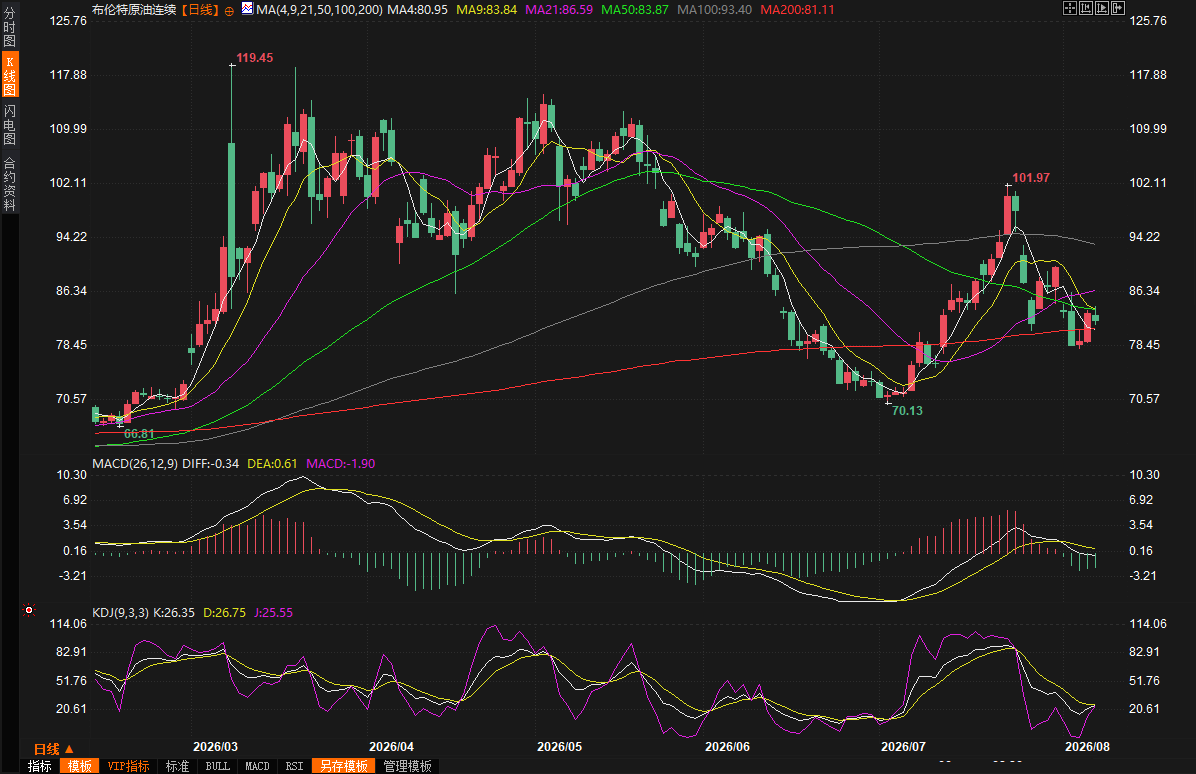 (US crude oil daily chart, source: FX678)
Progress in negotiations fueled expectations of easing tensions, causing oil prices to plummet by more than 5% on Tuesday.
At the beginning of this week, the most significant driver of the market was the significantly increased hope that the US and Iran could resolve the conflict through diplomatic means. On Tuesday (August 4), oil prices plummeted by more than 5%, both hitting three-week lows. Brent crude futures closed down $4.41, or 5.3%, at $79.36 per barrel; WTI crude futures fell $4.57, or 5.7%, to $75.77 per barrel. The key news driving the decline came from statements by US officials. US Secretary of State Rubio stated that negotiations with Iran and Oman on allowing more ships to pass through the Strait of Hormuz had made progress, although no final agreement had been reached. Treasury Secretary Bessant also revealed that an agreement on reopening the strait could be reached with Iran as early as Tuesday or Wednesday. Meanwhile, positive signals came from Qatar. A spokesperson for the Qatari Ministry of Foreign Affairs stated that efforts to resolve the war through diplomatic means were continuing; the Emir's office stated that the Emir had discussed with US President Trump how to de-escalate the situation and facilitate convergence of views between the US and Iran. Brokerage analysts point out that the prospect of a diplomatic solution to the conflict, following the resumption of US bombing of Iran last month, has helped to eliminate some of the geopolitical risk premium in oil prices. If negotiations make substantial progress, the market will further reduce its pricing of supply disruptions, thus continuing to suppress crude oil prices. At the beginning of this week, shipping traffic in the key Persian Gulf waterways of the Bab el-Mandeb Strait and the Strait of Hormuz remained largely stable, which also alleviated market concerns about logistical disruptions to some extent. Goldman Sachs predicts that Brent crude oil prices will remain within the $80 to $90 per barrel range until the prospects for an Iran agreement become clearer or the situation escalates significantly.Oil prices fluctuated on Wednesday as an unexpected increase in inventories mingled with Houthi attacks.
Oil prices were mixed on Wednesday (August 5). Brent crude rose slightly, while WTI crude fell slightly. Investors continued to weigh expectations of a de-escalation in US-Iran tensions, which, if realized, could facilitate the resumption of shipping through the Strait of Hormuz and bring Middle Eastern oil transport back to normal. Brent crude rose 9 cents, or 0.11%, to $79.45 a barrel; WTI crude fell 55 cents, or 0.73%, to $75.22 a barrel. President Trump stated that the US held "all-day talks" with Iran on Tuesday and gave a positive assessment of the negotiations, but also threatened a "fierce" strike against Tehran if no agreement was reached. Iran denied that peace talks were underway, stating that its foreign ministry said Iran and Oman had reached an understanding on how to manage the Strait of Hormuz and were finalizing a joint statement. Analysts cautioned that while the market was optimistic, it remained cautious because such agreements are often fragile, and historically, similar arrangements have rarely been sustained for long. Fundamental data also put some pressure on oil prices. Data released by the U.S. Energy Information Administration showed that crude oil inventories rose by 2.5 million barrels last week to 407 million barrels, far exceeding analysts' expectations of a 1.5 million barrel decrease. The larger-than-expected increase in inventories, particularly in Cushing, Oklahoma, exerted a greater downward pressure on U.S. crude oil. Meanwhile, Red Sea shipping risks limited further declines in oil prices. The Houthi rebels in Yemen, allied with Iran, claimed to have attacked a Saudi oil tanker near the Saudi oil export port of Yanbu. Furthermore, supply disruptions related to the Russia-Ukraine war also affected the Caspian Pipeline Union, Kazakhstan's main oil export route, which suspended operations multiple times this week due to security concerns and tanker shortages.Iran plans to ban US and Israeli ships from passing through the Strait of Hormuz; oil prices rebounded strongly by more than $3 on Thursday.
Oil prices rebounded significantly on Thursday (August 6). Influenced by news that an Iranian parliamentary committee was reviewing a bill, Brent crude closed up $3.04, or 3.83%, at $82.49 per barrel; WTI crude rose $2.07, or 2.75%, to $77.29 per barrel. Reports indicated that Iranian lawmakers revealed the parliamentary committee was reviewing a preliminary bill to ban US, Israeli, and other vessels considered hostile from entering the Strait of Hormuz, and to impose fines of up to 20% of the value of their cargo on violators. Traders said the market remained focused on the US-Iran agreement, and the longer the delay, the more likely oil prices were to recover. Geopolitical risks were also escalating. The Houthi rebels claimed responsibility for missile and drone attacks on "Saudi forces" in Yemen's Marib and Hadramawt regions on Thursday, stating they killed or wounded hundreds of pro-Saudi militants and destroyed military camps, weapons depots, and vehicles. The day before, the Houthi rebels claimed responsibility for missile attacks on Saudi oil tankers off the coast of Yanbu and in the Gulf of Aden, though Saudi Arabia has not yet confirmed this. Meanwhile, Saudi Arabia slightly lowered the official selling price of its flagship crude oil, Arab Light, for September exports to Asia, a price adjustment that reflects, to some extent, changes in market supply expectations. (US crude oil daily chart, source: FX678)Uncertainty remains in negotiations over control of the Taiwan Strait, and oil prices fluctuated on Friday.
Oil prices fluctuated on Friday. Brent crude settled up more than $1 at $83.55 a barrel, a 1.3% increase; WTI crude settled up 89 cents at $78.18 a barrel, a 1.15% increase. However, both crudes closed down about 1.5%. Market focus remained on the uncertainty surrounding negotiations regarding control and reopening of the Strait of Hormuz. Friday's gains, following Thursday's surge, continued this cautiously optimistic sentiment. Analysts pointed out that signals regarding a potential agreement this week caused market sentiment to fluctuate wildly, but the market remains unclear about the specific conditions required for an agreement. For example, will the agreement between Iran and Oman allow ships flying the US flag to pass through the strait? Will it allow US-owned ships or ships bound for US ports to pass through? These questions remain unanswered. It is understood that Iran and Oman have reached an agreement on shipping routes through the Strait of Hormuz between the two countries, but it remains unclear whether the US will agree to these terms. A senior Iranian official stated that Iran is demanding transit vessels pay 5% to 7% of the cargo price, Oman is negotiating a fee of approximately 3%, while Washington hopes for a complete waiver of fees. Industry sources indicate that the proposed agreement faces difficulties in practical implementation due to US sanctions and restrictive insurance clauses regarding payments. US officials, however, have signaled a relatively positive outlook, indicating that an agreement between Iran and Oman is expected soon to resume normal oil shipments. Once an agreement is announced and unimpeded commercial shipping resumes, the US will lift its blockade of Iranian ports, but actions will remain based on actual performance and linked to Iran's fulfillment of its commitments.The regional landscape is shifting as Saudi Arabia and two other countries sign a joint defense agreement.
Besides the direct negotiations between the US and Iran, new developments emerged in the Middle East this week. Saudi Arabia, Turkey, and Pakistan signed a joint defense agreement in Mecca on Friday, aiming to strengthen joint deterrence against aggression. The agreement stipulates that an armed attack on any one of the countries will be considered an attack on all three. Turkey emphasized that the agreement is purely defensive in nature and not directed against any specific country, but its signing comes at a time of escalating tensions with Iran. Meanwhile, under US mediation, Lebanon and Israel reached an agreement on a shortlist of candidate countries for sending troops to verify Hezbollah's disarmament, from which the US will select a country. Analysts also noted signs of a rift between Iranian President Pezechzian and other power centers in the country, potentially complicating peace efforts. In a televised interview, Pezechzian defended his government's policy of negotiating a ceasefire, insisting that most senior military commanders support this path.Summary and Outlook
This week, international oil prices fell sharply amid a tug-of-war between expectations of easing tensions in the Middle East and the risk of renewed conflict. WTI crude fell over 11% for the week, and Brent crude fell nearly 9.5%, fully reflecting the market's high level of attention to the Strait of Hormuz, a crucial choke point for global oil transportation. From Tuesday's sharp drop to Thursday's rebound, oil price movements clearly reflected every subtle change in the progress of negotiations. Goldman Sachs' range forecast and the market's general perception of the fragility of the agreement suggest that oil prices may remain highly volatile, driven by geopolitical news. Looking ahead, the final outcome of the Strait of Hormuz negotiations will continue to dominate oil price direction. If the agreement is implemented and brings about a substantial recovery in shipping, the supply disruption risk premium is expected to further decline, potentially putting downward pressure on oil prices. Conversely, if negotiations stall or regional conflicts escalate again, including risks such as Houthi attacks and Iranian legislative restrictions, oil prices will quickly rise. Meanwhile, changes in US crude oil inventories, adjustments to Saudi official selling prices, and the broader evolution of the regional defense landscape will also provide additional clues to the market. Investors need to closely monitor diplomatic developments between the US and Iran, as well as Oman, and the specific implementation of relevant ship passage arrangements to cope with potentially continued sharp fluctuations.- Risk Warning and Disclaimer
- The market involves risk, and trading may not be suitable for all investors. This article is for reference only and does not constitute personal investment advice, nor does it take into account certain users’ specific investment objectives, financial situation, or other needs. Any investment decisions made based on this information are at your own risk.