













Central banks in major Asian countries have continued gold purchases for 21 consecutive months, reaching a new high in July, demonstrating the underlying support logic for gold.
2026-08-10 10:58:54
The global central bank gold-buying spree continues, with major Asian central banks embarking on a 21-month-long cycle of continuous purchases. Even as gold prices have fallen nearly 30% from their year-to-date highs, they persist in strategically allocating gold assets. With multiple central banks following suit, institutional calculations suggest that the actual size of gold reserves in major Asian countries may be higher than officially disclosed figures. Against the backdrop of currency internationalization, the future demand for gold in these countries still holds significant potential, providing a solid foundation for gold prices to hold the key support level of $4,000 per ounce.
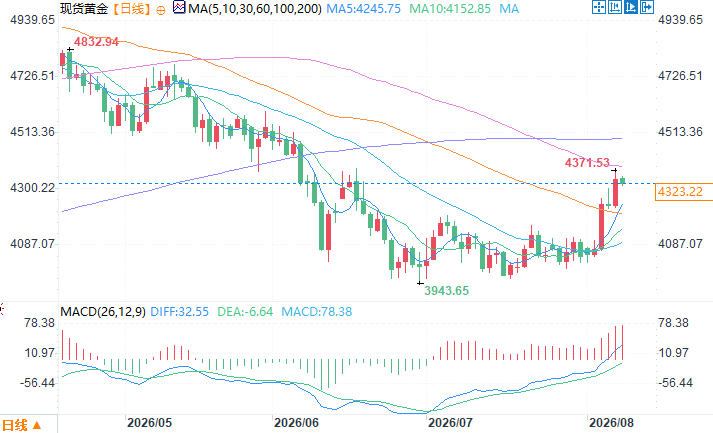 Spot gold daily chart source: FX678. At 10:57 AM Beijing time on August 10th, spot gold was trading at $4320.22 per ounce.
Central banks in many countries have begun increasing their gold holdings, with major Asian countries seeing record high gold purchases in July.
The latest foreign exchange reserve data shows that the central bank of a major Asian country increased its gold holdings by 20 tons in July, the highest monthly increase since October 2023. Since March of this year, the pace of central bank gold purchases has accelerated significantly. Krishan Gopaul, senior analyst for Europe, the Middle East and Africa at the World Gold Council, posted on social media that the country's central bank has made a net increase of 60 tons of gold this year, bringing its total gold reserves to 2,366 tons. Besides the major Asian country, many other central banks around the world are also continuously increasing their gold reserves. Gopaul stated that the Czech National Bank added 1.7 tons of gold last month, moving closer to its 100-ton reserve target, with a cumulative net purchase of 12 tons this year, bringing its current gold reserves to 84 tons. The National Bank of Kazakhstan also completed a gold purchase of over 1 ton, indicating that the global trend of official gold purchases remains unchanged. This continuous official buying has been a key force in helping gold prices stabilize above the key support level of $4,000 per ounce.Institutional estimates suggest that actual gold reserves are higher than publicly available data.
In a research report released at the end of July, BMO Capital Markets commodities analysts identified demand from a major Asian country as a key variable driving gold prices higher in the second half of the year. The analysts stated that the country possesses substantial undisclosed gold reserves, with the latest estimates suggesting that its above-ground gold stocks are significantly higher than official statistics. Currently, the country contributes one-third of global gold demand. Even with these massive gold reserves, the analysts believe that the country's demand for gold will not weaken in the medium to long term, and its reserve size is expected to converge with that of the United States in the future.In the context of currency internationalization, there is still room for gold purchases to rise.
The institution stated that while China has not publicly announced its ultimate target for gold reserves, considering the demands of economic expansion and currency internationalization, reaching the current level of US gold reserves is merely the minimum threshold. A cumulative purchase of 2,500 to 3,000 tons of gold is still required, and depending on the purchase channels, this is expected to be achieved within 2 to 5 years. Furthermore, to further enhance the credibility of the US currency in the global market, the actual allocation target is likely to be even higher. In short , continuous central bank gold purchases are solidifying the bottom of the gold market, and the long-term demand for currency internationalization will continue to drive demand for gold allocation. This means that the structural advantages of the gold market will not disappear for a considerable period. Spot gold daily chart source: FX678. At 10:57 AM Beijing time on August 10th, spot gold was trading at $4320.22 per ounce.
- Risk Warning and Disclaimer
- The market involves risk, and trading may not be suitable for all investors. This article is for reference only and does not constitute personal investment advice, nor does it take into account certain users’ specific investment objectives, financial situation, or other needs. Any investment decisions made based on this information are at your own risk.

