With the Reserve Bank of Australia's decision imminent, the market's real focus isn't on 4.35%.
2026-08-10 17:28:55
On Monday, August 10, the Australian dollar continued to trade above 0.70 against the US dollar. Meanwhile, the latest employment data weakened market expectations for further tightening by the Federal Reserve, and the Reserve Bank of Australia will announce its latest interest rate decision and monetary policy statement on August 11. Therefore, short-term pricing of the Australian dollar is simultaneously affected by the readjustment of interest rate expectations at both ends. 
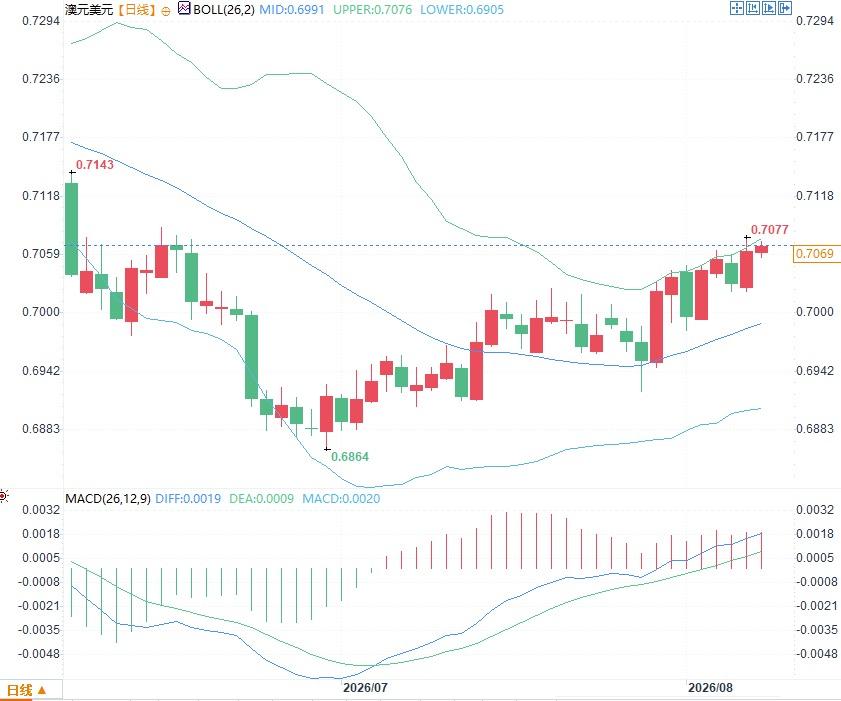 The Bollinger Band structure has changed significantly. The middle band is approximately 0.6991, the upper band is approximately 0.7076, and the lower band is approximately 0.6905. The exchange rate is currently close to the upper band, but the middle band itself has begun to rise, which is different from simply relying on short-term impulses to touch the upper band. Technically, it is more noteworthy that the distance between the price and the middle band is widening, and the Bollinger Bands, which previously narrowed, are beginning to show signs of expanding again, reflecting a recent recovery in volatility.
Cooling employment is altering US dollar interest rate pricing, providing relative interest rate support for the Australian dollar.
The most noteworthy aspect of the latest US employment data is not the monthly job growth itself, but rather the cooling signals simultaneously released by job growth, historical revisions, and labor force participation. July's non-farm payrolls unexpectedly decreased by 23,000, while the data for the previous two months were revised down by a combined 103,000, bringing the three-month average of new jobs added to approximately 20,000. Consequently, the market is reassessing the necessity for the Federal Reserve to continue tightening policy. Latest market pricing indicates that the probability of another rate hike in September has fallen from approximately 67% to around 44%. The internal structure of the employment data is equally important. Although the unemployment rate has fallen to 4.1%, the decline in the size of the labor force means that this change cannot be simply interpreted as a renewed strengthening of the job market. In other words, the current employment data presents a combination of "fewer new jobs but no corresponding rise in the unemployment rate," which is more related to changes in labor force participation than to a renewed expansion of demand. This directly affects the relative interest rate logic that the foreign exchange market focuses on. When policy expectations in the US cool down, while the Australian cash rate remains at a relatively high level of 4.35%, the relative changes in short-term interest rate expectations between the two countries will temporarily reduce the dollar's interest rate advantage. Official data from the Reserve Bank of Australia shows the current cash rate target is 4.35%, effective from June 17th. However, the market has not yet received full confirmation from US inflation. July consumer price data will be released on August 12th, and producer price data on August 13th; therefore, there is still a possibility of further interest rate adjustments triggered by employment data.The Reserve Bank of Australia is entering a policy watch window; the key is not just interest rates themselves.
The Reserve Bank of Australia's (RBA) August monetary policy meeting was held from August 10th to 11th. The market's current focus is not simply on whether the cash rate will change, but rather on how the policy committee will re-described inflation, employment, and the future policy path. The Australian labor market has shown some easing. The unemployment rate remained at 4.4% in June, relatively high in recent years, but employment still increased by approximately 76,000, and the labor force participation rate rose to 67.0%. This means that the labor market has not experienced a rapid, one-way deterioration, but rather that while employment growth remains resilient, labor supply and the unemployment rate are gradually normalizing. Inflation constitutes another constraint in policy decisions. Previously released official data showed that consumer prices rose 4.0% year-on-year in May, while the cut-off mean inflation was 3.6%. The latter is still significantly higher than the RBA's target range of 2% to 3%, so even if the policy committee sees a gradual cooling in the labor market, it needs to determine whether inflation stickiness has truly decreased. Therefore, more noteworthy than the simple interest rate outcome at this meeting are whether there have been adjustments to the latest inflation forecasts, economic growth forecasts, and cash rate path assumptions. Any change in the forecasting framework could affect how the market reprices the upcoming meetings.The technical structure has entered the upper Bollinger Band region; momentum and volatility warrant simultaneous observation.
From the daily chart, the Australian dollar against the US dollar has been rising steadily after forming a low of around 0.6864, and is currently trading around 0.7070, with a recent high of around 0.7077. The Bollinger Band structure has changed significantly. The middle band is approximately 0.6991, the upper band is approximately 0.7076, and the lower band is approximately 0.6905. The exchange rate is currently close to the upper band, but the middle band itself has begun to rise, which is different from simply relying on short-term impulses to touch the upper band. Technically, it is more noteworthy that the distance between the price and the middle band is widening, and the Bollinger Bands, which previously narrowed, are beginning to show signs of expanding again, reflecting a recent recovery in volatility.The real core variable at present is the policy expectation gap between the two ends.
The current Australian dollar/US dollar exchange rate is not driven by a single data point, but rather by a policy expectation gap created by a combination of a cooling US employment market and persistently high Australian inflation. US employment data has weakened previously tight interest rate expectations, but July consumer price data has not yet been released, so the US interest rate path is still in a repricing phase. Australia faces a different scenario: a slightly easing labor market, but core inflation remaining above target. From a market structure perspective, the Australian dollar/US dollar exchange rate has recently completed a significant recovery from its July lows, and the key events affecting volatility going forward are highly concentrated, including the Reserve Bank of Australia's policy decision, the latest monetary policy report, and the subsequent release of US inflation data.- Risk Warning and Disclaimer
- The market involves risk, and trading may not be suitable for all investors. This article is for reference only and does not constitute personal investment advice, nor does it take into account certain users’ specific investment objectives, financial situation, or other needs. Any investment decisions made based on this information are at your own risk.