From a sharp rise to a correction, what kind of expectation reassessment is the crude oil market undergoing?
2026-08-10 17:54:56
On Monday, August 10th, the international crude oil market was undergoing a rapid repricing driven by changes in geopolitical risk expectations, with Brent crude currently trading above $84. Previously, tensions in the Middle East had fueled concerns about disruptions to key shipping routes, pushing up crude oil risk premiums. However, recent negotiations between Iran and Oman regarding shipping in the Strait of Hormuz have alleviated some investors' concerns about supply disruptions. The Strait of Hormuz has long been a crucial node in global energy transportation, with large quantities of crude oil and related energy products passing through the region. Therefore, any news concerning shipping safety, navigation rules, and changes in regional relations can quickly impact energy market risk pricing.  However, the market has not yet fully equated the progress of the negotiations with the elimination of supply risks. This is because the arrangements still involve broader issues, including sanctions adjustments, security guarantees, and other diplomatic conditions. Whether the shipping framework negotiations can be transformed into a long-term, stable mechanism remains highly uncertain.
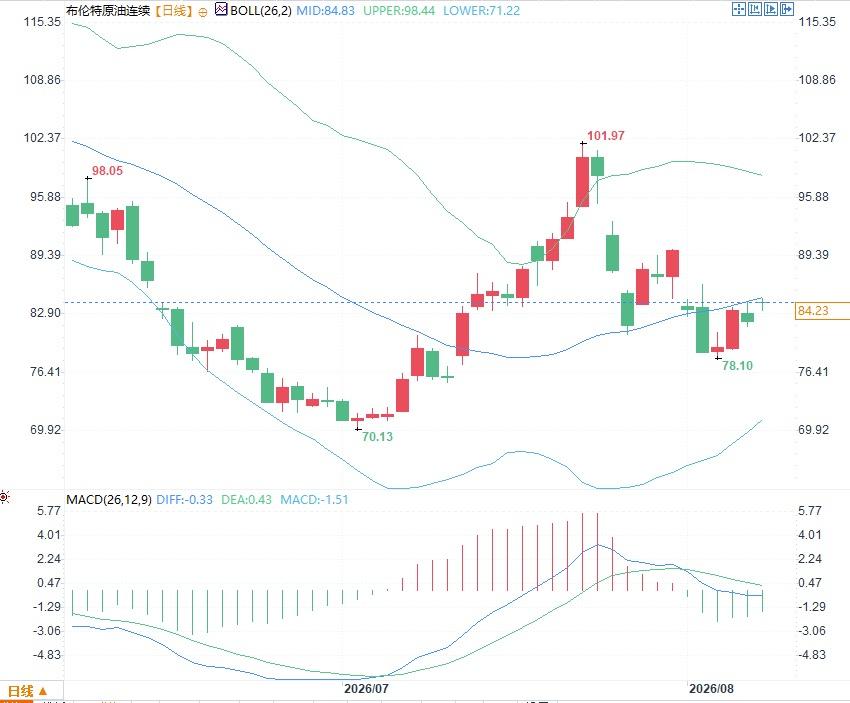 From a market structure perspective, this round of adjustment is not solely driven by changes in demand, but rather reflects a valuation correction following a decline in risk premiums. When the market perceives a decrease in the probability of supply disruptions, the geopolitical risk premium in crude oil prices naturally shrinks. However, the current market focus remains on the actual recovery of shipping, changes in regional relations, and adjustments to the supply policies of major oil-producing countries.
However, the market has not yet fully equated the progress of the negotiations with the elimination of supply risks. This is because the arrangements still involve broader issues, including sanctions adjustments, security guarantees, and other diplomatic conditions. Whether the shipping framework negotiations can be transformed into a long-term, stable mechanism remains highly uncertain.Technical indicators show signs of recovery, and the market is entering a phase of rebalancing between fundamentals and risk sentiment.
Observing the daily chart of Brent crude oil, prices previously experienced a rapid rise, followed by a continuous decline after reaching a temporary high. Currently, prices have returned to near the middle Bollinger Band, and the Bollinger Bands are generally converging, indicating that market volatility has decreased from previous highs. Technically, the MACD indicator, after a pullback from its highs, is currently in a weak consolidation phase, with short-term momentum weakening. Meanwhile, the rebound in oil prices from their lows suggests that the market has not completely turned pessimistic, but rather is seeking balance within a new information framework. From a market structure perspective, this round of adjustment is not solely driven by changes in demand, but rather reflects a valuation correction following a decline in risk premiums. When the market perceives a decrease in the probability of supply disruptions, the geopolitical risk premium in crude oil prices naturally shrinks. However, the current market focus remains on the actual recovery of shipping, changes in regional relations, and adjustments to the supply policies of major oil-producing countries.The logic of supply security has not completely changed, and the outcome of the negotiations still needs to be tested in reality.
The significance of the negotiations regarding the Strait of Hormuz lies not only in short-term oil price fluctuations, but also in its potential to alter the market's long-term assessment of supply security. The market's current cautious stance on the negotiations stems primarily from the clear distinction between technical shipping arrangements and a full resumption of normalcy. Even if some shipping mechanisms reach a consensus, the market still needs to observe actual implementation, including vessel traffic efficiency, changes in insurance costs, and energy companies' risk management strategies. Furthermore, Iran has repeatedly emphasized that any long-term arrangement needs to be integrated with broader conditions. This means the market cannot simply interpret the negotiations as a single shipping issue, but needs to comprehensively consider diplomatic relations, the energy export environment, and regional security factors. From a global energy market perspective, supply risk premiums are typically quite elastic. When risk events escalate, funds quickly factor in potential supply losses; conversely, when risks ease, valuation repair also occurs rapidly. Therefore, the recent adjustment in crude oil prices is essentially a result of the market repricing risk probabilities. Meanwhile, the global crude oil supply and demand fundamentals remain crucial factors determining the medium- to long-term market performance. If supply remains stable while demand growth expectations change, the market may continue to focus on inventory changes, refinery operations, and energy consumption trends in major economies.The energy market has entered a phase of multi-factor interaction, and the focus of investment attention is shifting.
The current crude oil market has moved from being driven solely by geopolitical factors to a stage influenced by multiple variables. On the one hand, the Hormuz negotiations have alleviated some short-term supply concerns, leading to a recovery in market risk appetite; on the other hand, the negotiations are still in a dynamic process, and any new information could re-influence market sentiment. The crude oil market is also affected by global economic growth expectations, policies of major oil-producing countries, inventory changes, and capital flows in financial markets. As geopolitical risk premiums decline, the importance of fundamental factors may increase again. From the perspective of price movement structure, recent fluctuations reflect the market's reassessment of uncertainty. Rapid price increases are usually accompanied by an expansion of risk premiums, while rapid corrections reflect a repricing after a contraction in risk premiums. Key areas to watch in the future include whether the Hormuz shipping arrangements can be continued, whether regional relations will further improve, and whether there will be new changes in the global energy supply system. These factors will collectively determine whether the risk pricing framework of the crude oil market will be further adjusted. At 17:50 Beijing time, Brent crude oil was trading at $84.56 per barrel.- Risk Warning and Disclaimer
- The market involves risk, and trading may not be suitable for all investors. This article is for reference only and does not constitute personal investment advice, nor does it take into account certain users’ specific investment objectives, financial situation, or other needs. Any investment decisions made based on this information are at your own risk.