Is gold ineffective at hedging inflation? Unveiling the truth behind the 0.07 correlation coefficient.
2026-08-10 17:32:54
A recent study published in the *Journal of Investing* has caused quite a stir in the investment community. Scholars at Julep Capital, using empirical data, pointed out that the correlation coefficient between gold prices and inflation data is only 0.07. A correlation of 0.07 is statistically almost equivalent to "no correlation." Based on this data, the report concludes that no matter how investors allocate their positions or time the market precisely, gold cannot effectively hedge against the erosion of assets by inflation. The data seems irrefutable, and there are many supporters in the industry—former Federal Reserve Chairman Ben Bernanke has stated bluntly that gold prices are difficult to use as a leading indicator of inflation, and even he cannot fully understand its pricing logic. However, is this really the case? Is the traditional logic of gold as an inflation hedge merely a "narrative illusion" caused by the market's collective confirmation bias? To answer this question, we first need to clarify: what exactly determines the price of gold? 
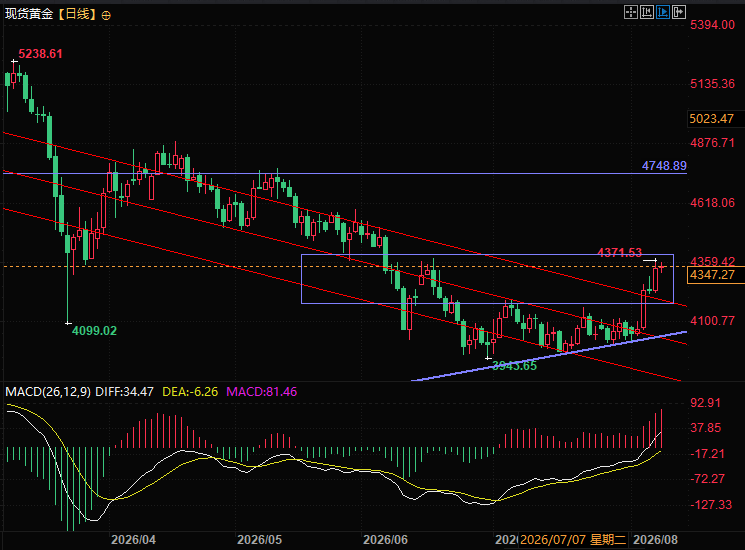 (Spot gold daily chart, source: EasyTrade) At 17:28 Beijing time, spot gold is currently trading at $4346.80 per ounce.
The Underlying Price of Gold: Geopolitical and Credit Games Beyond Single Inflation
Gold is not just an ordinary interest-bearing asset; it possesses the dual attributes of a hard currency free from sovereign credit risk and a hedging tool against extreme tail risk. Simply linking it to the CPI (Consumer Price Index) ignores other key variables affecting gold prices: "De-dollarization" and central bank gold purchases: Taking the Russia-Ukraine conflict as an example, the Western countries' freezing of Russia's foreign exchange reserves and the implementation of the SWIFT ruling shattered the traditional belief that "US Treasury bonds are absolutely safe." This directly spurred a strong de-dollarization motivation among central banks in non-Western countries (such as those in the Middle East and emerging markets), driving a sustained and large-scale wave of central bank gold purchases. Extreme geopolitical risks (such as expectations of World War III): When the market fears that a local conflict will escalate into a global war, the transaction is no longer about a few basis points of interest income, but about the continuation of fiat currency credit. As a globally universal "ultimate means of payment," gold's safe-haven pull is extremely strong. Therefore, gold's pricing mechanism is multi-dimensional. But returning to the issue of inflation itself—why does gold indeed "fail" in some periods, while experiencing super-large price movements in others?Why does gold appear to be "ineffective at fighting inflation" during periods of normal inflation?
The key point is that the pricing center for gold is the "real interest rate" (nominal interest rate minus inflation expectations), not "nominal inflation rate, which is simply CPI data." Taking the recent US-Iran conflict as an example, when the labor market is strong and the economy is at full employment, even if inflation risks rise or remain high, the market expects central banks (such as the Federal Reserve) to have sufficient confidence and leverage to take hawkish action. In this phase: although inflation expectations rise, central banks aggressively raise interest rates to curb inflation; nominal interest rates (US Treasury yields) surge, and the increase exceeds the increase in inflation; ultimately, real interest rates are pushed up, significantly increasing the opportunity cost of holding non-interest-bearing gold, causing funds to flow to high-yield US Treasury bonds or a strong-yielding US dollar. Against this backdrop, although inflation exists, the expectation of central bank interest rate hikes suppresses gold prices, making gold appear "unable to hedge against inflation."The true nature of gold as an inflation hedge: its explosive power in a stagflation environment.
So, under what circumstances can gold truly demonstrate its power as an inflation hedge? The answer is: when the labor market weakens, the economy faces recession, and inflation remains high due to supply-side shocks—a period of stagflation where central banks are "tied up and dare not raise interest rates." A classic historical example: the 1970s oil crisis. In the 1970s, the world was plunged into the shadow of the most famous "stagflation" in history. At that time, the US labor market stagnated, unemployment remained high, and the economic fundamentals were extremely fragile. However, the Middle East oil crisis caused oil prices to soar, pushing up overall inflation. The Federal Reserve was caught in a dilemma: if it forcibly raised interest rates significantly, the already fragile real economy and labor market would collapse directly; if it gave up raising interest rates, inflation would completely spiral out of control. With central banks hesitant to raise interest rates, nominal interest rates could not keep up with the soaring inflation, and real interest rates quickly fell into deep negative territory. As a result, holding cash and bonds resulted in huge purchasing power exploitation every year, and funds flowed into gold. The price of gold skyrocketed from about $35 per ounce in 1970 to $850 per ounce in 1980, an increase of more than 20 times in ten years.Conclusion: The conditions are stringent, not that the function is nonexistent.
Returning to the initial statistical data: Why is the correlation coefficient between gold and inflation calculated by institutions only 0.07? Because gold's role as an inflation hedge is not a "unconditionally effective" normal mechanism; it requires an extremely demanding macroeconomic environment—a combination of "economic recession/deteriorating labor market + soaring supply-side inflation + central bank inaction"—a stagflation scenario. Throughout long economic history: most periods have been "stable economic periods" or "periods of mild inflation where central banks can effectively control inflation through interest rate hikes" (during which gold prices are suppressed by real interest rates); true "stagflation windows" occur infrequently and are relatively short-lived. When decades of stable data are combined with a very small number of "stagflation surges" for statistical calculation, the excess returns of gold in hedging inflation during extreme periods are "diluted" by the lack of correlation in the vast majority of normal periods, ultimately resulting in a low correlation coefficient of 0.07. Therefore, gold is not incapable of hedging inflation, but rather it hedges against the "extreme stagflation risk under conditions of central bank out-of-control and economic stagnation." While simply defining gold as a hedge against conventional inflation is a simplification of market narratives, denying its value preservation and safe-haven function in extreme macroeconomic environments based solely on a cross-cycle correlation coefficient might also underestimate the macroeconomic logic behind this millennium-old hard currency. Recent US labor market data showing a significant easing has led to a 7% weekly rise in gold prices, partially supporting this view. Technically, gold prices are approaching the measured gains from the recent breakout of the trading range and are currently in a strong consolidation phase. Attention should be paid to Wednesday's CPI data; before that, gold prices are likely to maintain their strength. (Spot gold daily chart, source: EasyTrade) At 17:28 Beijing time, spot gold is currently trading at $4346.80 per ounce.
- Risk Warning and Disclaimer
- The market involves risk, and trading may not be suitable for all investors. This article is for reference only and does not constitute personal investment advice, nor does it take into account certain users’ specific investment objectives, financial situation, or other needs. Any investment decisions made based on this information are at your own risk.