Gold prices entered a consolidation phase after breaking out, with bullish sentiment continuing to strengthen.
2026-08-10 18:58:54
From June to July this year, gold prices consistently saw buying interest whenever they fell below $4,000 per ounce, a signal that foreshadowed a larger upward trend, which culminated in a strong breakout in early August. This surge was driven by multiple positive factors, and the subsequent price action will determine whether this breakout can evolve into a sustained bull market.  Multiple positive factors supported the rise in gold prices. The July Federal Reserve meeting released a dovish signal, contrasting with the market's generally hawkish pricing expectations. Before the meeting, the market priced in a one-in-three probability of a rate hike. Although three regional Fed presidents voted in favor of a rate hike, no Fed Board members opposed the dovish stance, leading the market to significantly lower its rate hike expectations and dampening the dollar's upward momentum. Subsequently, the US and Japan jointly intervened in the foreign exchange market to support the yen. The US Treasury and the Japanese Ministry of Finance worked together, further exacerbating the downward pressure on the dollar as the yen strengthened. The World Gold Council subsequently released a report showing a significant surge in central bank gold purchases in the second quarter, with a substantial downward revision of first-quarter central bank gold purchase data also contributing to the increased second-quarter growth. More importantly, reserve management institutions around the world stated that they will continue to increase their gold reserves in the medium to long term, meaning that central bank demand for gold remains solid at current price levels. Gold defies high real yields to rally This round of gold price increases is highly unusual: historically, when the benchmark real yield in the US climbs to the level of late 2023 (the peak yield of the Fed's last aggressive rate hike cycle), gold typically weakens under pressure. However, gold, a non-interest-bearing asset, has not been pressured this time; instead, it has continued to rise, proving that the support from other bullish factors has completely offset the bearish pressure from high real yields. The US dollar is one of the core bullish factors. After the Fed's interest rate meeting and the intervention of the USD/JPY foreign exchange market, the dollar index fell sharply, and the DXY dollar index is currently in a narrow sideways trading range. Key US inflation data will be released later this week, and the short-term consolidation of the dollar will likely cause a brief pause in this gold rally. Technical Analysis
 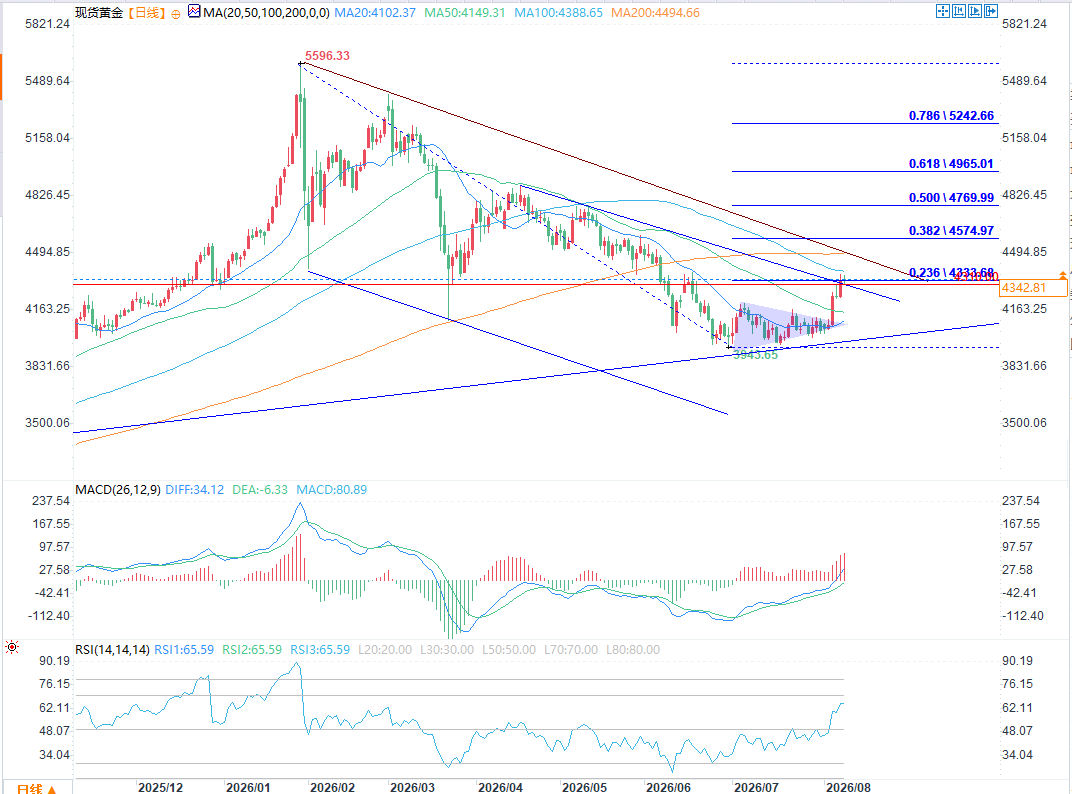 (Spot Gold Daily Chart Source: FX678) Gold prices rose 7% last week, with further upside potential. A break above 4380 would target the 200-period moving average around 4495. Support is seen around 4310. Gold experienced its second-strongest weekly rally this year, surging approximately 7%, breaking out of a triangle consolidation pattern and subsequently reaching a seven-week high of 4371. After a slight opening dip today, bullish momentum is building, potentially breaking through the resistance trendline around 4330. The MACD fast line remains significantly above the slow line, both lines are stable above the zero line, and the red bars are expanding, indicating a clear bullish trend on the daily chart. Price and indicators are rising in tandem without a bearish divergence, and upward momentum continues to be released. The RSI value is 65.29, very close to the 70 overbought threshold, suggesting a potential pullback due to accumulated profits. However, the indicator has also reached a new high alongside the gold price, without a bearish divergence, indicating that the medium-to-long-term upward structure remains intact. Bullish Trading Scenario Forecast: If gold prices stabilize above the 4380 level (a level that acts as resistance against both the 20-week and 50-week moving averages), the next bullish target is the 200-day moving average around 4495. Further upward movement, the 38.2% Fibonacci retracement level at 4574 may hinder further gains. Downside Risk Warning: If gold prices decisively break below the 4310 support level, a new round of selling pressure may emerge.
Multiple positive factors supported the rise in gold prices. The July Federal Reserve meeting released a dovish signal, contrasting with the market's generally hawkish pricing expectations. Before the meeting, the market priced in a one-in-three probability of a rate hike. Although three regional Fed presidents voted in favor of a rate hike, no Fed Board members opposed the dovish stance, leading the market to significantly lower its rate hike expectations and dampening the dollar's upward momentum. Subsequently, the US and Japan jointly intervened in the foreign exchange market to support the yen. The US Treasury and the Japanese Ministry of Finance worked together, further exacerbating the downward pressure on the dollar as the yen strengthened. The World Gold Council subsequently released a report showing a significant surge in central bank gold purchases in the second quarter, with a substantial downward revision of first-quarter central bank gold purchase data also contributing to the increased second-quarter growth. More importantly, reserve management institutions around the world stated that they will continue to increase their gold reserves in the medium to long term, meaning that central bank demand for gold remains solid at current price levels. Gold defies high real yields to rally This round of gold price increases is highly unusual: historically, when the benchmark real yield in the US climbs to the level of late 2023 (the peak yield of the Fed's last aggressive rate hike cycle), gold typically weakens under pressure. However, gold, a non-interest-bearing asset, has not been pressured this time; instead, it has continued to rise, proving that the support from other bullish factors has completely offset the bearish pressure from high real yields. The US dollar is one of the core bullish factors. After the Fed's interest rate meeting and the intervention of the USD/JPY foreign exchange market, the dollar index fell sharply, and the DXY dollar index is currently in a narrow sideways trading range. Key US inflation data will be released later this week, and the short-term consolidation of the dollar will likely cause a brief pause in this gold rally. Technical Analysis (Spot Gold Daily Chart Source: FX678) Gold prices rose 7% last week, with further upside potential. A break above 4380 would target the 200-period moving average around 4495. Support is seen around 4310. Gold experienced its second-strongest weekly rally this year, surging approximately 7%, breaking out of a triangle consolidation pattern and subsequently reaching a seven-week high of 4371. After a slight opening dip today, bullish momentum is building, potentially breaking through the resistance trendline around 4330. The MACD fast line remains significantly above the slow line, both lines are stable above the zero line, and the red bars are expanding, indicating a clear bullish trend on the daily chart. Price and indicators are rising in tandem without a bearish divergence, and upward momentum continues to be released. The RSI value is 65.29, very close to the 70 overbought threshold, suggesting a potential pullback due to accumulated profits. However, the indicator has also reached a new high alongside the gold price, without a bearish divergence, indicating that the medium-to-long-term upward structure remains intact. Bullish Trading Scenario Forecast: If gold prices stabilize above the 4380 level (a level that acts as resistance against both the 20-week and 50-week moving averages), the next bullish target is the 200-day moving average around 4495. Further upward movement, the 38.2% Fibonacci retracement level at 4574 may hinder further gains. Downside Risk Warning: If gold prices decisively break below the 4310 support level, a new round of selling pressure may emerge.- Risk Warning and Disclaimer
- The market involves risk, and trading may not be suitable for all investors. This article is for reference only and does not constitute personal investment advice, nor does it take into account certain users’ specific investment objectives, financial situation, or other needs. Any investment decisions made based on this information are at your own risk.