The fuse of a debt collapse: when the global bond market loses its last cooling tool
2026-08-10 20:22:57
"Although the yen is under Japanese jurisdiction, the chain of risks it brings is a problem faced by the entire world." While the global financial market's attention remains focused on the frequent joint interventions of the US and Japan in the foreign exchange market, a deeper earthquake of greater scale and more complex structure has already been brewing violently in the depths of the global sovereign bond market. Previous articles have discussed how the joint US-Japan intervention was essentially a self-rescue effort by the US. So, what will the global market look like? Let's continue with this installment on the global bond market from the perspective of US-Japan joint intervention. In the past year, long-term government bond yields in major global economies have frequently experienced unexpected "surges," and localized debt crises have intensified. Exchange rate fluctuations are just the tip of the iceberg; the core support of the global financial system—the sovereign debt market—is facing an unprecedented asset repricing storm. 
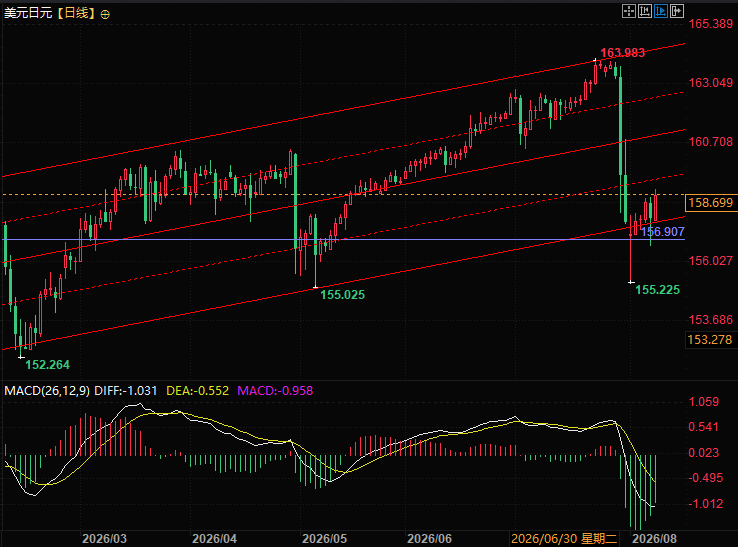 (USD/JPY daily chart, source: FX678) At 20:18 Beijing time, USD/JPY is currently trading at 158.70/71.
Each harboring its own hidden ailments: the endogenous "debt wounds" of major developed economies.
From a macro perspective, the current global bond market downturn is not caused by a single factor, but rather by the concentrated outbreak of internal contradictions in various major economies within the same time window. These countries rely on the same pool of global long-term capital for financing, yet each faces irreconcilable domestic predicaments: In the United States, the fiscal deficit has soared to 6% of GDP, an abnormally high level typically seen only during wartime or deep recessions. Coupled with the dovish stance and lack of clear forward guidance from the new Federal Reserve Chairman, Kevin Warsh, this has greatly fueled market anxiety about a rebound in inflation and policy spiraling out of control. This has directly led to a surge in selling pressure on medium- and long-term US Treasuries, with 10-year and 30-year yields climbing to highs of 4.67% and 5.22%, respectively. In Europe, the UK's fiscal credit rating has plummeted due to the aftermath of Brexit and previous budget turmoil, forcing it to pay higher credit risk premiums and putting pressure on its government bond auctions. Germany, in order to bear the high costs of military reconstruction, has had to break the traditional "fiscal brake" deficit constraint, putting immense supply pressure on its bonds, which were previously considered a "safe haven" in Europe, and passively pushing up yields. Meanwhile, France, caught in the fierce political maneuvering under a polarized political climate, is struggling to implement fiscal austerity measures, prompting strong market doubts about the sustainability of its debt and causing the spread between French and German bonds to widen continuously. These intertwined localized fiscal and political predicaments have collectively pushed national debt to the brink of a dangerous surge in yields. The inherent contradictions of major developed economies worldwide are erupting simultaneously, fundamentally shaking the stability of sovereign debt markets. Under normal circumstances, if global funding is ample, these localized contradictions could be gradually resolved through market mechanisms. However, this time, the supply side of the funding pool has completely changed.Bipolar Reversal: The Collapse and Withdrawal of Marginal Buying in Japan
For decades, Japanese capital has been a key "systemic cooling tool" for maintaining balance in the global bond market despite high deficits. Because the Bank of Japan has long suppressed interest rates to zero or even negative levels, massive amounts of institutional funds from Japanese life insurance companies and pension funds have had to "go overseas" on a large scale to cover liability costs. They borrowed low-cost yen to buy US and European bonds, forming not only the cornerstone of the global yen carry trade but also becoming the most crucial "marginal buyers" (marginal bargaining chips determining marginal pricing) in the US and European sovereign debt markets. This continuous capital outflow is equivalent to providing long-term "implicit financing subsidies" to all sovereign nations with high deficits. However, this balance is being rapidly disrupted: This is evidenced by the fact that the price of essential imported goods such as crude oil, denominated in US dollars, has risen by as much as 50% this year, pushing Japanese inflation above the 2% policy target for four consecutive years, and causing the yen exchange rate to hit a 40-year low. This imported inflation has forced the yen's exchange rate to plummet. During the yen's depreciation, coupled with public debt approaching 230% of GDP, Japanese long-term government bond yields passively surged, with the 30-year JGB yield nearing 4%. From the perspective of Japanese institutions, after deducting exchange rate hedging costs, the 4% yield on 30-year JGBs offered extremely high investment value compared to the 5.2% yield on 30-year US Treasuries, resulting in a capital outflow effect. This led to extremely serious consequences: Japanese capital, which had previously acted as the "footballers" for US and European debt, began to stop replenishing its marginal holdings and even withdrew funds back to Japan. Government bonds purchased with yen faced the risk of being liquidated and sold off. This is one of the reasons why the US sold euros, even though it temporarily pushed up European government bond yields—because rescuing Japanese debt was equivalent to rescuing European debt.Crowding-out effect: The massive AI financing boom fuels the sovereign debt crisis.
While sovereign debt itself lacks buyers, an unprecedented "capital grab" has erupted in the real economy. Tech giants, particularly in the AI industry, are engaged in fierce capital expenditure competition. To raise funds for computing power and infrastructure construction, companies are issuing bonds on a massive scale. Last week alone, Google issued a massive $25 billion debt; in the private debt market, the financing costs for some high-growth tech companies (such as SpaceX) have even been driven up to around 7%. This continuous drain on capital markets and high corporate bond yields are directly diverting extremely scarce long-term liquidity from the market. Corporate bonds attracting funds with high interest rates are forcing sovereign debt issuers like the US Treasury to raise Treasury yields (i.e., lower Treasury prices) to compete for funds. The AI bond issuance boom and the retreat of Japanese buying have created a double whammy, pushing global sovereign bond yields into a more dangerous vicious cycle.Avoiding the real issue and focusing on the superficial: Intervention merely "buys time," the crisis remains fundamentally unresolved.
It was precisely because of the fear that a sharp depreciation of the yen would force Japan to "sell off all its US Treasury bonds" that the joint intervention by the US and Japan adopted an extremely complex compromise—the US sold euros to obtain yen, while Japan borrowed funds through special overseas currency management tools, striving to avoid directly dumping US Treasury bonds. At the same time, the US Treasury had to indirectly inject liquidity into the market through structural optimization of "reducing long-term debt and issuing large amounts of short-term debt," forcibly suppressing the surge in US Treasury yields. However, this merely used crisis diversion to mask the crisis itself; the deep-seated problems causing the global surge in government bond yields remained unresolved.Why would a runaway surge in government bond yields have devastating consequences?
Government bond yields are considered the "risk-free interest rate benchmark" and "pricing anchor" for global financial assets. A disorderly surge in sovereign bond yields can directly trigger a global financial crisis affecting the real economy and the financial system: When government bond yields surge disorderly, it will trigger a chain reaction of crises across the real economy, public finances, and the financial system. First, the surge in government bond yields, serving as the "risk-free interest rate benchmark," will rapidly spread throughout society, leading to a comprehensive increase in borrowing costs for the real economy. This will not only trigger a sharp rise in mortgage rates but also freeze corporate financing channels, potentially pushing highly indebted entities to the brink of bankruptcy. Second, the government will instantly face a severe fiscal interest payment crisis. The exorbitant interest payments will not only severely crowd out public spending on healthcare, infrastructure, and other areas but will also force the government to issue more high-interest bonds to repay old debts, completely trapping it in a vicious cycle of "debt expansion—soaring interest rates—continued bond issuance." Finally, this storm will directly impact the balance sheets of banks and other financial institutions. Their previously held large amounts of low-interest government bond assets will suffer significant impairment, resulting not only in huge unrealized losses but also draining market liquidity, easily triggering systemic bank runs and chain reactions of defaults.Conclusion:
The joint US-Japan intervention in the foreign exchange market successfully prevented the "first domino" from falling due to a disorderly collapse of the yen. However, this intervention did not add a single penny to the global money pool. As Japan ceases to provide cheap funds, as sovereign fiscal deficits continue to expand unchecked, and as AI giants continue to drain market liquidity with high interest rates, the "volcano" of global government bond yields remains on the verge of eruption. This is not a firefighting operation that has ended, but the beginning of a long and extremely dangerous global debt repricing crisis. The current yen's trend is a counterpoint to the global debt crisis. If the yen continues to depreciate significantly, global government bond yields will face significant pressure. Technically, the USD/JPY pair has returned to an upward trend, which is not good news. This means that the yen still faces the risk of further depreciation, and Japanese government bonds may continue to rise. (USD/JPY daily chart, source: FX678) At 20:18 Beijing time, USD/JPY is currently trading at 158.70/71.
- Risk Warning and Disclaimer
- The market involves risk, and trading may not be suitable for all investors. This article is for reference only and does not constitute personal investment advice, nor does it take into account certain users’ specific investment objectives, financial situation, or other needs. Any investment decisions made based on this information are at your own risk.