The yen plunged 40 points intraday before quickly rebounding, as the Bank of Japan hinted at a September rate hike while being pressured by the government to print money and buy bonds.
2026-08-10 20:22:58
On Monday evening (August 10), the USD/JPY pair experienced a brief but sharp decline, falling approximately 40 points to a low of 158.41 before quickly recovering to around 158.67. This volatility occurred against a complex backdrop of rising expectations of a September rate hike by the Bank of Japan (BOJ) and speculation surrounding potential currency intervention. Market consensus, citing sources within the Japanese government, suggested that BOJ Governor Kazuo Ueda's signals of a September rate hike provided a catalyst for coordinated currency intervention, with the US expressing support due to concerns that excessive yen weakness could drive up inflation and global bond yields. However, before the lingering effects of these intervention expectations had fully dissipated, the yen weakened again across the board, pressured by softening Japanese government bond yields, improved risk appetite, and rising oil prices. The current heightened scrutiny of the BOJ's credibility has resulted in a tug-of-war between policy signals and actual price movements in the USD/JPY pair. 
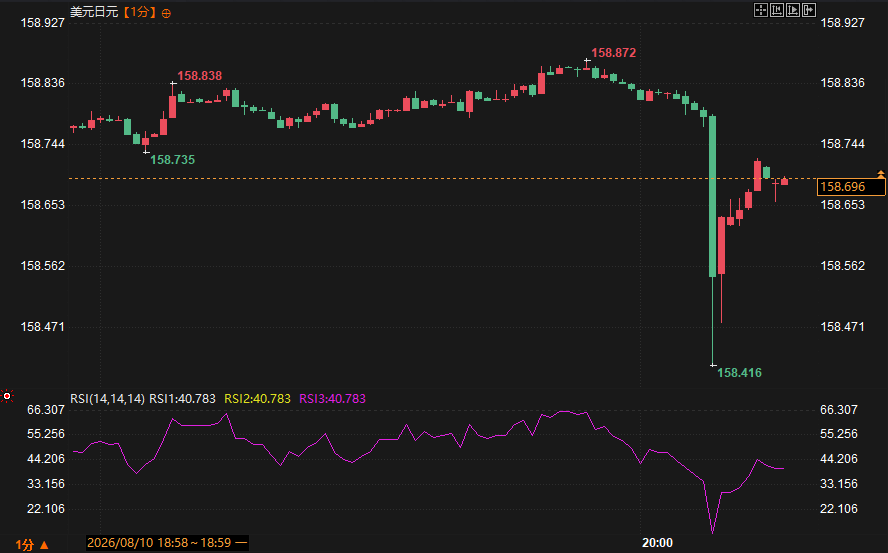 From a technical perspective, the sharp two-way fluctuations of USD/JPY have left a clear trail on the chart. During Monday's session, the brief dip triggered by intervention rumors found support near the 200-day moving average at 158.09 and the psychological level of 158.00 . The strength of buying support in this area will be a crucial test of market sentiment in the near term. The long-tailed candlestick pattern indicates strong buying interest at lower levels, but the risk of continued bullishness remains. On the upside, the next key challenge lies in the turning point near 159.55 . On the downside, support can be seen at the double-top neckline area near 158.55 , followed by the confluence of the 200-day moving average and the psychological level of 158.00. Close attention should be paid to the latest developments regarding the policy game between the Bank of Japan and the government. Any renewed signs of substantial intervention risk could lead the exchange rate to retest the 158.00 support area or even lower.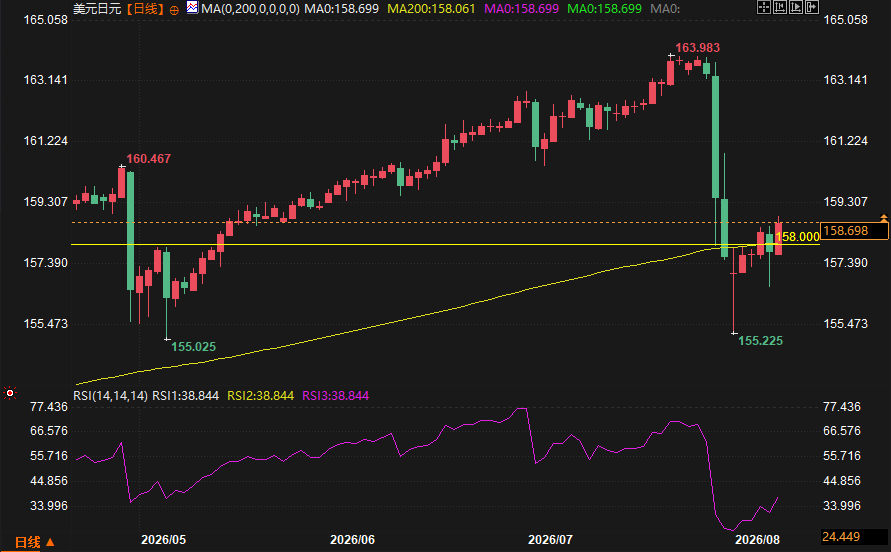
Macroeconomic policy divisions and the struggle for key technological positions
The core contradiction facing the yen stems from the increasingly sharp interplay between the Bank of Japan's efforts to normalize monetary policy and growing political resistance. On the one hand, the summary of opinions from the Bank of Japan's June policy meeting showed that some members supported accelerating the pace of interest rate hikes, and some even discussed the final size of the central bank's balance sheet, demonstrating its firm stance on policy normalization. Kazuo Ueda also explicitly stated that the pace of tightening would be accelerated if necessary, a hawkish signal that directly catalyzed a brief rise in the yen. However, on the other hand, the fiscal expansion policy led by Prime Minister Sanae Takaichi is constraining the central bank. A deep analysis by a well-known institution points out that Prime Minister Takaichi and her "reflationist" aides are highly vigilant about soaring bond yields, even hinting at pressuring the central bank to increase its purchases of government bonds to curb long-term interest rates if necessary. This political pressure was already evident; while raising interest rates in June, the Bank of Japan unexpectedly announced a suspension of its bond-buying program from the next fiscal year, which some analysts interpreted as a compromise with political demands. More seriously, Japan recorded its first current account deficit in nearly 18 months, while business leaders called for exchange rate stability due to the weak yen pushing up import costs, deepening the pressure on the yen from a fundamental economic perspective. Markets are nervously watching whether political intervention will ultimately force the central bank to intervene in bond markets during periods of turmoil, thus completely eroding its credibility for normalization, given that central banks have identified inflation, rather than debt tightening, as the primary driver of rising yields. From a technical perspective, the sharp two-way fluctuations of USD/JPY have left a clear trail on the chart. During Monday's session, the brief dip triggered by intervention rumors found support near the 200-day moving average at 158.09 and the psychological level of 158.00 . The strength of buying support in this area will be a crucial test of market sentiment in the near term. The long-tailed candlestick pattern indicates strong buying interest at lower levels, but the risk of continued bullishness remains. On the upside, the next key challenge lies in the turning point near 159.55 . On the downside, support can be seen at the double-top neckline area near 158.55 , followed by the confluence of the 200-day moving average and the psychological level of 158.00. Close attention should be paid to the latest developments regarding the policy game between the Bank of Japan and the government. Any renewed signs of substantial intervention risk could lead the exchange rate to retest the 158.00 support area or even lower. Short-term policy dynamics will dominate market outlook
In the coming trading days, USD/JPY volatility will heavily depend on the further clarification of the Bank of Japan's policy signals and political reactions . If expectations of a September rate hike receive more credible confirmation, and if the political situation does not substantially erode the central bank's independence, the yen has the potential for a phase of correction, and the exchange rate may repeatedly test the 200-day moving average support. Conversely, if market concerns about fiscal dominance intensify, leading to an irrational surge in Japanese government bond yields and ultimately forcing the central bank to expand bond purchases, the yen may resume its decline, bringing the intervention risk zone above 160.00 back into focus. The growing calls for exchange rate stability from Japanese businesses also make exchange rate volatility itself a potential policy trigger. Overall, the market is currently in a sensitive period where policy narratives and key technical levels intersect, and the direction of the breakout depends on the final outcome of the game between the central bank and the market regarding the pricing of "credibility."Frequently Asked Questions
Why did the yen weaken overall despite the Bank of Japan's (BOJ) signal of an interest rate hike? This reveals a deep-seated market skepticism regarding the BOJ's credibility. While the interest rate hike signal itself is bullish for the yen, the market simultaneously received strong political noise from Prime Minister Sanae Takaichi and her aides pressuring the BOJ to purchase bonds if necessary to suppress yields. This contradictory expectation of "raising interest rates on one hand and buying bonds on the other" weakened the credibility of the tightening policy, causing hesitation among those bullish on the yen and leading to selling pressure after a brief surge in the exchange rate. How will political pressure in Japan specifically affect the BOJ's policy? Political pressure primarily works by influencing the BOJ's balance sheet reduction plan. To finance its massive government debt, the political sphere desires to maintain low interest rates. If bond yields surge due to government expansionary fiscal policy, triggering market turmoil, the political sphere may intensify its lobbying efforts against the BOJ, demanding that it slow down or even suspend the reduction of bond purchases. This would directly conflict with the BOJ's normalization goals and could force the BOJ to passively purchase bonds during market instability, constituting a de facto "fiscal-led" approach. How should the main technical range of the current USD/JPY exchange rate be defined? The current reference contract is USD/JPY spot. On the upside, immediate resistance is at 158.92 , followed by 159.55 . On the downside, initial support forms at 158.55 , with the key support zone being the overlap of the 200-day moving average at 158.09 and the psychological level of 158.00 . Whether this support zone holds or fails is crucial for determining the short-term bullish or bearish trend of the exchange rate. Why is the US stance so important for yen exchange rate intervention? The attitude of the US Treasury is key to the success of coordinated exchange rate intervention. Market information indicates that the US expressed support for potential intervention because it is concerned that excessive yen weakness would transmit to domestic inflation through import prices and potentially push up global bond yields. Without US backing, the effectiveness and market deterrent of unilateral Japanese intervention would be significantly reduced, as unilateral intervention could conflict with the policy directions of major economic partners. What do the two clues—"current account deficit" and "calls from the business community"—tell? These two points reveal, from both macro and micro perspectives, that the negative feedback from the yen's weakness is solidifying. Japan's first current account deficit in nearly 18 months indicates that income outflows have begun to exceed trade and investment inflows, fundamentally weakening the yen's support base. Simultaneously, direct calls from business leaders for exchange rate stability demonstrate that the yen's depreciation has severely eroded profits in the real economy. This means that the struggle surrounding the yen's exchange rate has expanded from the financial markets to broader economic and political dimensions.- Risk Warning and Disclaimer
- The market involves risk, and trading may not be suitable for all investors. This article is for reference only and does not constitute personal investment advice, nor does it take into account certain users’ specific investment objectives, financial situation, or other needs. Any investment decisions made based on this information are at your own risk.