The US dollar index remained range-bound, awaiting guidance from CPI data.
2026-08-11 10:14:54
The US dollar index traded cautiously in Asian trading on Tuesday, failing to extend its gains after the previous session and currently fluctuating narrowly around the 99.75 area. The market is awaiting new catalysts, including the latest developments in the Middle East and the release of US inflation data. In the absence of clear directional signals, investors tend to reduce one-sided bets, and the dollar is temporarily entering a consolidation phase.  The US dollar has recently received some support, mainly due to a rebound in safe-haven demand and a market reassessment of inflationary pressures. Given the significant uncertainty surrounding the situation, investors are again focusing on the volatility of risky assets and increasing their allocation to safe-haven assets such as the US dollar. Meanwhile, the US has rejected compensation claims, arguing that the attribution of responsibility for the losses is disputed; Iran has stated that it lacks the willingness to engage in further negotiations in the near term. These statements have lowered market expectations for a rapid easing of the short-term situation. Against this backdrop, geopolitical risk premiums have returned to the financial market pricing system and become a significant supporting factor for the US dollar recently . Typically, when global markets face increased supply risks and political uncertainty, the US dollar, due to its safe-haven attributes, tends to attract capital inflows. Energy supply concerns have further intensified market focus on inflationary pressures. Uncertainty remains regarding the reopening of key shipping routes, while another important shipping route is also affected by transportation restrictions, leading to a recent rapid rebound in oil prices. Rising energy prices increase the risk of a global inflation rebound and may influence future interest rate decisions by major central banks . For the Federal Reserve, the market is reassessing its future policy path. Previously, the market anticipated continued declines in inflation, prompting a shift towards looser policy. However, if rising energy prices lead to renewed inflationary pressures, the Federal Reserve may need to maintain a restrictive policy environment for a longer period. Market surveys indicate that investors remain focused on the possibility of further interest rate hikes, an expectation that has kept US Treasury yields relatively high and provided support for the dollar. However, the dollar's upward momentum remains limited. Investors have not established large-scale directional positions but are awaiting clearer data guidance. The upcoming US Consumer Price Index (CPI) will be a key focus, followed by the Producer Price Index (PPI), which will further influence inflation assessments. If US inflation data is stronger than expected, the market may re-escalate expectations that the Fed will maintain high interest rates or even further tighten policy, thereby strengthening the dollar. Conversely, if data shows continued easing of price pressures, it could weaken the dollar's upward momentum and prompt the market to refocus on the scope for future interest rate cuts. From a global market perspective, the dollar's trajectory depends not only on US economic data but also on energy prices, risk aversion, and global risk appetite. The market is currently forming a "double support" pattern: on the one hand, the Middle East situation provides safe-haven buying; on the other hand, rising oil prices strengthen inflation expectations, increasing the probability of interest rates remaining high. From a daily chart perspective, the US dollar index has recently formed a consolidation pattern in the 98.50-100 range, and the price is now approaching the 100 level again, indicating that bulls are attempting to regain control. The daily moving average structure has improved, and market momentum is gradually strengthening. If the DXY can effectively break through the resistance area near 100.20, it may further test the 101.00-101.50 area. The key support level to watch is around 99.00; if this area is broken, it may fall back to around 98.50 to find support again. The overall trend is currently biased towards a slightly bullish consolidation, but we still need to wait for macroeconomic data to confirm the direction. Observing the 4-hour chart, the US dollar index is maintaining a high-level sideways trend, and the short-term upward momentum has slowed. Technical indicators show that the market's bullish and bearish forces are approaching equilibrium, and the price is awaiting a new breakout signal. If the US dollar breaks through the 99.90 to 100.20 range, it may open up further upside potential in the short term; however, if it encounters resistance and falls below the 99.40 support level, it may trigger a short-term correction, with a target of the 98.80 area. Short-term trends still depend on US inflation data and changes in risk events.
 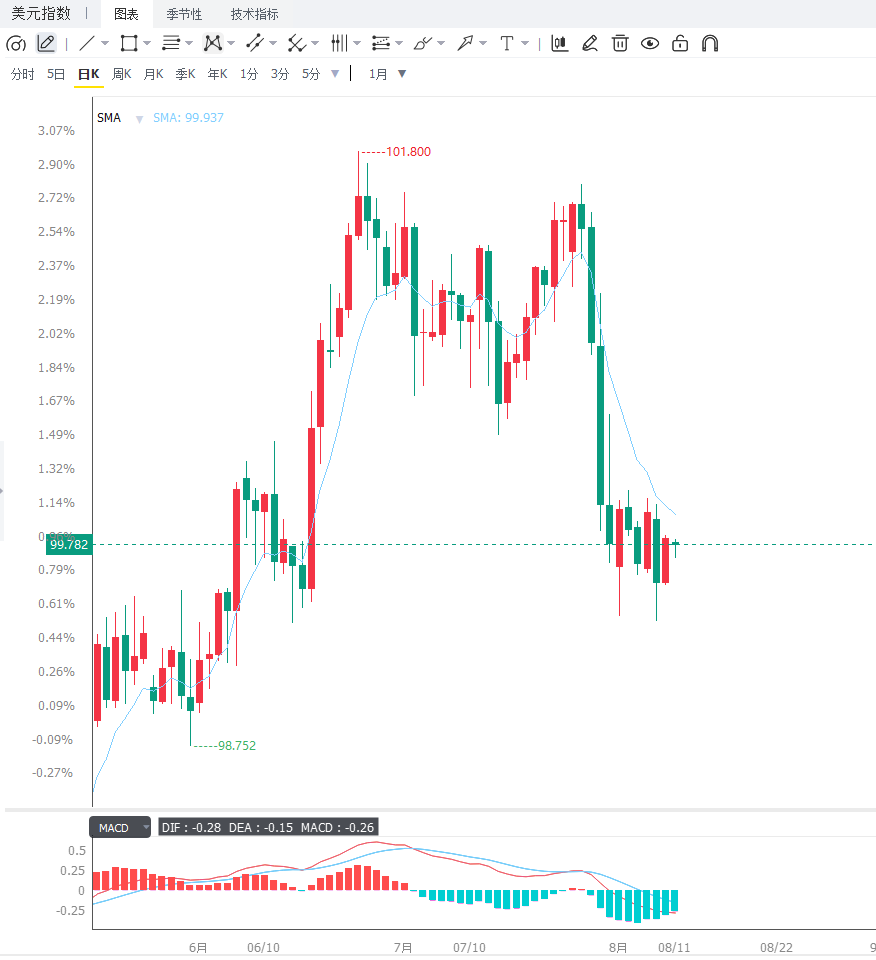 Editor's Summary: The US dollar is currently in a phase of intertwined factors, with safe-haven demand, rising energy prices, and expectations regarding Federal Reserve policy all influencing market direction. In the short term, uncertainty surrounding the Middle East situation continues to support the dollar, while US inflation data will determine whether the market further strengthens expectations of high interest rates. The future direction of the dollar hinges on two variables: whether risk events continue to escalate and whether the downward trend in US inflation can continue. If risk sentiment remains high and inflationary pressures persist, the dollar may continue to maintain its strength; however, if the situation eases and economic data supports expectations of a policy shift, the dollar's upside potential may be limited. Continue to monitor the correlation between macroeconomic data and changes in risk assets.
The US dollar has recently received some support, mainly due to a rebound in safe-haven demand and a market reassessment of inflationary pressures. Given the significant uncertainty surrounding the situation, investors are again focusing on the volatility of risky assets and increasing their allocation to safe-haven assets such as the US dollar. Meanwhile, the US has rejected compensation claims, arguing that the attribution of responsibility for the losses is disputed; Iran has stated that it lacks the willingness to engage in further negotiations in the near term. These statements have lowered market expectations for a rapid easing of the short-term situation. Against this backdrop, geopolitical risk premiums have returned to the financial market pricing system and become a significant supporting factor for the US dollar recently . Typically, when global markets face increased supply risks and political uncertainty, the US dollar, due to its safe-haven attributes, tends to attract capital inflows. Energy supply concerns have further intensified market focus on inflationary pressures. Uncertainty remains regarding the reopening of key shipping routes, while another important shipping route is also affected by transportation restrictions, leading to a recent rapid rebound in oil prices. Rising energy prices increase the risk of a global inflation rebound and may influence future interest rate decisions by major central banks . For the Federal Reserve, the market is reassessing its future policy path. Previously, the market anticipated continued declines in inflation, prompting a shift towards looser policy. However, if rising energy prices lead to renewed inflationary pressures, the Federal Reserve may need to maintain a restrictive policy environment for a longer period. Market surveys indicate that investors remain focused on the possibility of further interest rate hikes, an expectation that has kept US Treasury yields relatively high and provided support for the dollar. However, the dollar's upward momentum remains limited. Investors have not established large-scale directional positions but are awaiting clearer data guidance. The upcoming US Consumer Price Index (CPI) will be a key focus, followed by the Producer Price Index (PPI), which will further influence inflation assessments. If US inflation data is stronger than expected, the market may re-escalate expectations that the Fed will maintain high interest rates or even further tighten policy, thereby strengthening the dollar. Conversely, if data shows continued easing of price pressures, it could weaken the dollar's upward momentum and prompt the market to refocus on the scope for future interest rate cuts. From a global market perspective, the dollar's trajectory depends not only on US economic data but also on energy prices, risk aversion, and global risk appetite. The market is currently forming a "double support" pattern: on the one hand, the Middle East situation provides safe-haven buying; on the other hand, rising oil prices strengthen inflation expectations, increasing the probability of interest rates remaining high. From a daily chart perspective, the US dollar index has recently formed a consolidation pattern in the 98.50-100 range, and the price is now approaching the 100 level again, indicating that bulls are attempting to regain control. The daily moving average structure has improved, and market momentum is gradually strengthening. If the DXY can effectively break through the resistance area near 100.20, it may further test the 101.00-101.50 area. The key support level to watch is around 99.00; if this area is broken, it may fall back to around 98.50 to find support again. The overall trend is currently biased towards a slightly bullish consolidation, but we still need to wait for macroeconomic data to confirm the direction. Observing the 4-hour chart, the US dollar index is maintaining a high-level sideways trend, and the short-term upward momentum has slowed. Technical indicators show that the market's bullish and bearish forces are approaching equilibrium, and the price is awaiting a new breakout signal. If the US dollar breaks through the 99.90 to 100.20 range, it may open up further upside potential in the short term; however, if it encounters resistance and falls below the 99.40 support level, it may trigger a short-term correction, with a target of the 98.80 area. Short-term trends still depend on US inflation data and changes in risk events. Editor's Summary: The US dollar is currently in a phase of intertwined factors, with safe-haven demand, rising energy prices, and expectations regarding Federal Reserve policy all influencing market direction. In the short term, uncertainty surrounding the Middle East situation continues to support the dollar, while US inflation data will determine whether the market further strengthens expectations of high interest rates. The future direction of the dollar hinges on two variables: whether risk events continue to escalate and whether the downward trend in US inflation can continue. If risk sentiment remains high and inflationary pressures persist, the dollar may continue to maintain its strength; however, if the situation eases and economic data supports expectations of a policy shift, the dollar's upside potential may be limited. Continue to monitor the correlation between macroeconomic data and changes in risk assets.
- Risk Warning and Disclaimer
- The market involves risk, and trading may not be suitable for all investors. This article is for reference only and does not constitute personal investment advice, nor does it take into account certain users’ specific investment objectives, financial situation, or other needs. Any investment decisions made based on this information are at your own risk.