Gold hit a near two-month high as the market bets on a Federal Reserve "shift" and whether tomorrow's CPI will "reverse".
2026-08-11 11:04:58
On Tuesday (August 11), spot gold fluctuated higher, currently up over 0.6%, trading around $4415 per ounce. It had previously hit a high of $4435.20 per ounce, its highest level since early June, and is on track for its third consecutive trading day of gains. Last Friday's weak US non-farm payroll report—showing a loss of approximately 23,000 jobs in July and a slight decrease in the unemployment rate from 4.2% to 4.1%—prompted the market to significantly lower its expectations for a Federal Reserve rate hike next month. This decline in interest rate expectations provided key support for gold. Market focus has now shifted to this week's upcoming US inflation data—Wednesday's CPI and Thursday's PPI—both of which will have a decisive impact on the short-term direction of gold prices. 
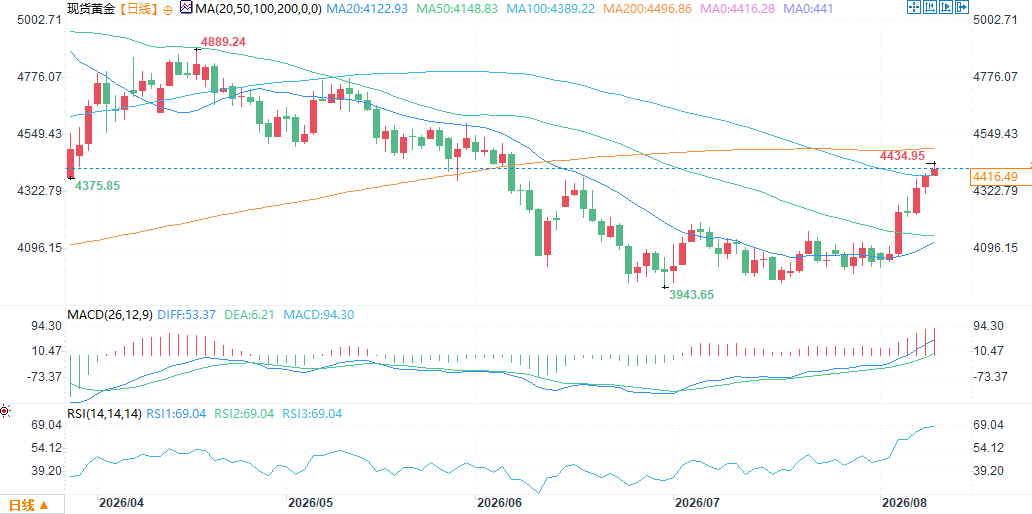 (Spot gold daily chart, source: EasyTrade) At 11:02 Beijing time on August 11, spot gold was trading at $4413.36 per ounce.
Weak non-farm payrolls data reshapes expectations for interest rate hikes
The US non-farm payrolls report released last Friday showed a loss of approximately 23,000 jobs in July, far worse than market expectations, although the unemployment rate slightly decreased from 4.2% to 4.1%. This data significantly dampened previously strong bets on interest rate hikes, and market confidence in further tightening by the Federal Reserve was clearly shaken. It's worth noting that while the Fed kept interest rates unchanged at its July meeting, three officials have publicly dissented and supported a rate hike, clearly indicating that the debate within the central bank regarding its policy stance is far from over, and hawkish voices have not completely subsided. Following the impact of the latest data, the market is now pricing in a 25 basis point rate hike by the Fed in September, which has fallen to about 50%, far below the high levels before the non-farm payrolls report. For gold, the significant decline in rate hike expectations directly reduces the opportunity cost of holding a zero-yield asset, thereby increasing its relative attractiveness and providing additional support for gold prices.Technical Trends and Driving Logic of Gold
Spot gold has risen approximately 3.5% from last week's low, hitting a two-month high. This rally is entirely driven by the repricing of interest rate expectations—there have been no fundamental changes in gold itself, such as supply and demand or geopolitical factors. Instead, the market's assessment of the US monetary policy path is shifting from "hawkish" to "neutral to dovish." Low interest rate expectations are naturally favorable for gold. Since gold itself does not pay interest, when the market expects interest rates to fall further, the opportunity cost of holding this zero-yield asset decreases, increasing its relative attractiveness. This logic has sustained the rise in gold prices over the past few trading days. In other words, the current strength in gold prices is more of a direct reflection of the revision of expectations for Federal Reserve policy than a substantial improvement in gold's own fundamentals. If interest rate expectations subsequently turn hawkish again, the sustainability of this rally will be tested.Inflation data: a key variable for short-term direction
Market focus has shifted to two key inflation data releases this week—Wednesday's CPI and Thursday's PPI. These two figures are crucial for gold holdings: Higher-than-expected inflation will quickly reignite bets on interest rate hikes, and a rebound in interest rate expectations will suppress gold's current gains, potentially causing prices to retest the $4,300 support level. Lower-than-expected or moderate inflation will further strengthen expectations of interest rate cuts or maintaining current rates, continuing the current bullish logic and pushing gold towards $4,500 or even higher.Market Outlook
Gold is currently at a critical juncture, facing a crucial decision point. The recent rise in gold prices is essentially a reflection of a core assumption: the weak July non-farm payroll data suggests a potential shift towards easing by the Federal Reserve. Whether this assumption holds true will directly determine the next move in gold prices. This week's upcoming inflation data will be a key litmus test for this logic. It will either confirm the policy shift signal implied by the weak employment data or completely reverse it. If inflation data is moderate, market expectations for the Fed to maintain or even shift towards easing will strengthen further, and gold is likely to continue its current upward trend, pushing towards above $4,500. Conversely, if inflation significantly exceeds expectations, expectations of interest rate hikes will quickly resurface, and the support previously gained from declining interest rate expectations will rapidly fade, potentially putting significant downward pressure on gold prices. Therefore, the short-term trend of gold is highly dependent on the final tone set by this week's inflation data regarding the path of monetary policy.Summarize
Spot gold is poised for a third consecutive trading day of gains, currently hitting a more than two-month high of $4435.20 per ounce. Last Friday's weak non-farm payroll report reshaped market expectations for a Federal Reserve rate hike, providing key support for gold. While the Fed kept interest rates unchanged at its July meeting, significant internal divisions remain, and the policy direction remains uncertain. This week's CPI and PPI data will be crucial variables in determining the sustainability of gold's rally—moderate inflation data will strengthen expectations of rate cuts, pushing gold prices further upward; stronger-than-expected data could reignite bets on rate hikes, limiting or reversing the current upward trend. Gold's short-term direction depends on how inflation data affects the market's repricing of the Fed's policy path. (Spot gold daily chart, source: EasyTrade) At 11:02 Beijing time on August 11, spot gold was trading at $4413.36 per ounce.
- Risk Warning and Disclaimer
- The market involves risk, and trading may not be suitable for all investors. This article is for reference only and does not constitute personal investment advice, nor does it take into account certain users’ specific investment objectives, financial situation, or other needs. Any investment decisions made based on this information are at your own risk.