Cooling job market weakens expectations of interest rate hikes; gold breaks through $4,400 to reach a two-month high.
2026-08-11 10:30:56
International gold prices continued their upward trend in Asian trading on Tuesday, with spot gold (XAU/USD) rising for the third consecutive trading day and the fifth in the past six trading days. The price briefly broke through the $4,400 mark, reaching its highest level since June 5th. The recent rise in gold prices was mainly driven by a cooling US job market and a readjustment of market expectations regarding Federal Reserve policy.  Previously released US employment data was weaker than market expectations, indicating a gradual cooling in the labor market. Slower job growth reduced market concerns about further tightening of monetary policy by the Federal Reserve, while simultaneously increasing investor expectations for a future policy shift. Since gold does not generate interest income, its investment appeal typically increases during periods of declining interest rate expectations. The weakening of the US job market and the resulting interest rate hike expectations have become a significant factor driving the recent gold rebound . Market funds have flowed back into the precious metals market, freeing gold from previous adjustment pressures and allowing it to continue testing higher levels. However, the rise in gold is not without its obstacles. The recent rapid rise in oil prices has led the market to refocus on global inflation risks. As energy prices may drive inflation through cost channels, investors are beginning to reassess the Fed's future policy path. The market has not yet completely ruled out future interest rate hikes, limiting further short-term gains for gold. Uncertainty surrounding the Middle East situation remains a significant factor influencing gold's price movements. Slow progress in related negotiations has reduced market expectations for a rapid recovery of key energy transport routes. At the same time, restrictions on another important shipping route have increased concerns about global energy supply and pushed up oil prices. Rising oil prices are impacting the gold market through both inflation and interest rate expectations . On the one hand, increased risk events typically benefit safe-haven demand for gold; on the other hand, if energy prices lead to renewed inflationary pressures, the Federal Reserve may maintain a higher interest rate environment, thereby increasing the opportunity cost of holding gold. The US dollar has also recently become an important variable in the gold market. As the market is still digesting future policy changes, US Treasury yields remain high, helping the dollar index maintain its rebound. A stronger dollar typically increases the cost of purchasing dollar-denominated gold, thus potentially limiting short-term price increases. Currently, investors are awaiting further confirmation of policy direction from US inflation data. The upcoming Consumer Price Index (CPI) and subsequent Producer Price Index (PPI) will be crucial indicators for the market to judge the Fed's next move. If inflation continues to decline, gold may gain further upward momentum; if energy prices drive a rebound in inflation, it could reinforce expectations of high interest rates. From a market sentiment perspective, gold is currently driven by both safe-haven demand and changes in policy expectations. Although facing short-term pressure from the dollar and yields, investors' expectations of slower economic growth and a shift in monetary policy provide strong support for gold. From a daily chart perspective, spot gold has recently re-entered an upward structure, with bulls taking control after breaking through the $4400 area. Gold has broken through the 100-day moving average and the 50% Fibonacci retracement level of the April-June correction, indicating strengthening buying power. The first resistance level to watch is the 200-day moving average around $4498. A decisive break above this level could lead to a further test of the 61.8% Fibonacci retracement level around $4515, followed by the 78.6% Fibonacci retracement area around $4669. Short-term support is around $4406, with further support at the $4389 area. A break below this level could lead to a pullback to around $4297, with key support at the $4162 area. On the 4-hour chart, gold maintains a clear upward trend in the short term, with prices moving along short-term moving averages, and market momentum still biased towards the bulls. However, after the continuous rise, technical indicators suggest that some profit-taking is increasing, and short-term consolidation is possible. If gold can hold firmly above the $4400-$4410 range, the upward trend is likely to continue, potentially challenging the resistance near $4500. However, a break below the $4380 support level could trigger a short-term correction, with a target of $4330-$4300. Short-term price movements will be heavily influenced by the US dollar, US Treasury yields, and US inflation data.
 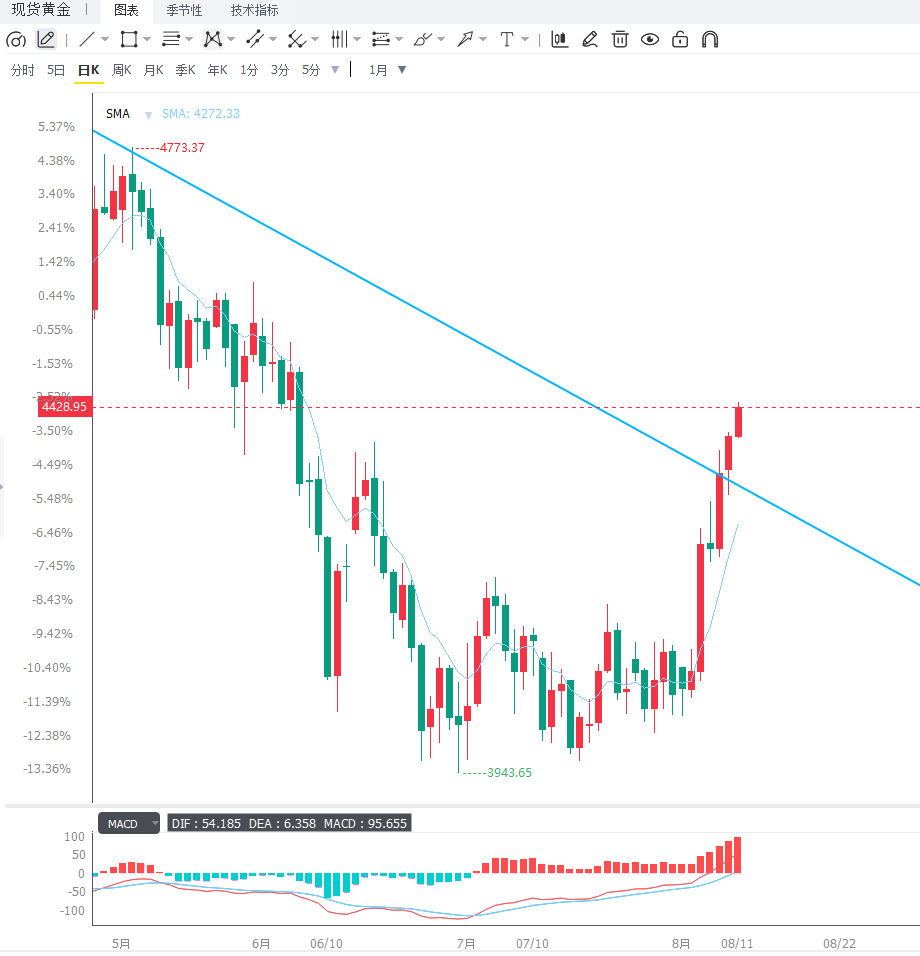 Editor's Summary: The recent rise in gold prices has been driven primarily by a cooling job market, increased safe-haven demand, and changing expectations regarding Federal Reserve policy. The market is currently trading on the contradiction between "economic slowdown reducing interest rate pressure" and "rising energy prices increasing inflation risks," thus gold remains in a high-level consolidation phase with a slight upward bias. The future direction of gold hinges on whether US inflation data supports expectations of a policy shift. If CPI and PPI continue to show declining price pressures, gold may further extend its gains; however, if energy prices lead to a resurgence of inflation, the likelihood of the Fed maintaining high interest rates increases, and a rebound in the dollar and yields could limit gold's performance. In the short term, gold still has upward momentum, but the risk of high-level volatility should be carefully considered.
Previously released US employment data was weaker than market expectations, indicating a gradual cooling in the labor market. Slower job growth reduced market concerns about further tightening of monetary policy by the Federal Reserve, while simultaneously increasing investor expectations for a future policy shift. Since gold does not generate interest income, its investment appeal typically increases during periods of declining interest rate expectations. The weakening of the US job market and the resulting interest rate hike expectations have become a significant factor driving the recent gold rebound . Market funds have flowed back into the precious metals market, freeing gold from previous adjustment pressures and allowing it to continue testing higher levels. However, the rise in gold is not without its obstacles. The recent rapid rise in oil prices has led the market to refocus on global inflation risks. As energy prices may drive inflation through cost channels, investors are beginning to reassess the Fed's future policy path. The market has not yet completely ruled out future interest rate hikes, limiting further short-term gains for gold. Uncertainty surrounding the Middle East situation remains a significant factor influencing gold's price movements. Slow progress in related negotiations has reduced market expectations for a rapid recovery of key energy transport routes. At the same time, restrictions on another important shipping route have increased concerns about global energy supply and pushed up oil prices. Rising oil prices are impacting the gold market through both inflation and interest rate expectations . On the one hand, increased risk events typically benefit safe-haven demand for gold; on the other hand, if energy prices lead to renewed inflationary pressures, the Federal Reserve may maintain a higher interest rate environment, thereby increasing the opportunity cost of holding gold. The US dollar has also recently become an important variable in the gold market. As the market is still digesting future policy changes, US Treasury yields remain high, helping the dollar index maintain its rebound. A stronger dollar typically increases the cost of purchasing dollar-denominated gold, thus potentially limiting short-term price increases. Currently, investors are awaiting further confirmation of policy direction from US inflation data. The upcoming Consumer Price Index (CPI) and subsequent Producer Price Index (PPI) will be crucial indicators for the market to judge the Fed's next move. If inflation continues to decline, gold may gain further upward momentum; if energy prices drive a rebound in inflation, it could reinforce expectations of high interest rates. From a market sentiment perspective, gold is currently driven by both safe-haven demand and changes in policy expectations. Although facing short-term pressure from the dollar and yields, investors' expectations of slower economic growth and a shift in monetary policy provide strong support for gold. From a daily chart perspective, spot gold has recently re-entered an upward structure, with bulls taking control after breaking through the $4400 area. Gold has broken through the 100-day moving average and the 50% Fibonacci retracement level of the April-June correction, indicating strengthening buying power. The first resistance level to watch is the 200-day moving average around $4498. A decisive break above this level could lead to a further test of the 61.8% Fibonacci retracement level around $4515, followed by the 78.6% Fibonacci retracement area around $4669. Short-term support is around $4406, with further support at the $4389 area. A break below this level could lead to a pullback to around $4297, with key support at the $4162 area. On the 4-hour chart, gold maintains a clear upward trend in the short term, with prices moving along short-term moving averages, and market momentum still biased towards the bulls. However, after the continuous rise, technical indicators suggest that some profit-taking is increasing, and short-term consolidation is possible. If gold can hold firmly above the $4400-$4410 range, the upward trend is likely to continue, potentially challenging the resistance near $4500. However, a break below the $4380 support level could trigger a short-term correction, with a target of $4330-$4300. Short-term price movements will be heavily influenced by the US dollar, US Treasury yields, and US inflation data. Editor's Summary: The recent rise in gold prices has been driven primarily by a cooling job market, increased safe-haven demand, and changing expectations regarding Federal Reserve policy. The market is currently trading on the contradiction between "economic slowdown reducing interest rate pressure" and "rising energy prices increasing inflation risks," thus gold remains in a high-level consolidation phase with a slight upward bias. The future direction of gold hinges on whether US inflation data supports expectations of a policy shift. If CPI and PPI continue to show declining price pressures, gold may further extend its gains; however, if energy prices lead to a resurgence of inflation, the likelihood of the Fed maintaining high interest rates increases, and a rebound in the dollar and yields could limit gold's performance. In the short term, gold still has upward momentum, but the risk of high-level volatility should be carefully considered.
- Risk Warning and Disclaimer
- The market involves risk, and trading may not be suitable for all investors. This article is for reference only and does not constitute personal investment advice, nor does it take into account certain users’ specific investment objectives, financial situation, or other needs. Any investment decisions made based on this information are at your own risk.