Japanese investors are still buying foreign bonds; Goldman Sachs says only interest rate hikes can turn the yen around.
2026-08-11 10:30:57
On Tuesday (August 11) during Asian trading hours, the USD/JPY pair fluctuated after a nearly 1% overnight rise, currently trading around 159.25. Since last week's lows, the exchange rate has rebounded by approximately 400 points, essentially recovering about half of the losses from the historical high near 164 to the 155 range. Although the Japanese Ministry of Finance intervened in the foreign exchange market with a record amount of funds in a single day, and then acted in conjunction with the US the following day, the effects of the intervention are rapidly fading. Goldman Sachs economists pointed out that although the Japanese government has clearly stated its desire to guide capital back to the country, the latest data shows that Japanese investors are still buying foreign bonds in large quantities, with a considerable net purchase in July. Goldman Sachs believes that any policy-driven changes in capital repatriation may take time to appear in the data, but based on the fundamental judgment that overseas returns continue to be higher than domestic returns, its skepticism about a large-scale unhedged capital repatriation remains reasonable. Goldman Sachs further pointed out that a more reliable path for the yen's strengthening comes from the Bank of Japan's interest rate hike next month, rather than capital repatriation or intervention. 
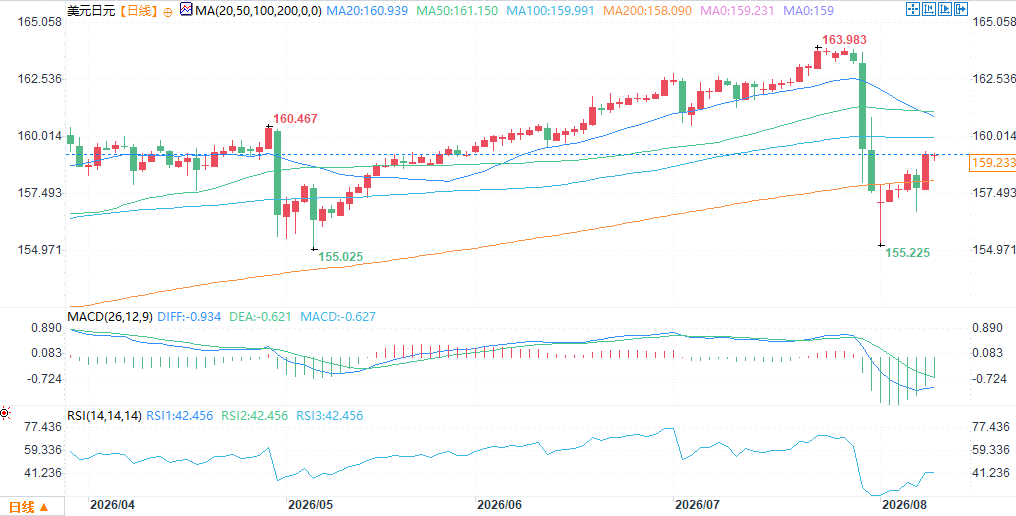 (USD/JPY daily chart, source: FX678) At 10:28 Beijing time on August 11, the USD/JPY exchange rate was 159.25/26.
Capital repatriation has not yet materialized.
Goldman Sachs, citing a recent report from Japan's Ministry of Finance, pointed out that Japanese investors continued to be net buyers of foreign bonds in July, and the scale was considerable. This data clearly shows that despite Tokyo's repeated and explicit policy intentions to guide capital back to the domestic market, actual investor behavior has not yet undergone a substantial change. The divergence between policy signals and capital flows highlights that the current market is still primarily driven by returns. Goldman Sachs acknowledges that such policy-driven shifts often take time to be fully reflected in flow data, and therefore the possibility of future changes cannot be completely ruled out. However, the bank also emphasized that its core judgment of continued superior returns overseas, and its reservations about a large-scale repatriation of unhedgeped capital, remain reasonable in the face of the latest data. In other words, as long as the relative attractiveness of overseas assets does not significantly weaken, the expectation of a large-scale repatriation of Japanese funds is unlikely to materialize quickly.Key Implications from the Dimension of Capital Flows
Goldman Sachs' latest research report adds a crucial, previously overlooked dimension to the yen debate: capital flows. Previous market discussions primarily focused on the effectiveness of intervention and interest rate differentials. Mitsubishi UFJ Financial Group pointed out that historically, coordinated intervention has often only delayed, not reversed, currency trends; a true turning point requires changes in fundamentals. Other analysts suggested that Japan's recent relatively passive stance might further provoke short sellers to tentatively sell the yen. Goldman Sachs, however, draws a more cautious conclusion from the perspective of capital flows: if even with explicit policy encouragement, Japanese capital fails to see substantial repatriation, then capital repatriation itself is unlikely to be a reliable channel for the yen to achieve sustained strength. This assessment further weakens expectations of solely relying on policy guidance to reverse the yen's weakness and prompts the market to re-examine the true forces driving the yen's long-term trend.Raising interest rates is a more reliable path.
Conversely, Goldman Sachs directly links the more reliable path to a stronger yen to monetary policy itself, explicitly stating that a rate hike by the Bank of Japan next month would provide longer-term, more sustainable support for the yen. The core of this judgment lies in the fact that adjustments to policy rates can substantially alter relative return expectations, thereby fundamentally impacting exchange rate pricing. This view aligns closely with the fundamental-driven logic expressed by several institutions this week—the market generally believes that a truly sustained strengthening of the yen is more likely to stem from a substantial narrowing of the US-Japan interest rate differential, rather than simply relying on foreign exchange intervention or a passive shift in Japanese investors' asset allocation. Intervention often only brings about short-term technical rebounds, and capital repatriation is difficult to realize in a timely manner given the current favorable environment for overseas returns. In contrast, the Bank of Japan's direct narrowing of the policy rate gap with the Federal Reserve through rate hikes can fundamentally weaken the attractiveness of carry trades and enhance the relative attractiveness of yen assets. This adjustment driven by monetary policy is the more reliable path for the yen to move from a cyclical rebound to a sustained strengthening trend.Summarize
Goldman Sachs points out that although the Japanese government clearly hopes to guide capital inflows, July data shows that Japanese investors are still net buyers of foreign bonds, indicating that policy-driven capital repatriation has not yet materialized. The research report adds the crucial dimension of capital flows to the yen debate and concludes that if capital does not return despite policy encouragement, then capital repatriation is unlikely to become a channel for sustained yen appreciation. Instead, Goldman Sachs links a more reliable path for yen appreciation to the Bank of Japan's interest rate hike next month, believing that narrowing interest rate differentials are the driving force for a sustained yen appreciation. This judgment aligns with the consensus of many institutions this week—the market is gradually converging on a core view: the Bank of Japan's own policy path, rather than intervention or capital flow guidance, is the more reliable determinant of the yen's future direction. (USD/JPY daily chart, source: FX678) At 10:28 Beijing time on August 11, the USD/JPY exchange rate was 159.25/26.
- Risk Warning and Disclaimer
- The market involves risk, and trading may not be suitable for all investors. This article is for reference only and does not constitute personal investment advice, nor does it take into account certain users’ specific investment objectives, financial situation, or other needs. Any investment decisions made based on this information are at your own risk.