Non-farm payrolls suddenly weakened, but inflation remained high, resulting in the most complex combination for the US dollar index.
2026-08-11 21:00:54
On Tuesday, August 11, the US dollar index hovered around 99.8, with limited intraday fluctuations. The dollar is currently facing not just a single economic data point, but a complex interplay of four factors: the Federal Reserve's internal policy stance, inflationary pressures, cooling employment, and energy prices. Following the July policy meeting, the Fed's internal divisions on whether to further tighten policy have widened significantly, giving the upcoming July inflation data a higher policy weight than before. 
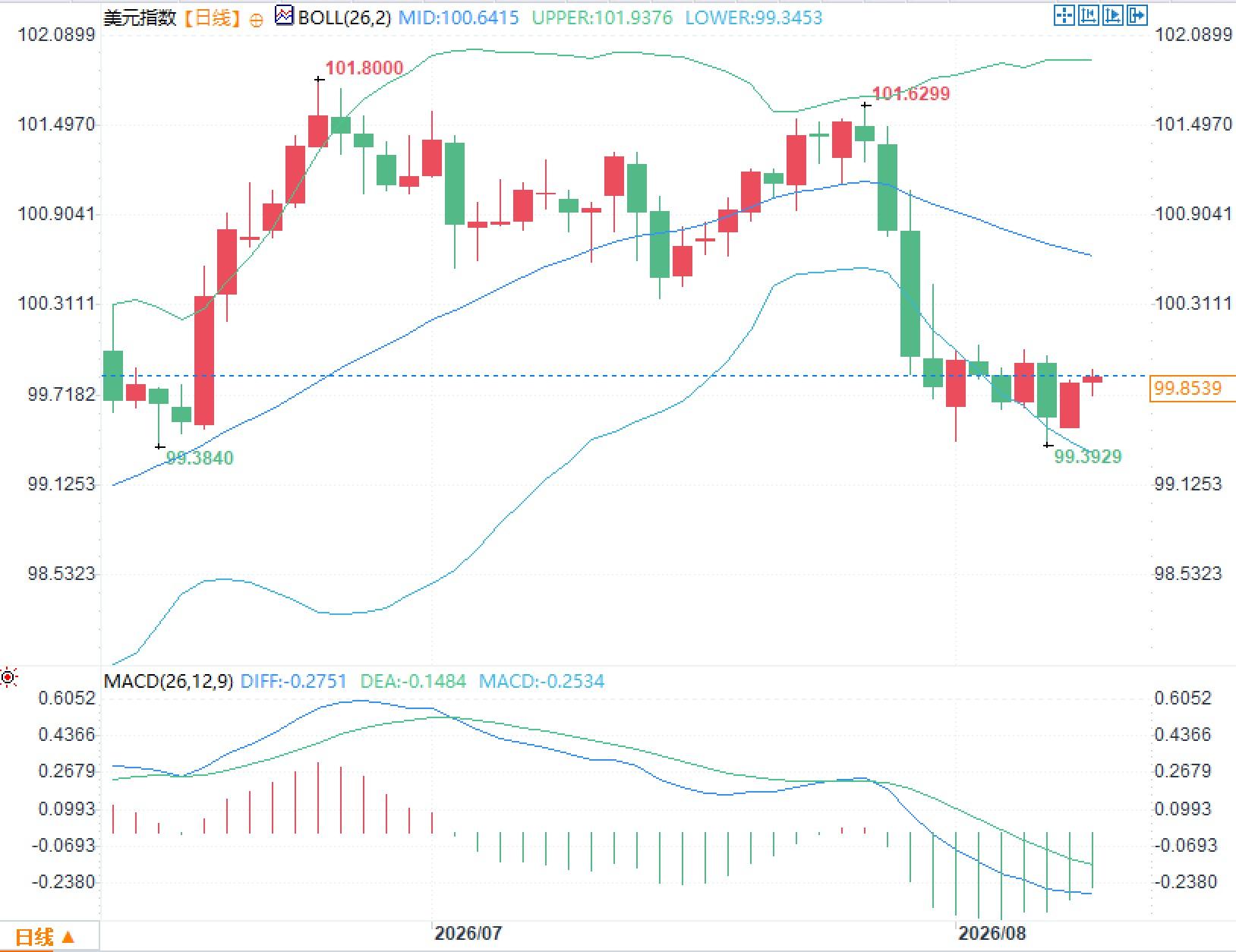 Regarding the MACD, the DIFF is -0.2751, the DEA is -0.1484, and the MACD histogram is -0.2534. Both indicator lines are below the zero axis, indicating that the negative momentum formed during the previous downward phase has not yet been fully digested. However, the recent candlestick bodies have shrunk significantly, and the price volatility has decreased, reflecting that the market is waiting for new macroeconomic information to complete the repricing.
A rare division has emerged within the Federal Reserve, and the focus of policy discussions has shifted.
On July 29, the Federal Reserve voted 9-3 to maintain the target range for the federal funds rate at 3.50% to 3.75%. However, Cleveland Fed President Hammark, Minneapolis Fed President Kashkari, and Dallas Fed President Logan all advocated for a 25-basis-point rate hike at that meeting. The fact that all three members opposed maintaining the current rate indicates that the policy discussion has clearly shifted from when to ease monetary policy to whether the current rate is sufficient to suppress inflation. Kashkari, explaining his dissent on July 31, stated that given the possibility of continued supply shocks solidifying high inflation, he preferred a gradual approach through a series of smaller policy adjustments rather than waiting for larger actions later. Logan stated that inflation was not clearly on a sustainable path back to the 2% target, and therefore believed that a moderate increase in interest rates would better balance the risks. This means that the real importance of the September meeting lies not in any single statement, but in whether the vote continues to move towards tightening. Once more members who previously supported maintaining the current rate reassess the inflation risks, the market's pricing of the policy path could see a significant adjustment.The key signal Warsh released is that market pricing is re-entering the policy function.
Federal Reserve Chairman Kevin Warsh stated on July 29th that the Fed will not be constrained by market prices or mechanically copy market signals, but market prices still have reference value for understanding the financial environment. He also emphasized that the Fed will not rely solely on a single data point to make judgments. This statement is crucial. The current market discussion is no longer focused on traditional, explicit forward guidance, but rather on re-deriving the Fed's reaction function—that is, what combination of inflation, employment, and financial conditions would be sufficient to drive a change in policy stance. Currently, the interest rate market has raised its pricing for a 25 basis point rate hike in September back to around 50%. Meanwhile, the 10-year Treasury yield has risen to around 4.73%, indicating that the market still demands a higher term compensation for medium- to long-term inflation and interest rate risks. Therefore, the dollar currently faces a complex combination. On the one hand, higher interest rate expectations can increase the attractiveness of dollar-denominated asset yields; on the other hand, if rate hike expectations stem from energy shocks and inflation stickiness, while economic activity simultaneously slows, the traditional positive correlation between the dollar and interest rates may become unstable.Employment has already shown signs of cooling, making inflation the key variable for the next stage.
The July US jobs report significantly weakened the narrative of a strong labor market. Non-farm payrolls fell by 23,000 in July, with the unemployment rate at 4.1%. More importantly, the combined job gains for May and June were revised down by 103,000, and the average monthly job gains over the past 12 months were only 34,000. While the employment data itself did not show a severe deterioration, a marginal slowdown was quite clear. Meanwhile, inflation remains significantly below the Fed's 2% target. Fed Governor Lisa Cook stated on August 5th that as of June, the personal consumption expenditures price index rose 3.7% year-on-year, and the core index rose 3.3%, with energy prices and some investment demand contributing to price pressures. She believes the current risk balance has tilted more towards inflation. This creates the most difficult combination for the market to handle: employment data limits the scope for aggressive tightening, but persistently high inflation limits the scope for policy easing. Therefore, the July consumer price data released on August 12th, and the subsequent producer price and retail sales data, effectively serve the important function of re-pricing the probability of policy in September.Technical analysis indicates that the US dollar has entered a consolidation phase, with momentum indicators remaining weak.
Observing the daily chart of the US Dollar Index, the latest price is around 99.8. The Bollinger Band middle line is at 100.6415, the upper line is at 101.9376, and the lower line is at 99.3453. The index is currently trading below the middle line and close to the lower line area. After a rapid decline from around 101.6299, the index has been consolidating in the 99.7 to 99.9 range for the past few trading days. Regarding the MACD, the DIFF is -0.2751, the DEA is -0.1484, and the MACD histogram is -0.2534. Both indicator lines are below the zero axis, indicating that the negative momentum formed during the previous downward phase has not yet been fully digested. However, the recent candlestick bodies have shrunk significantly, and the price volatility has decreased, reflecting that the market is waiting for new macroeconomic information to complete the repricing.
- Risk Warning and Disclaimer
- The market involves risk, and trading may not be suitable for all investors. This article is for reference only and does not constitute personal investment advice, nor does it take into account certain users’ specific investment objectives, financial situation, or other needs. Any investment decisions made based on this information are at your own risk.