A chart shows that the Baltic Dry Index has slightly declined, while Panamax freight rates have risen for the tenth consecutive month, reaching a two-month high.
2026-08-11 21:50:57
Latest data shows that on August 11, 2026, the Baltic Dry Index (BDI) stood at 3046 points, a five-day low, down 1.20% week-on-week (compared to the previous value), marking the largest drop since July 29, 2026, and the second consecutive day of decline (including zero growth). Looking at the short-term charts, the recent 11 BDI data points show: 6 positive increases, 5 negative increases, and 0 zero increases. Specifically, the Panamax Freight Index (BPI) was at 2312 points, up 0.26% from the previous value; the Capesize Freight Index (BCI) was at 5001 points, down 2.04%; and the Supramax Freight Index (BSI) was at 1600 points, down 0.19%. For detailed 720-day and 10-year trend charts of the Baltic Dry Index and its three main sub-indices, please refer to the charts specially created by FX678. 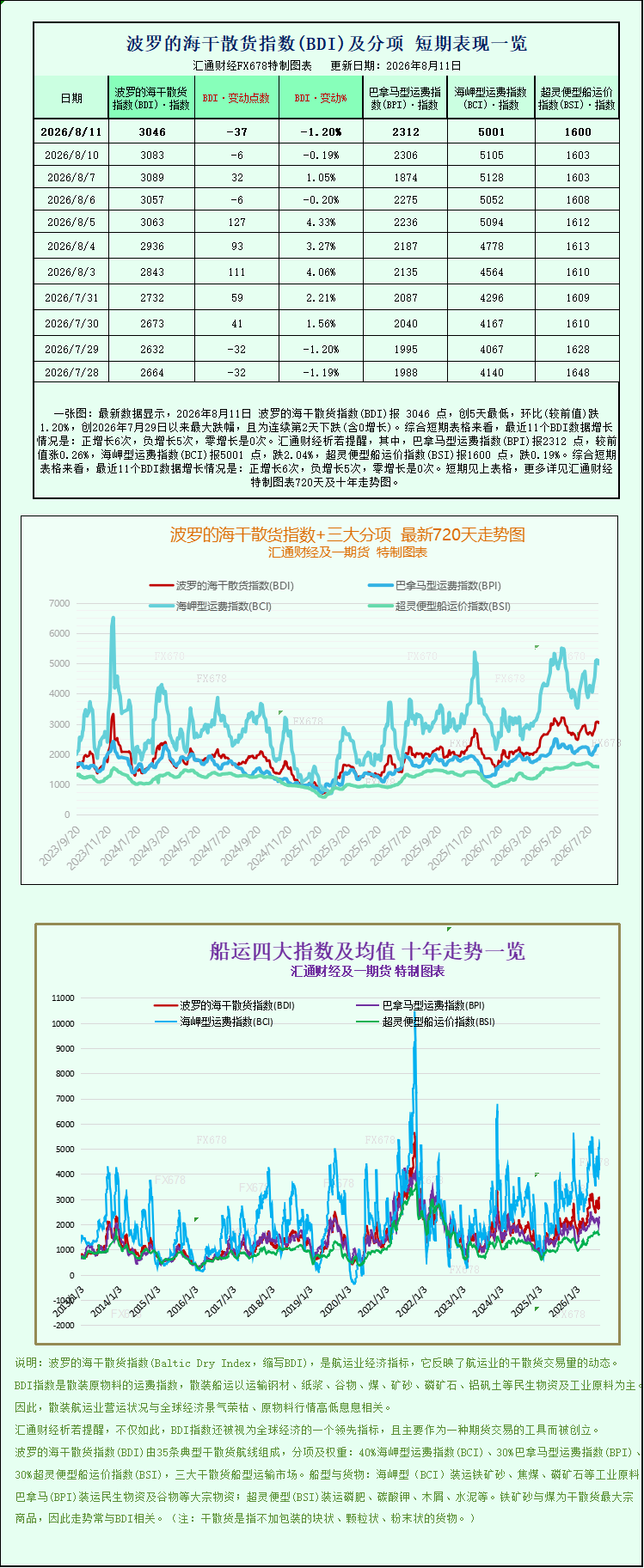 The global dry bulk shipping market has recently shown a structural divergence, with overall market sentiment slightly down, but the trends for different vessel types diverging significantly. On Tuesday, August 11th, the Baltic Dry Index (BDI) continued its downward trend, dragged down by declining freight rates for Capesize and Supramax vessels, resulting in a slight drop in the composite index. In stark contrast, the Panamax freight index continued its strong upward trend, achieving its tenth consecutive trading day of gains and reaching a new high in over two months, becoming the core growth highlight of the current dry bulk shipping market. As a key indicator of the global dry bulk shipping market, the Baltic Dry Index comprehensively covers freight rates for the three major dry bulk vessel types: Capesize, Panamax, and Supramax, directly reflecting the overall health of global bulk shipping trade. Data shows that the index fell 37 points that day, a 1.2% decrease, ultimately closing at 3046 points. It's worth noting that this decline is a temporary correction. The index had surged to its highest level since June 3rd on the previous trading day (last Friday), releasing some of the previously accumulated upward momentum. Coupled with weak demand for some ship types, this ultimately led to a slight decrease in the composite index. The large dry bulk carrier market was under significant pressure, with Capesize vessels experiencing the most significant decline. Data shows that the Capesize freight index fell sharply by 104 points that day, a drop of 2%, closing at 5001 points. Capesize vessels, as 150,000-ton ultra-large bulk carriers, are the core carriers for the global transport of ultra-large industrial raw materials such as iron ore and thermal coal. Their market performance is highly correlated with global industrial production and the steel industry's prosperity. Corresponding ship revenue data shows that the average daily revenue of Capesize vessels fell by $941 to $41,856. The temporary weakening of demand in the large-scale ocean-going industrial raw material transportation market is the core reason for the decline in charter revenue. However, the shipping market and the commodity market are showing divergent trends. While Capesize freight rates have declined, global iron ore futures prices have risen against the trend. This iron ore price increase is mainly due to short-term tightening of market supply, coupled with rigid support from shipping costs, and the continued stabilization of international oil prices at a one-week high, further solidifying the bottom of commodity prices. Industry analysts point out that the recovery in the iron ore market fundamentals is sustainable. As steel mill operating rates steadily recover, seaborne iron ore demand is expected to recover, potentially driving a rebound in Capesize freight rates and correcting the current market divergence. Against the backdrop of an overall market correction, the Panamax market has shown independent strength, becoming the biggest highlight of the shipping market this week. Data shows that the Panamax freight index rose slightly by 6 points, or 0.3%, to 2312 points, reaching its highest level in more than two months since June 2nd, and achieving a rare ten-day winning streak, with the upward cycle spanning nearly half a month of trading days. Panamax vessels, with a deadweight tonnage of 60,000 to 70,000 tons, are compliant with Panama Canal navigation standards and primarily handle transoceanic transport of bulk commodities such as coal, grain, and agricultural supplies, making them a mainstay of global trade. The rising market prices directly boosted vessel operating profits; the average daily charter earnings for Panamax vessels increased by $58 to $20,813 on that day. This continued rise was mainly due to the peak season for global grain trade, coupled with increased regional energy transport demand. Preparations for the export of autumn harvest grain in the Northern Hemisphere and early stockpiling of coal for winter in various countries have continuously driven demand for medium-sized bulk carriers, resulting in a supply shortage and pushing freight rates steadily higher. This upward trend is expected to continue in the short term. Meanwhile, the market for small and medium-sized vessels weakened. The Supramax freight index fell 3 points, a slight decrease of 0.2%, to 1600 points, a new low since June 8th. Supramax vessels, with their high flexibility and wide port adaptability, are primarily used for short-haul general cargo and small-batch bulk cargo transportation. Their price decline reflects a cooling in global short-haul and regional bulk cargo trade activity, with weak demand for small and medium-sized shipping orders offsetting some of the gains seen in medium-sized vessels. Overall, the current global dry bulk shipping market exhibits a pronounced structural divergence: large industrial raw material carriers are experiencing a price correction, medium-sized commercial carriers are strengthening, and small general cargo vessels continue to weaken. This market divergence is essentially a direct reflection of differences in global commodity supply and demand and regional trade rhythms. In the short term, demand for food and energy reserves will continue to support Panamax vessel prices, while the recovery in iron ore supply and demand is expected to drive a rebound in large vessels. The overall market is expected to gradually return to a balanced trend.
The global dry bulk shipping market has recently shown a structural divergence, with overall market sentiment slightly down, but the trends for different vessel types diverging significantly. On Tuesday, August 11th, the Baltic Dry Index (BDI) continued its downward trend, dragged down by declining freight rates for Capesize and Supramax vessels, resulting in a slight drop in the composite index. In stark contrast, the Panamax freight index continued its strong upward trend, achieving its tenth consecutive trading day of gains and reaching a new high in over two months, becoming the core growth highlight of the current dry bulk shipping market. As a key indicator of the global dry bulk shipping market, the Baltic Dry Index comprehensively covers freight rates for the three major dry bulk vessel types: Capesize, Panamax, and Supramax, directly reflecting the overall health of global bulk shipping trade. Data shows that the index fell 37 points that day, a 1.2% decrease, ultimately closing at 3046 points. It's worth noting that this decline is a temporary correction. The index had surged to its highest level since June 3rd on the previous trading day (last Friday), releasing some of the previously accumulated upward momentum. Coupled with weak demand for some ship types, this ultimately led to a slight decrease in the composite index. The large dry bulk carrier market was under significant pressure, with Capesize vessels experiencing the most significant decline. Data shows that the Capesize freight index fell sharply by 104 points that day, a drop of 2%, closing at 5001 points. Capesize vessels, as 150,000-ton ultra-large bulk carriers, are the core carriers for the global transport of ultra-large industrial raw materials such as iron ore and thermal coal. Their market performance is highly correlated with global industrial production and the steel industry's prosperity. Corresponding ship revenue data shows that the average daily revenue of Capesize vessels fell by $941 to $41,856. The temporary weakening of demand in the large-scale ocean-going industrial raw material transportation market is the core reason for the decline in charter revenue. However, the shipping market and the commodity market are showing divergent trends. While Capesize freight rates have declined, global iron ore futures prices have risen against the trend. This iron ore price increase is mainly due to short-term tightening of market supply, coupled with rigid support from shipping costs, and the continued stabilization of international oil prices at a one-week high, further solidifying the bottom of commodity prices. Industry analysts point out that the recovery in the iron ore market fundamentals is sustainable. As steel mill operating rates steadily recover, seaborne iron ore demand is expected to recover, potentially driving a rebound in Capesize freight rates and correcting the current market divergence. Against the backdrop of an overall market correction, the Panamax market has shown independent strength, becoming the biggest highlight of the shipping market this week. Data shows that the Panamax freight index rose slightly by 6 points, or 0.3%, to 2312 points, reaching its highest level in more than two months since June 2nd, and achieving a rare ten-day winning streak, with the upward cycle spanning nearly half a month of trading days. Panamax vessels, with a deadweight tonnage of 60,000 to 70,000 tons, are compliant with Panama Canal navigation standards and primarily handle transoceanic transport of bulk commodities such as coal, grain, and agricultural supplies, making them a mainstay of global trade. The rising market prices directly boosted vessel operating profits; the average daily charter earnings for Panamax vessels increased by $58 to $20,813 on that day. This continued rise was mainly due to the peak season for global grain trade, coupled with increased regional energy transport demand. Preparations for the export of autumn harvest grain in the Northern Hemisphere and early stockpiling of coal for winter in various countries have continuously driven demand for medium-sized bulk carriers, resulting in a supply shortage and pushing freight rates steadily higher. This upward trend is expected to continue in the short term. Meanwhile, the market for small and medium-sized vessels weakened. The Supramax freight index fell 3 points, a slight decrease of 0.2%, to 1600 points, a new low since June 8th. Supramax vessels, with their high flexibility and wide port adaptability, are primarily used for short-haul general cargo and small-batch bulk cargo transportation. Their price decline reflects a cooling in global short-haul and regional bulk cargo trade activity, with weak demand for small and medium-sized shipping orders offsetting some of the gains seen in medium-sized vessels. Overall, the current global dry bulk shipping market exhibits a pronounced structural divergence: large industrial raw material carriers are experiencing a price correction, medium-sized commercial carriers are strengthening, and small general cargo vessels continue to weaken. This market divergence is essentially a direct reflection of differences in global commodity supply and demand and regional trade rhythms. In the short term, demand for food and energy reserves will continue to support Panamax vessel prices, while the recovery in iron ore supply and demand is expected to drive a rebound in large vessels. The overall market is expected to gradually return to a balanced trend.
- Risk Warning and Disclaimer
- The market involves risk, and trading may not be suitable for all investors. This article is for reference only and does not constitute personal investment advice, nor does it take into account certain users’ specific investment objectives, financial situation, or other needs. Any investment decisions made based on this information are at your own risk.