Iran sets five conditions to maintain its red line on closing the Strait of Hormuz; Trump counters with a "50-year reparations" proposal, casting further uncertainty over the prospects of US-Iran negotiations.
2026-08-12 09:34:55
Iran clarified on Tuesday (August 11) that reopening the Strait of Hormuz requires the US to meet five conditions, including a ceasefire, unfreezing assets, and compensation. Trump countered on the same day by demanding compensation for "50 years of damage," highlighting the stark contrast in positions between the two sides. On Monday, only six ships passed through the strait, a 95% drop from the pre-war daily average of 130. The optimistic signals previously released by the mediators were quickly rejected by Iran. An attack on a cargo ship in the Bab el-Mandeb Strait in the Red Sea resulted in six deaths, marking the first fatalities in Houthi attacks on ships since the start of the war. US forces intercepted another merchant ship in the Gulf of Oman. International oil prices rose for the fourth consecutive day, hitting a more than one-week high. WTI crude closed at $83.20 per barrel on Tuesday, while Brent crude closed at $88.91 per barrel. In early Asian trading on Wednesday (August 12), international oil prices fluctuated narrowly near one-week highs. 
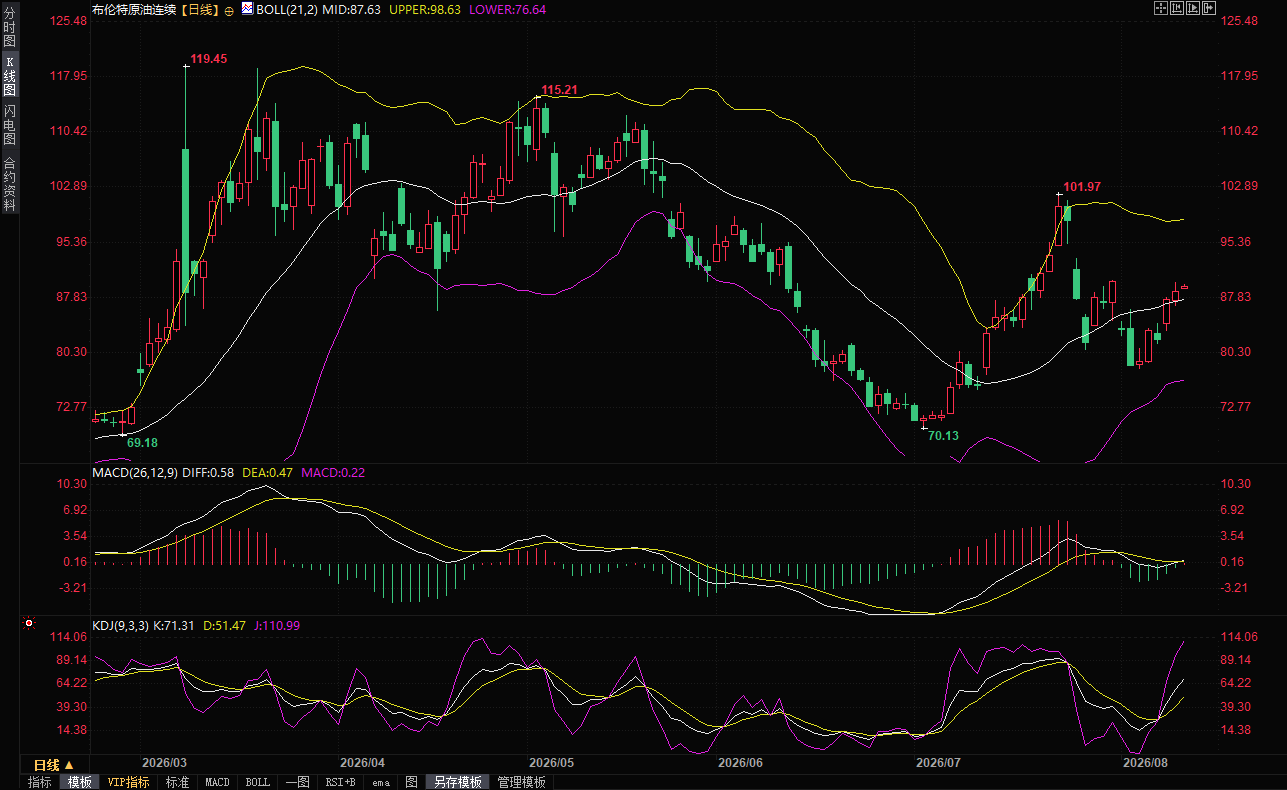 (Brent crude oil daily chart, source: FX678) Analysts point out that the current oil market is highly driven by news. Last week, Trump's expectations of "easing tensions and reaching an agreement" were quickly disproven, and market optimism about the short-term resumption of navigation in the Strait of Hormuz has disappeared. ING strategists stated in a report: "Current rhetoric suggests that any potential agreement is still some distance away, meaning that the risks to oil prices remain skewed to the upside." Regarding inventories, EIA data shows that US strategic petroleum reserves fell to 305 million barrels last week, approaching the 250 million barrel reserve threshold. Kpler data shows that the average open shipment volume through the Strait of Hormuz in the first three weeks was 4.16 million barrels per day, a significant decline compared to the exemption window period of the US-Iran memorandum of understanding.
I. Stalemate Continues: Iran clarifies conditions for closure, US bargaining leverage rejected.
The stalemate over navigation in the Strait of Hormuz continues. On Tuesday (August 11), Rezaei, the newly appointed secretary of Iran's Supreme National Security Council, publicly stated that the Strait of Hormuz will not reopen unless the United States changes its behavior and accepts Iran's conditions for ending the war. This is one of the clearest signals to date, indicating that even if Iran and Oman reach an agreement on navigation in the strait, shipping cannot immediately return to normal if the United States fails to fulfill its commitments in the memorandum of understanding reached between the two sides in June. According to Iran's Tasnim News Agency, Rezaei, who is close to Iran's Supreme Leader Mojtaba Khamenei, said that Iran's conditions include: the United States must end the war, return Iran's frozen assets, and the war must cease throughout the region, including Lebanon and Gaza. He emphasized that even if Iran and Oman reach an agreement on transit routes through the Strait of Hormuz, this agreement is a separate matter from the issue of closing the strait. Previously, on August 8, Zulghader, Secretary of Iran's Supreme National Security Council, listed five conditions for reopening the Strait of Hormuz: a permanent cessation of military operations against Iran and its regional allies; an end to threats or insults against Iran; the lifting of the naval blockade and all sanctions against Iran; the return of frozen Iranian assets; and compensation for losses caused to Iran by the related military operations. Iranian Foreign Minister Araqchi stated on August 9 that Iran was not currently engaged in any negotiations with the United States, and the two sides were only exchanging information through intermediaries. On August 10, Iranian Foreign Ministry spokesman Bagaei further pointed out that the US naval blockade and military action against Iran were the main obstacles preventing the full restoration of safe navigation in the Strait of Hormuz. On August 11, Mohber, an advisor to Iran's Supreme Leader, posted on the social media platform X: "The punishment of aggressors will continue, and the Strait of Hormuz will not be opened until Iran's conditions are met."II. Trump's retaliatory measure: Demanding Iran compensate for "losses of the past 50 years"
In response to Iran's tough demands, US President Trump countered on August 10 by demanding compensation from Iran. Speaking at the White House, Trump stated he would require Iran to compensate for all damages caused over the past 50 years. He posted on social media that Iran should be held responsible for its "use of roadside bombs and all the casualties caused in past conflicts," and should pay compensation to "the families of hundreds of thousands of innocent protesters" over the past 50 years. Trump has instructed US negotiators to explicitly include compensation demands in all future negotiations. In an interview released Monday evening, he stated that options under consideration include "allowing the Iranian economy to continue to deteriorate" or launching a "very, very tough" strike, calling Iran a "very cunning negotiator." Analysts point out that Trump's compensation demands essentially create a new obstacle in US-Iran negotiations. Iran had previously included US compensation as one of the five conditions for reopening the Strait of Hormuz, and Trump's reverse demand has created a stalemate of "who pays whom" on the issue of compensation.III. The Gap Between Mediation Signals and Reality
Before the rhetoric escalated again, the main mediators had released optimistic signals. Pakistani Defense Minister Asif, in an interview with Bloomberg on August 11, stated, "The signals released in the past two or three days indicate that the two sides are close to reaching some kind of arrangement." Mediators such as Qatar had also hinted that an agreement might be imminent, potentially pushing for the reopening of this crucial shipping route. However, Iran's latest statement quickly extinguished market expectations for a short-term agreement. Iranian Foreign Minister Araghchi explicitly stated that establishing a new shipping route with Oman "does not mean that the Strait of Hormuz will be reopened," and that the reopening of the strait depends on other conditions conveyed to the United States through intermediaries.IV. Shipping Data: Strait Traffic Volume Plummets to Zero
Data from shipping tracking agency Kpler shows that the number of ships passing through the Strait of Hormuz on Monday (August 10) dropped to six, compared to an average of about 11 ships per day over the previous 10 days. Before the outbreak of the war with Iran in late February, the strait saw an average of 130 to 140 ships passing through daily. On August 4, only eight ships passed through the Strait of Hormuz. In the week of August 3-6, a total of only 33 ships transited the strait, far fewer than the 50 ships in the same period of the previous week. Kpler data shows that of the four ships entering the waterway on Monday, two were empty product tankers, and two others left the strait—one a small tanker carrying liquefied petroleum gas, and the other carrying residual fuel. A senior crude oil analyst at Kpler pointed out that current crude oil transport volume through the strait is only about 15% of pre-war levels. The Strait of Hormuz handles about one-fifth of global crude oil and refined product transport, with a pre-war daily transport volume of approximately 20 million barrels. Meanwhile, 25 ships navigated the Bab el-Mandeb Strait on Monday, roughly the same as the daily average of nearly 24 ships over the previous 10 days.V. The Red Sea and the Gulf of Oman: Ship attacks result in multiple deaths, and maritime risks continue to escalate.
The maritime security situation in the region continues to deteriorate. On August 11, the Yemeni Ministry of Transport stated that a small cargo ship was attacked that day in the Strait of Bab el-Mandeb by suspected Houthi rebels. The Yemeni Coast Guard subsequently confirmed that the attacked vessel was the "Tihamah," owned by Egypt. The attack resulted in 6 deaths and 10 injuries—4 crew members (3 Pakistani and 1 Indonesian) and 2 personnel from the Yemeni Armed Forces Navy's 2nd Brigade were killed, and the injured included 7 crew members, 2 coast guard personnel, and 1 naval personnel. The Yemeni Coast Guard stated that the merchant ship caught fire and was severely damaged after being hit by multiple missiles from the Houthis. During the rescue operation, the Houthis again fired missiles at the merchant ship, affecting the rescue area and causing casualties among Yemeni armed personnel involved in the rescue. If the deaths are confirmed, this would be the first deaths caused by Houthi attacks on merchant ships since the start of the war with Iran on February 28. Later that day, the Houthis claimed responsibility for attacking a ship carrying Saudi military equipment in the Strait of Bab el-Mandeb, but did not disclose the ship's name. According to other media reports, the Panamanian-flagged container ship Vela Nova was attacked by missiles in the Gulf of Oman. The Wall Street Journal, citing US officials, reported that the ship ignored warnings from personnel enforcing the maritime blockade of Iranian ports and was attacked from its engine room by two Hellfire missiles fired from a US Navy MH-60 helicopter, causing the ship to lose its maneuverability. US Central Command confirmed the operation. If confirmed, this would be the 12th ship attacked by the US military since the blockade was announced in April.VI. Energy Market Reaction: Oil Prices Rise for Four Consecutive Days
International oil prices continued their upward trend, influenced by uncertainty surrounding the Strait of Hormuz and the ongoing deterioration of regional security. As of the close of trading on August 11, WTI crude oil futures rose 1.3% to $83.20 per barrel, and Brent crude oil futures rose 1.4% to $88.91 per barrel. This marked the fourth consecutive trading day of gains for international oil prices. WTI crude oil prices rose nearly 3% to $84.61 per barrel on Tuesday, while Brent crude oil prices rose as much as 2.5% to $90.00 per barrel, both reaching more than a week's high. (Brent crude oil daily chart, source: FX678) Analysts point out that the current oil market is highly driven by news. Last week, Trump's expectations of "easing tensions and reaching an agreement" were quickly disproven, and market optimism about the short-term resumption of navigation in the Strait of Hormuz has disappeared. ING strategists stated in a report: "Current rhetoric suggests that any potential agreement is still some distance away, meaning that the risks to oil prices remain skewed to the upside." Regarding inventories, EIA data shows that US strategic petroleum reserves fell to 305 million barrels last week, approaching the 250 million barrel reserve threshold. Kpler data shows that the average open shipment volume through the Strait of Hormuz in the first three weeks was 4.16 million barrels per day, a significant decline compared to the exemption window period of the US-Iran memorandum of understanding.Editor's Summary
The deadlock in navigation through the Strait of Hormuz is unlikely to be broken in the short term. Iran has linked the reopening of the strait to the fulfillment of five conditions by the United States, including the core demand for US compensation; while Trump has countered with a demand for "50 years of compensation," essentially setting a new precondition for negotiations, leading to a "condition-for-condition" confrontation between the two sides on core issues. Shipping data shows a significant drop in the daily average of six vessels passing through the strait compared to the pre-war level of 130-140 vessels, with approximately one-fifth of global oil transportation still effectively disrupted. The deadly attack on a ship in the Bab el-Mandeb Strait in the Red Sea and the direct US military strikes in the Gulf of Oman have further increased the risk premium for regional shipping. International oil prices have risen for four consecutive trading days, hitting a one-week high, reflecting continued market concerns about supply disruptions. With both the US and Iran using compensation as a bargaining chip, the likelihood of reaching a substantial agreement in the short term is low, and the restoration of regional energy transport routes will take time.Frequently Asked Questions
Q1: What are the specific conditions for Iran to close the Strait of Hormuz? Iran's Supreme National Security Council listed five conditions: a permanent cessation of military operations against Iran and its regional allies; cessation of threats or insults against Iran; lifting of the maritime blockade and all sanctions against Iran; return of frozen Iranian assets; and compensation for losses caused to Iran by the related military operations. Iran emphasized that all these conditions must be met before the strait will reopen. Q2: What are the specific contents of Trump's compensation demands? On August 10, Trump filed a counterclaim demanding that Iran compensate for "damage caused over the past 50 years," including casualties from the use of roadside bombs and various conflicts, as well as compensation to the families of the hundreds of thousands of innocent protesters killed over the past 50 years. He has instructed US negotiators to include this demand in all future negotiation agendas. Q3: What is the current navigation status of the Strait of Hormuz? According to Kpler data, only 6 ships passed through the Strait of Hormuz on August 11, compared to a pre-war daily average of 130 to 140 ships. Current crude oil transport volume in the strait is approximately 15% of pre-war levels. Although negotiations between Iran and Oman are "close" to reaching a new shipping agreement, this does not mean the strait will reopen. Question 4: What attacks have occurred recently in the Bab el-Mandeb Strait in the Red Sea? On August 11, Houthi rebels attacked the Egyptian cargo ship "Tahama" in the Bab el-Mandeb Strait, killing 6 people (4 crew members and 2 Yemeni militants) and injuring 10. This was the first death toll from Houthi attacks on merchant ships since the start of the Iran-Iraq War in February. On the same day, the US military opened fire on the Panamanian-flagged cargo ship "Villanova" in the Gulf of Oman, firing two Hellfire missiles that rendered it unable to maneuver. Question 5: What impact has the current situation had on international oil prices? International oil prices have risen for four consecutive trading days. As of the close of trading on August 11, WTI crude oil was at $83.20 per barrel, and Brent crude oil was at $88.91 per barrel. Market optimism regarding the short-term reopening of the Strait of Hormuz has vanished. Analysts point out that with the prospects for a US-Iran agreement uncertain, the risks to oil prices remain skewed to the upside. At 09:31 Beijing time, Brent crude was trading at $89.56 per barrel.- Risk Warning and Disclaimer
- The market involves risk, and trading may not be suitable for all investors. This article is for reference only and does not constitute personal investment advice, nor does it take into account certain users’ specific investment objectives, financial situation, or other needs. Any investment decisions made based on this information are at your own risk.