The US dollar index rose for the third consecutive day, approaching the 100 mark, awaiting guidance from US inflation data.
2026-08-12 14:16:54
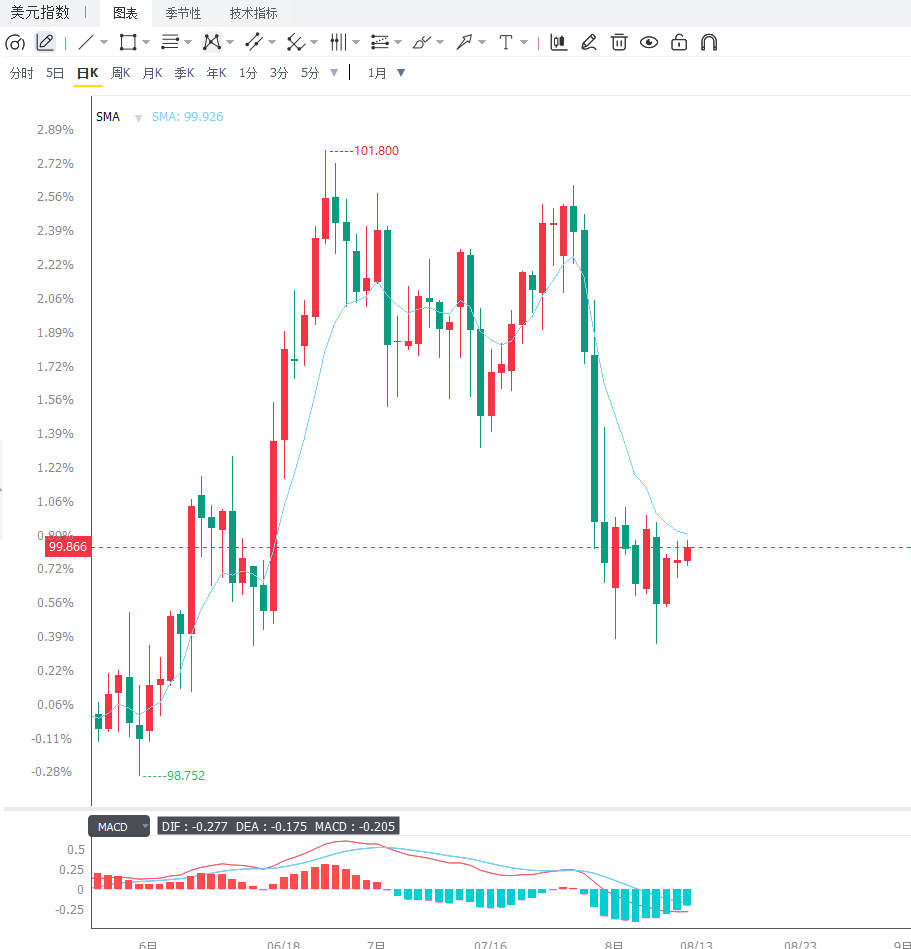
The US dollar index (DXY) continued its upward trend in Asian trading on Wednesday, maintaining its strength for the third consecutive session, trading around 99.90. Market focus is currently on the upcoming release of US inflation data, which is considered a key indicator of the Federal Reserve's next monetary policy move.  The recent rise in the US dollar has been driven by two main factors: firstly, investors readjusted their expectations for the Federal Reserve's interest rate policy ahead of the release of US inflation data; secondly, global risk sentiment was affected by changes in the Middle East situation, leading to safe-haven flows into dollar assets. The trajectory of US inflation will determine the medium-term direction of the dollar . A key market concern is whether the rate of decline in inflation will be sufficient to prevent the Federal Reserve from further tightening its policy. If price pressures fall less than expected, the Federal Reserve may continue to maintain a restrictive policy, thereby supporting the dollar and US Treasury yields. Commerzbank analysts believe that the US market is currently focused on whether inflation can fall quickly enough to prevent the Federal Reserve from raising interest rates further. Future changes in price pressures will directly affect the dollar's policy environment and yield performance. Meanwhile, uncertainty in the Middle East has enhanced the dollar's safe-haven appeal. Recently, market risk sentiment improved due to the possibility of an agreement between the US and Iran on arrangements for the Strait of Hormuz, but subsequent disagreements have reignited market caution. Changes in energy prices are also a significant factor influencing the dollar's performance. Recent increases in oil prices have renewed inflation concerns, with investors worried that rising energy costs may slow the decline in inflation and force the Federal Reserve to maintain a tighter policy stance. However, there are still disagreements in the market regarding the future policy path of the Federal Reserve. The Federal Reserve kept interest rates unchanged at its July meeting, and investors are currently assessing the possibility of further rate hikes. According to market interest rate tools, market expectations for a 25 basis point rate hike by the Fed in September have declined, currently showing a probability of about 48%, down from the previous level of about 52%. This indicates that while investors are concerned about inflation risks, their confidence in a short-term rate hike has weakened. Recent speeches by Fed officials have also become a focus of market attention. Officials stated that the main problems facing the US economy remain price pressures and changes in consumer purchasing power, while the labor market remains stable but not strong. The Fed still prefers to maintain a restrictive policy stance, but the market is reassessing the future pace of tightening . Policymakers are concerned about inflation risks while also needing to consider the economic pressure from a slowing job market. Currently, the dollar index's movement still depends on US economic data. If CPI data shows continued easing of inflation, the market may lower its expectations for rate hikes, and the dollar's upward momentum may weaken; if inflation is higher than expected, the dollar may further challenge the 100 level. The daily chart of the dollar index shows that the DXY has rebounded recently, with the price approaching the important psychological level of 100 again. The short-term moving average system is gradually strengthening, and the MACD indicator shows improved upward momentum, but there is significant resistance in the 100.00-100.50 area. A break above this area could see the index further test the 101.20 level. Support levels to watch are the 99.20 area, followed by the 98.50 area; a break below these levels could trigger a correction. Overall, the daily chart structure leans towards a fluctuating upward trend, but data confirmation is needed to validate the breakout. The 4-hour chart for the US Dollar Index shows the price holding above 99.80, with bulls in control in the short term. The RSI indicator is in a strong zone, indicating continued buying activity, but the pace of increase has slowed. A break above 100.00 could extend the short-term upward trend, targeting 100.50; if it encounters resistance and falls back, support around 99.20 should be monitored. The MACD remains positive, indicating a continued bullish short-term trend, but US inflation data could trigger significant volatility.
  Editor's Summary: The US dollar index is currently near a key technical zone, with the market awaiting confirmation from US inflation data regarding its future direction. Recent gains in oil prices, Middle East risks, and expectations of a cautious Federal Reserve policy have collectively supported the dollar, but a reassessment of the scope for interest rate hikes has limited further gains. The future trajectory of the dollar will depend on inflation data, Fed policy signals, and changes in global risk sentiment. If inflation declines as expected, the dollar may consolidate at higher levels; if energy prices drive inflation back up, the dollar may continue its strength. In the short term, the 99.00-100.50 area will be a crucial trading range for the dollar index, and investors should pay close attention to policy expectations arising from US economic data.
The recent rise in the US dollar has been driven by two main factors: firstly, investors readjusted their expectations for the Federal Reserve's interest rate policy ahead of the release of US inflation data; secondly, global risk sentiment was affected by changes in the Middle East situation, leading to safe-haven flows into dollar assets. The trajectory of US inflation will determine the medium-term direction of the dollar . A key market concern is whether the rate of decline in inflation will be sufficient to prevent the Federal Reserve from further tightening its policy. If price pressures fall less than expected, the Federal Reserve may continue to maintain a restrictive policy, thereby supporting the dollar and US Treasury yields. Commerzbank analysts believe that the US market is currently focused on whether inflation can fall quickly enough to prevent the Federal Reserve from raising interest rates further. Future changes in price pressures will directly affect the dollar's policy environment and yield performance. Meanwhile, uncertainty in the Middle East has enhanced the dollar's safe-haven appeal. Recently, market risk sentiment improved due to the possibility of an agreement between the US and Iran on arrangements for the Strait of Hormuz, but subsequent disagreements have reignited market caution. Changes in energy prices are also a significant factor influencing the dollar's performance. Recent increases in oil prices have renewed inflation concerns, with investors worried that rising energy costs may slow the decline in inflation and force the Federal Reserve to maintain a tighter policy stance. However, there are still disagreements in the market regarding the future policy path of the Federal Reserve. The Federal Reserve kept interest rates unchanged at its July meeting, and investors are currently assessing the possibility of further rate hikes. According to market interest rate tools, market expectations for a 25 basis point rate hike by the Fed in September have declined, currently showing a probability of about 48%, down from the previous level of about 52%. This indicates that while investors are concerned about inflation risks, their confidence in a short-term rate hike has weakened. Recent speeches by Fed officials have also become a focus of market attention. Officials stated that the main problems facing the US economy remain price pressures and changes in consumer purchasing power, while the labor market remains stable but not strong. The Fed still prefers to maintain a restrictive policy stance, but the market is reassessing the future pace of tightening . Policymakers are concerned about inflation risks while also needing to consider the economic pressure from a slowing job market. Currently, the dollar index's movement still depends on US economic data. If CPI data shows continued easing of inflation, the market may lower its expectations for rate hikes, and the dollar's upward momentum may weaken; if inflation is higher than expected, the dollar may further challenge the 100 level. The daily chart of the dollar index shows that the DXY has rebounded recently, with the price approaching the important psychological level of 100 again. The short-term moving average system is gradually strengthening, and the MACD indicator shows improved upward momentum, but there is significant resistance in the 100.00-100.50 area. A break above this area could see the index further test the 101.20 level. Support levels to watch are the 99.20 area, followed by the 98.50 area; a break below these levels could trigger a correction. Overall, the daily chart structure leans towards a fluctuating upward trend, but data confirmation is needed to validate the breakout. The 4-hour chart for the US Dollar Index shows the price holding above 99.80, with bulls in control in the short term. The RSI indicator is in a strong zone, indicating continued buying activity, but the pace of increase has slowed. A break above 100.00 could extend the short-term upward trend, targeting 100.50; if it encounters resistance and falls back, support around 99.20 should be monitored. The MACD remains positive, indicating a continued bullish short-term trend, but US inflation data could trigger significant volatility. Editor's Summary: The US dollar index is currently near a key technical zone, with the market awaiting confirmation from US inflation data regarding its future direction. Recent gains in oil prices, Middle East risks, and expectations of a cautious Federal Reserve policy have collectively supported the dollar, but a reassessment of the scope for interest rate hikes has limited further gains. The future trajectory of the dollar will depend on inflation data, Fed policy signals, and changes in global risk sentiment. If inflation declines as expected, the dollar may consolidate at higher levels; if energy prices drive inflation back up, the dollar may continue its strength. In the short term, the 99.00-100.50 area will be a crucial trading range for the dollar index, and investors should pay close attention to policy expectations arising from US economic data.
- Risk Warning and Disclaimer
- The market involves risk, and trading may not be suitable for all investors. This article is for reference only and does not constitute personal investment advice, nor does it take into account certain users’ specific investment objectives, financial situation, or other needs. Any investment decisions made based on this information are at your own risk.