After a sharp rebound, the USD/JPY pair is consolidating slightly, awaiting a stress test.
2026-08-12 14:20:54
The US dollar continued its upward trend against the Japanese yen (USD/JPY) in Asian trading on Wednesday, hitting a near one-and-a-half-week high and seeking further upside momentum around 159.40. The recent rebound in USD/JPY has been primarily driven by interest rate differentials, market risk aversion, and changing expectations regarding US monetary policy. Previously, after joint intervention in the foreign exchange market by the US and Japan, USD/JPY initially fell sharply, but the market believes that the significant interest rate differentials among major global economies continue to support carry trade demand, putting ongoing pressure on the yen.  The US-Japan interest rate differential remains the core factor influencing the USD/JPY exchange rate . As Japanese interest rates remain relatively low compared to other major economies, investors continue to use low-cost yen to finance their allocation to high-yield assets, limiting the yen's rebound. Meanwhile, changes in Japanese domestic economic policy have increased market concerns about the fiscal situation. Following the Japanese government's large-scale economic stimulus and tax cuts, some investors worry about further fiscal pressure, which also weakens the yen's attractiveness. Energy supply risks are also a significant factor affecting the yen. Given Japan's high dependence on energy imports, rising international oil prices and uncertainties in energy transportation may increase Japan's trade costs and put pressure on the yen. However, recent Japanese economic data has shown signs of improvement. Market surveys show that Japan's manufacturing confidence index rose to 18 in August, higher than the previous value of 13, reaching its highest level since March 2026; the non-manufacturing confidence index also rose from 25 in July to 28, indicating a recovery in business sentiment. Furthermore, market expectations for further interest rate hikes by the Bank of Japan are rising. Market data shows that investors expect a higher probability of the Bank of Japan adjusting interest rates in September, with some institutions believing that the policy normalization process may continue. However, at present, the expectation of interest rate hikes has not significantly changed the upward trend of USD/JPY. This is because the market remains more focused on US economic data and the future policy direction of the Federal Reserve. Regarding the dollar, rising oil prices have reignited market concerns about US inflationary pressures. Investors believe that if energy prices continue to rise, it may limit the rate of decline in inflation and prompt the Federal Reserve to maintain a hawkish policy stance. According to market interest rate tools, investors expect the Federal Reserve to raise interest rates further in the future, which has pushed US Treasury yields high and provided support for the dollar. Currently, the market is awaiting US Consumer Price Index (CPI) data and the subsequent Producer Price Index (PPI). These data will influence the market's judgment on the future path of the Federal Reserve's interest rates and further determine the direction of dollar demand. If US inflation data is higher than expected, the dollar may continue to strengthen, pushing USD/JPY to test the 160 level; if inflation cools significantly, the market may reduce expectations of policy tightening, and USD/JPY may experience a technical correction. The daily chart of USD/JPY shows that the exchange rate has recently rebounded rapidly from a low near 155.20 and is currently approaching the important psychological level of 160 again. Short-term moving averages are gradually strengthening, and the MACD indicator shows improved rebound momentum, but the price is approaching the previous resistance zone, limiting upside potential. The area around 160.60 is a key resistance zone; a break above this level could lead to a further challenge of the 161.50-162.00 area. Support levels to watch are around 158.50, followed by the 157.30 area. A break below 155.20 could indicate a breakdown of the current rebound structure. Overall, the daily trend leans towards a sideways upward movement, but profit-taking at higher levels should be anticipated. The USD/JPY 4-hour chart shows the price trading above 159.00, with short-term bulls holding the upper hand, but upward momentum has slowed. The exchange rate is currently approaching the 50% Fibonacci retracement level of the post-intervention decline, while the 61.8% retracement level is around 160.63, forming significant resistance. A break above 160.60 could open up further upside potential in the short term; if it encounters resistance and falls back, initial support is seen around 158.58, followed by the 157.31 area. The RSI indicator remains in a relatively strong zone, but no extreme overbought signal has appeared, suggesting that there is still a possibility of further testing of the upper resistance level in the short term.
 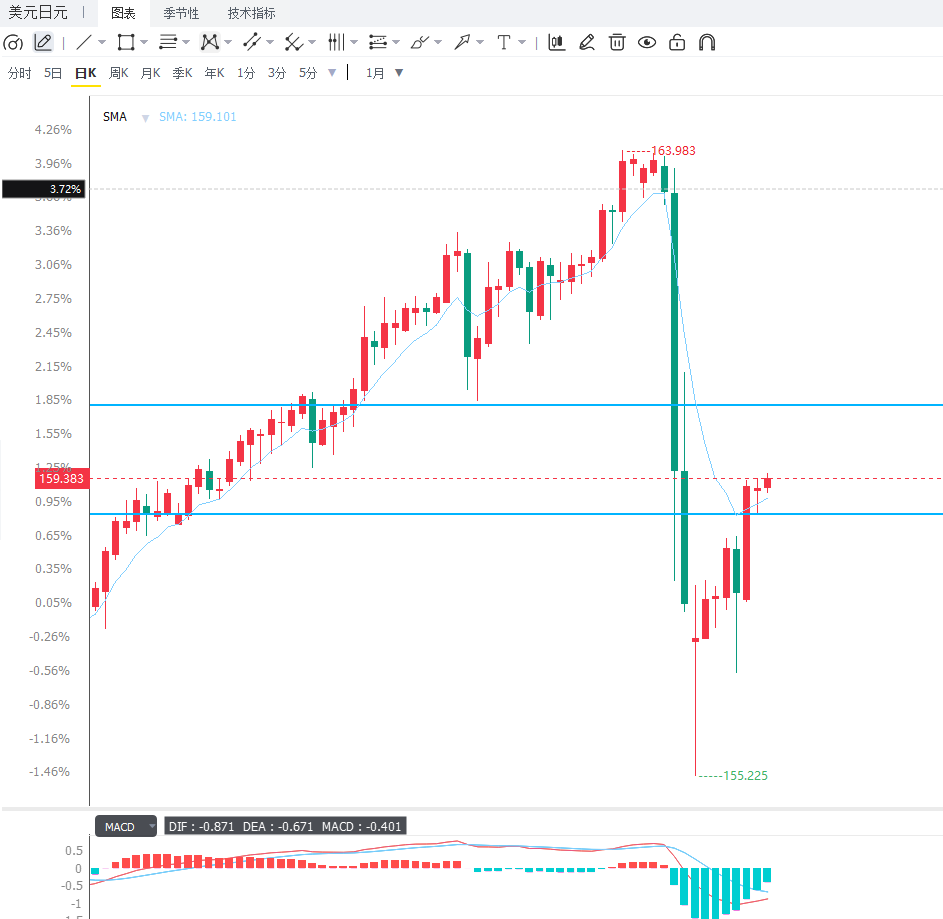 Editor's Summary: The USD/JPY pair is currently driven by interest rate differentials, a strong dollar, and energy risks, maintaining a bullish bias in the short term. However, as the exchange rate approaches the 160 area again, market attention is increasing regarding the risk of Japanese policy intervention and technical pressures. Future movements will primarily depend on US inflation data, Federal Reserve policy expectations, and the pace of policy adjustments by the Bank of Japan. If US inflation remains high, USD/JPY may continue to challenge the area above 160; however, if data weakens the dollar while the Bank of Japan releases stronger policy signals, the yen may have a chance to rebound. Overall, USD/JPY is still biased towards a high-level upward trend in the short term, but the area around 160 will become a crucial battleground for both bulls and bears.
The US-Japan interest rate differential remains the core factor influencing the USD/JPY exchange rate . As Japanese interest rates remain relatively low compared to other major economies, investors continue to use low-cost yen to finance their allocation to high-yield assets, limiting the yen's rebound. Meanwhile, changes in Japanese domestic economic policy have increased market concerns about the fiscal situation. Following the Japanese government's large-scale economic stimulus and tax cuts, some investors worry about further fiscal pressure, which also weakens the yen's attractiveness. Energy supply risks are also a significant factor affecting the yen. Given Japan's high dependence on energy imports, rising international oil prices and uncertainties in energy transportation may increase Japan's trade costs and put pressure on the yen. However, recent Japanese economic data has shown signs of improvement. Market surveys show that Japan's manufacturing confidence index rose to 18 in August, higher than the previous value of 13, reaching its highest level since March 2026; the non-manufacturing confidence index also rose from 25 in July to 28, indicating a recovery in business sentiment. Furthermore, market expectations for further interest rate hikes by the Bank of Japan are rising. Market data shows that investors expect a higher probability of the Bank of Japan adjusting interest rates in September, with some institutions believing that the policy normalization process may continue. However, at present, the expectation of interest rate hikes has not significantly changed the upward trend of USD/JPY. This is because the market remains more focused on US economic data and the future policy direction of the Federal Reserve. Regarding the dollar, rising oil prices have reignited market concerns about US inflationary pressures. Investors believe that if energy prices continue to rise, it may limit the rate of decline in inflation and prompt the Federal Reserve to maintain a hawkish policy stance. According to market interest rate tools, investors expect the Federal Reserve to raise interest rates further in the future, which has pushed US Treasury yields high and provided support for the dollar. Currently, the market is awaiting US Consumer Price Index (CPI) data and the subsequent Producer Price Index (PPI). These data will influence the market's judgment on the future path of the Federal Reserve's interest rates and further determine the direction of dollar demand. If US inflation data is higher than expected, the dollar may continue to strengthen, pushing USD/JPY to test the 160 level; if inflation cools significantly, the market may reduce expectations of policy tightening, and USD/JPY may experience a technical correction. The daily chart of USD/JPY shows that the exchange rate has recently rebounded rapidly from a low near 155.20 and is currently approaching the important psychological level of 160 again. Short-term moving averages are gradually strengthening, and the MACD indicator shows improved rebound momentum, but the price is approaching the previous resistance zone, limiting upside potential. The area around 160.60 is a key resistance zone; a break above this level could lead to a further challenge of the 161.50-162.00 area. Support levels to watch are around 158.50, followed by the 157.30 area. A break below 155.20 could indicate a breakdown of the current rebound structure. Overall, the daily trend leans towards a sideways upward movement, but profit-taking at higher levels should be anticipated. The USD/JPY 4-hour chart shows the price trading above 159.00, with short-term bulls holding the upper hand, but upward momentum has slowed. The exchange rate is currently approaching the 50% Fibonacci retracement level of the post-intervention decline, while the 61.8% retracement level is around 160.63, forming significant resistance. A break above 160.60 could open up further upside potential in the short term; if it encounters resistance and falls back, initial support is seen around 158.58, followed by the 157.31 area. The RSI indicator remains in a relatively strong zone, but no extreme overbought signal has appeared, suggesting that there is still a possibility of further testing of the upper resistance level in the short term. Editor's Summary: The USD/JPY pair is currently driven by interest rate differentials, a strong dollar, and energy risks, maintaining a bullish bias in the short term. However, as the exchange rate approaches the 160 area again, market attention is increasing regarding the risk of Japanese policy intervention and technical pressures. Future movements will primarily depend on US inflation data, Federal Reserve policy expectations, and the pace of policy adjustments by the Bank of Japan. If US inflation remains high, USD/JPY may continue to challenge the area above 160; however, if data weakens the dollar while the Bank of Japan releases stronger policy signals, the yen may have a chance to rebound. Overall, USD/JPY is still biased towards a high-level upward trend in the short term, but the area around 160 will become a crucial battleground for both bulls and bears.
- Risk Warning and Disclaimer
- The market involves risk, and trading may not be suitable for all investors. This article is for reference only and does not constitute personal investment advice, nor does it take into account certain users’ specific investment objectives, financial situation, or other needs. Any investment decisions made based on this information are at your own risk.