Brent crude briefly returned to the $90 mark, but strategic reserves are running low and refineries have been attacked, raising concerns about a repeat of the 2022 inflation crisis.
2026-08-12 15:54:56
On Wednesday (August 12) during the European session, escalating geopolitical risks pushed oil prices higher, with Brent crude futures currently trading around $89.50 per barrel, having previously risen above $90 per barrel. Market hopes for Middle East peace are rapidly fading. Traffic in the Strait of Hormuz plummeted to just six vessels on Monday—far below the recent 10-day average of about 11—despite Trump and Bessant's claims that an agreement could be reached "today or tomorrow." Meanwhile, attacks on Russian and Saudi refineries further exacerbated pressure on global energy markets, with US diesel prices surging recently. Higher energy prices could trigger a new round of inflation, forcing central banks to maintain high interest rates for a longer period, which would be bearish for stocks, gold, and bonds. 
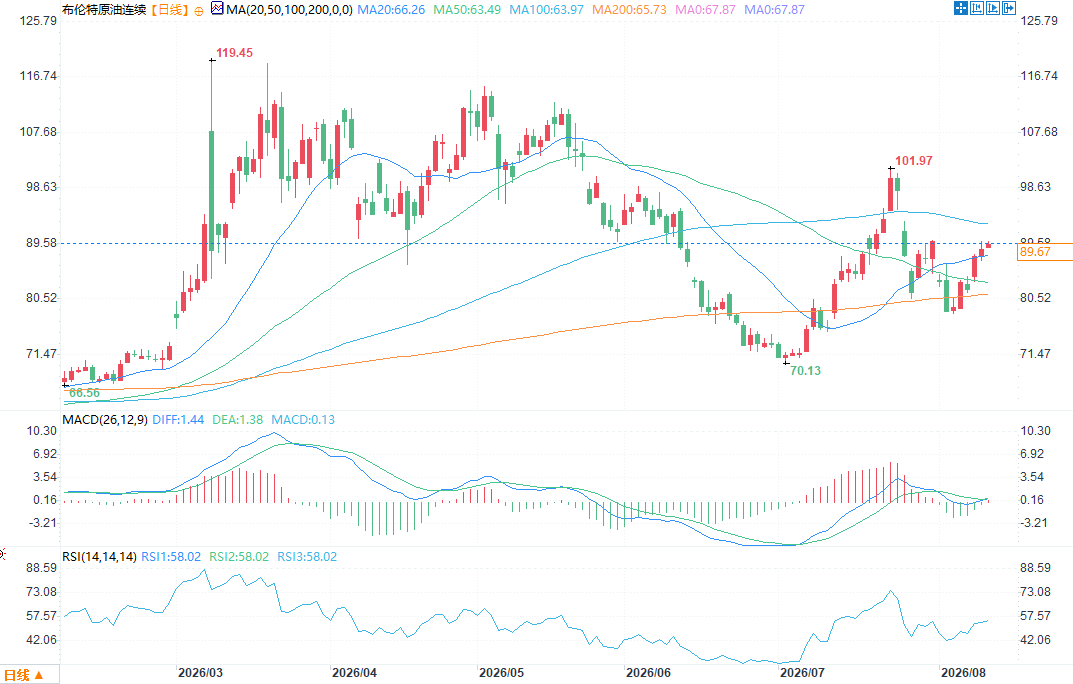 (Brent crude oil futures daily chart, source: EasyTrade) At 15:52 Beijing time on August 12, Brent crude oil futures were trading at $89.53 per barrel.
The Hormuz Stalemate: A Huge Gap Between Verbal Intervention and Actual Traffic Volume
Despite Trump and Bessant's claims that an agreement could be reached "today or tomorrow," actual traffic through the Strait of Hormuz plummeted to just six vessels on Monday, far below the recent 10-day average of about 11. This stark contrast between verbal intervention and actual data highlights market disappointment. Last week, the White House stated the conflict was nearing its end, but on Monday Trump demanded that Iran pay compensation for those killed and wounded in the war—a demand Iran had previously made of the US regarding damages from the conflict. The ongoing cat-and-mouse game between the US and Iran further diminishes the prospect of reopening the Strait of Hormuz.Multiple pressures on the supply side: attacks on refineries and depletion of strategic reserves
The Iran-US standoff is not the only issue. Attacks on Russian and Saudi refineries have further exacerbated pressure on global energy markets, with diesel prices in the US and Europe surging recently. Multiple supply-side shocks are pushing up energy prices and intensifying market concerns about inflation. The depletion of strategic reserves is limiting the "safety cushion" for oil prices. The US strategic petroleum reserve has fallen below 300 million barrels, the lowest level since 1983, compared to approximately 415 million barrels on February 28. Inventories in Asia are also declining, and global oil inventories are reportedly being depleted at a rate of approximately 6.3 million barrels per day. While strategic reserves are temporarily keeping oil prices below $100 per barrel, they are not unlimited.Inflation and its market impact: Will 2022 repeat itself?
Higher energy prices could trigger a new round of inflation, forcing central banks to maintain high interest rates for an extended period—a negative factor for stocks, gold, and bonds. The current macroeconomic environment is approaching the scenario of 2022—the longer the conflict lasts, the greater the impact on the global economy and financial markets. Even if the White House pushes for an agreement and reopens the Strait of Hormuz before the midterm elections, Iran appears poised to charge additional fees for passage, which will drive up logistical costs and ultimately inflation. Unless the US and Iran reach an agreement that includes the unconditional reopening of the Strait of Hormuz, inflation is unlikely to ease anytime soon. Maintaining appropriate hedging and defensive positions remains strategically important for investors.Summarize
Market hopes for Middle East peace are fading. Traffic in the Strait of Hormuz has plummeted to just six vessels, despite optimistic signals from Trump and Bessant that an agreement could be reached "today or tomorrow." Attacks on Russian and Saudi refineries have further exacerbated supply pressures, causing diesel prices in the US and Europe to surge. Depletion of strategic reserves—with the US SPR falling to its lowest level since 1983—limits the safety cushion for oil prices. High energy prices could trigger a new round of inflation, forcing central banks to maintain high interest rates, which would be bearish for stocks, gold, and bonds. Unless the US and Iran reach an agreement to unconditionally reopen the Strait of Hormuz, inflation is unlikely to ease anytime soon, and maintaining hedging and defensive positions remains a prudent choice for investors. The next direction for oil prices depends on the actual navigation situation in the Strait of Hormuz and the evolution of geopolitical events. (Brent crude oil futures daily chart, source: EasyTrade) At 15:52 Beijing time on August 12, Brent crude oil futures were trading at $89.53 per barrel.
- Risk Warning and Disclaimer
- The market involves risk, and trading may not be suitable for all investors. This article is for reference only and does not constitute personal investment advice, nor does it take into account certain users’ specific investment objectives, financial situation, or other needs. Any investment decisions made based on this information are at your own risk.