The yen surged a bizarre 80 points intraday. Will the Japanese Ministry of Finance launch another surprise attack based on tonight's US CPI data?
2026-08-12 18:02:55
On Wednesday (August 12) at 20:30, the US July CPI data will be released. Market attention to inflation data is no longer limited to the data itself; whether the Japanese Ministry of Finance will take the opportunity to intervene again has become a huge concern for both USD/JPY bears and bulls.  The market had already issued a warning. Around 17:22 Beijing time, the yen surged across the board without any significant news trigger, with GBP/JPY falling nearly 80 points and EUR/JPY dropping over 60 points. Although USD/JPY subsequently rebounded above the 159 level, this unusual movement clearly indicates thin market liquidity, with a large number of algorithmic trades and stop-loss orders closely watching the same direction. Some market participants speculate that this might be a preliminary test by the authorities to "inquire about prices."
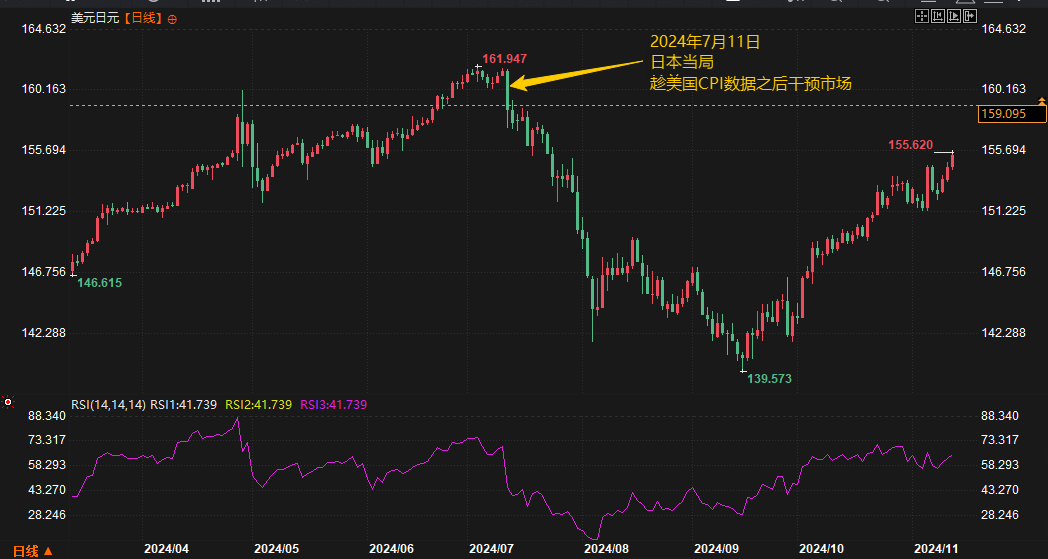 The current environment shares two key similarities with the aforementioned case. First, the USD/JPY exchange rate has rebounded from its post-intervention low in late July to 159.46, recovering approximately half of its losses and once again approaching the psychologically sensitive 160 level, a level that has repeatedly triggered official intervention. Second, Japan is currently on the Obon holiday, resulting in thin liquidity, which would amplify the volatility caused by intervention, making it more cost-effective. The Ministry of Finance can operate directly through the Bank of Japan or entrust institutions such as the Federal Reserve Bank of New York to execute the intervention during North American trading hours, without any holiday-related obstacles.
 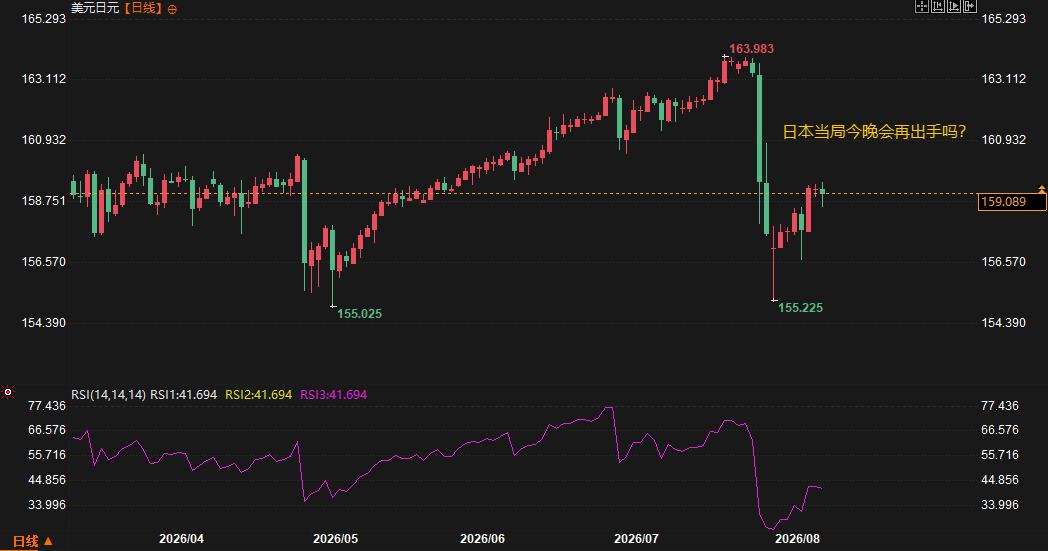 Whether intervention will occur tonight depends on two sets of variables. If the CPI data is significantly lower than expected, triggering a natural weakening of the US dollar, the probability of intervention will increase significantly. If intervention does occur, the support and resistance structure of USD/JPY needs to be re-evaluated. On the downside, the first key support is in the 157.40-157.70 range, which is the low area after the intervention in July 2024 and the bottom tested multiple times after the intervention at the end of July 2026. If this level is broken, the exchange rate may further test 155.00-155.20 , the extreme area of the intervention at the end of July. On the upside, if the Japanese authorities remain inactive, the bulls who have recovered the 200-day moving average (around 158.15) and the bottom of the daily Ichimoku Cloud (158.92) may see these levels as a signal to add to their positions, pushing the exchange rate to retest 160.00-160.50 or even higher.
The market had already issued a warning. Around 17:22 Beijing time, the yen surged across the board without any significant news trigger, with GBP/JPY falling nearly 80 points and EUR/JPY dropping over 60 points. Although USD/JPY subsequently rebounded above the 159 level, this unusual movement clearly indicates thin market liquidity, with a large number of algorithmic trades and stop-loss orders closely watching the same direction. Some market participants speculate that this might be a preliminary test by the authorities to "inquire about prices."Why intervene tonight? What are the technical price levels and conditions for intervention?
Japan's Ministry of Finance has historically favored intervention following market trends . On July 11, 2024, after the release of the weaker-than-expected US June CPI, the USD/JPY exchange rate was quickly pushed down from around 161.60 to around 157.40, a single-day fluctuation of approximately 4 yen. The core logic behind that operation was to increase short selling as the dollar weakened due to data, creating maximum short-selling pressure at minimal cost. A more recent example occurred at the end of July 2026, with an estimated single-day intervention exceeding 8 trillion yen, forcefully pushing the exchange rate from the 162-164 range to the 155-157 range. The current environment shares two key similarities with the aforementioned case. First, the USD/JPY exchange rate has rebounded from its post-intervention low in late July to 159.46, recovering approximately half of its losses and once again approaching the psychologically sensitive 160 level, a level that has repeatedly triggered official intervention. Second, Japan is currently on the Obon holiday, resulting in thin liquidity, which would amplify the volatility caused by intervention, making it more cost-effective. The Ministry of Finance can operate directly through the Bank of Japan or entrust institutions such as the Federal Reserve Bank of New York to execute the intervention during North American trading hours, without any holiday-related obstacles. Whether intervention will occur tonight depends on two sets of variables. If the CPI data is significantly lower than expected, triggering a natural weakening of the US dollar, the probability of intervention will increase significantly. If intervention does occur, the support and resistance structure of USD/JPY needs to be re-evaluated. On the downside, the first key support is in the 157.40-157.70 range, which is the low area after the intervention in July 2024 and the bottom tested multiple times after the intervention at the end of July 2026. If this level is broken, the exchange rate may further test 155.00-155.20 , the extreme area of the intervention at the end of July. On the upside, if the Japanese authorities remain inactive, the bulls who have recovered the 200-day moving average (around 158.15) and the bottom of the daily Ichimoku Cloud (158.92) may see these levels as a signal to add to their positions, pushing the exchange rate to retest 160.00-160.50 or even higher.Intervention is merely an amplifier; the medium-term trend depends on interest rate differentials.
Even if Japanese authorities intervene tonight, based on historical experience, the impact of a single intervention is concentrated within minutes to hours. The USD/JPY exchange rate may experience a sharp drop of 2 to 5 yen in the short term, followed by consolidation. The medium-term direction will still be determined by the USD/JPY interest rate differential and the Bank of Japan's policy path. The Bank of Japan's current interest rate is around 1%. If there is a lack of follow-up rate hikes, or if the Federal Reserve does not clearly shift to a dovish stance, the yen appreciation resulting from intervention will often be partially reversed within days to weeks. The key point to observe tonight is the speed of the exchange rate's reaction and unusual trading volume within 30 minutes of the data release, which will directly test the strength of the official intervention's intent.Frequently Asked Questions
Why do Japanese authorities prefer to intervene after the CPI release? When the CPI is weak, the US dollar naturally weakens. The Ministry of Finance can then sell dollars and buy yen at a lower cost, and amplify the effect of the data-induced volatility. The classic operation in July 2024 fully validated this approach. Under what conditions is intervention most likely tonight? The core condition is that the CPI is significantly lower than the mainstream market expectation, and the USD/JPY pair quickly moves towards 160 or higher after the data release, exhibiting a one-sided speculative trend. If the data meets expectations or is stronger than expected, the government's willingness to intervene against the trend will be greatly reduced. How to identify early signals of intervention from the market? Pay attention to sudden sharp rises in the exchange rate without significant news, and market rumors of "rate checks" (official price inquiries). Abnormally high trading volume and the concentrated appearance of multiple large sell orders are also typical characteristics. How far can the market go after intervention? Referring to cases from the past two years, the short-term impact is about 2 to 5 yen, often accompanied by short-selling stop-loss orders. However, without monetary policy support, the appreciation effect is usually gradually eroded by the USD/JPY interest rate advantage within several days to several weeks, with some or even all of it being reversed. Will Japanese holidays affect the implementation of interventions? No, they will not pose a substantial obstacle. The Ministry of Finance can entrust overseas institutions such as the Federal Reserve Bank of New York to operate on its behalf during North American trading hours, with funds provided by Japan. Similar arrangements have historical precedents.- Risk Warning and Disclaimer
- The market involves risk, and trading may not be suitable for all investors. This article is for reference only and does not constitute personal investment advice, nor does it take into account certain users’ specific investment objectives, financial situation, or other needs. Any investment decisions made based on this information are at your own risk.