Federal Reserve Chairman Warsh's Dilemma and the Outlook for the U.S. Economy
2026-08-12 18:22:55
The US economy is currently facing a rare structural paradox: while overall growth is resilient and domestic demand continues to recover, it also faces persistently high inflation and hidden risks in the labor market. Coupled with multiple external disturbances such as geopolitical conflicts, fiscal expansion, and political interference, newly appointed Federal Reserve Chairman Warsh faces the most severe policy test since taking office, caught in a dilemma between "actively leading policy" and "being passively constrained by the market and public opinion."  The annualized growth rate of US real GDP in the second quarter of 2026 is expected to slow to 1.5%, a decline from 2.1% in the first quarter (real GDP is nominal GDP adjusted for inflation). However, this slowdown is not a sign of economic weakness. It was mainly dragged down by short-term factors such as reduced government spending, increased imports, and depletion of crude oil inventories. Domestic core demand remained strong, with the annualized growth rate of domestic demand surging to 3.9% in the second quarter, far exceeding the performance in the first quarter. Household consumption remained robust, supported by the wealth effect of high-income groups and a temporary decline in energy prices. The AI industry boom spurred high investment growth in data centers, hardware and software, and power infrastructure, becoming a core growth engine for the economy. The market expects US GDP growth to rebound to 2.2% in the third quarter. At the same time, the structural weaknesses of the US economy are very prominent, and the problem of growth divergence is becoming increasingly serious. Low- and middle-income families have long faced high living costs, making it increasingly difficult to balance their income and expenditure; high mortgage rates have frozen the vitality of the housing market, suppressing housing demand for a long time; various tariff costs are gradually being passed on to downstream supply chains, continuously increasing the operating costs of enterprises. The AI industry exhibits a clear double-edged sword effect: while it stimulates investment and boosts economic activity, its rapid expansion also strains electricity resources and drives up chip and high-end labor costs, further exacerbating inflationary pressures before the industry's production efficiency is fully realized. Furthermore, factors such as geopolitical instability in the Middle East, increased US defense spending, and new tariffs on Russian energy and semiconductors continue to solidify inflationary rigidity, making it difficult to alleviate the high price situation quickly.
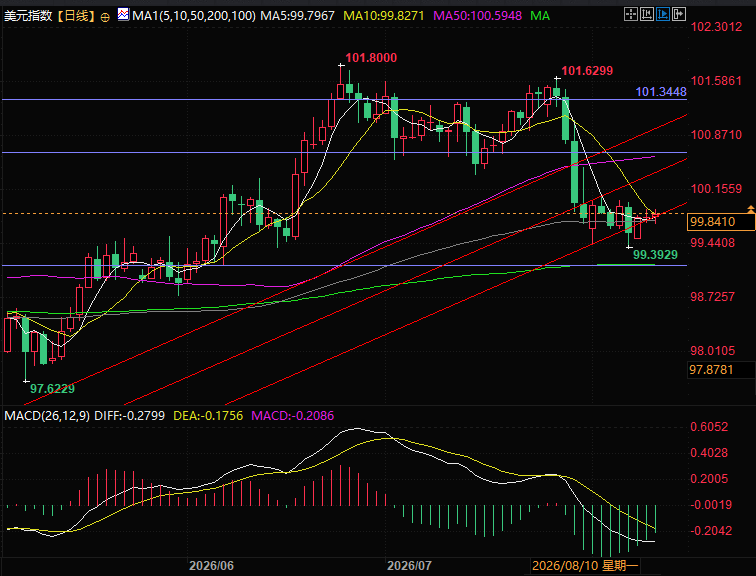 (US Dollar Index Daily Chart, Source: EasyTrade) At 18:17 Beijing time, the US Dollar Index is currently at 99.83.
The annualized growth rate of US real GDP in the second quarter of 2026 is expected to slow to 1.5%, a decline from 2.1% in the first quarter (real GDP is nominal GDP adjusted for inflation). However, this slowdown is not a sign of economic weakness. It was mainly dragged down by short-term factors such as reduced government spending, increased imports, and depletion of crude oil inventories. Domestic core demand remained strong, with the annualized growth rate of domestic demand surging to 3.9% in the second quarter, far exceeding the performance in the first quarter. Household consumption remained robust, supported by the wealth effect of high-income groups and a temporary decline in energy prices. The AI industry boom spurred high investment growth in data centers, hardware and software, and power infrastructure, becoming a core growth engine for the economy. The market expects US GDP growth to rebound to 2.2% in the third quarter. At the same time, the structural weaknesses of the US economy are very prominent, and the problem of growth divergence is becoming increasingly serious. Low- and middle-income families have long faced high living costs, making it increasingly difficult to balance their income and expenditure; high mortgage rates have frozen the vitality of the housing market, suppressing housing demand for a long time; various tariff costs are gradually being passed on to downstream supply chains, continuously increasing the operating costs of enterprises. The AI industry exhibits a clear double-edged sword effect: while it stimulates investment and boosts economic activity, its rapid expansion also strains electricity resources and drives up chip and high-end labor costs, further exacerbating inflationary pressures before the industry's production efficiency is fully realized. Furthermore, factors such as geopolitical instability in the Middle East, increased US defense spending, and new tariffs on Russian energy and semiconductors continue to solidify inflationary rigidity, making it difficult to alleviate the high price situation quickly.Deep-seated problems in the labor market: data distortion and a continuously deteriorating supply-demand structure.
The current US labor market exhibits a highly deceptive divergence, a key challenge interfering with the Federal Reserve's policy decisions. While the US unemployment rate fell to 4.1% in July 2026, a 18-month low, this impressive figure was not due to a job market recovery, but rather a false improvement resulting from a significant contraction in labor supply. Non-farm payrolls decreased by over 20,000 that month, and the labor force participation rate fell to a five-year low, reaching levels not seen since the mid-1970s, indicating a continued weakening of the real job market. The persistently low labor force participation rate is driven by four core factors: adjustments to the statistical base, the concentrated retirement of the aging baby boomer generation, tightened immigration policies reducing the supply of foreign labor, and a significant reduction in entry-level jobs. The current job market is stuck in a stalemate of "low hiring, low layoffs," with narrowing employment opportunities for recent graduates and inexperienced job seekers, a rising youth unemployment rate, and a large number of unsuccessful job seekers leaving the labor market, further shrinking the labor supply. The pressure on the labor market will continue to mount, with the legal work permits of a large number of immigrants from Haiti and Venezuela expiring soon, leaving hundreds of thousands of employed immigrants facing unemployment. This loss of labor will only manifest as a contraction in non-farm payrolls, not in pushing up the unemployment rate, and will perpetuate the distorted pattern of "low unemployment and weak employment." Meanwhile, although wage growth has slowed somewhat, rising employee welfare costs continue to support inflation in the service sector, becoming a significant driver of price stickiness and completely distorting the Federal Reserve's dual policy objectives of stabilizing employment and prices.Prolonged Inflation: Multiple Factors Combined, Risk of Stagflation Continues to Rise
Compared to the sluggish and divergent job market, persistent high inflation is the core risk to the current US economy and the primary factor constraining the Federal Reserve's monetary policy. The high inflation pattern in the US has persisted for five years, not due to a sudden short-term shock, but rather the result of multiple overlapping structural pressures. The continued transmission of tariff costs, geopolitical conflicts in the Middle East disrupting energy prices, immigration shortages leading to a nationwide labor shortage, and the expansion of AI infrastructure and defense spending generating sustained demand dividends—all these factors have collectively solidified the inflation base. Currently, the core PCE price index remains significantly higher than the Fed's 2% policy target, and this high inflation trend is expected to continue until 2027. The inflation structure is showing significant divergence. Commodity inflation still has some buffer space; businesses can offset cost pressures through inventory adjustments, supply chain shifts, end-user price reductions, and product substitution. Supermarkets are also stabilizing essential consumption through price reductions and promotions. However, the profit buffer space for businesses is nearing its limit, and subsequent costs will eventually be passed down across the board. Meanwhile, inflation in the service sector is extremely rigid. Service industries such as catering, elderly care, and construction are highly dependent on immediate labor supply. The situation of immigration shortages and labor shortages is difficult to reverse quickly, and the pace of service price declines is extremely slow. More alarmingly, prolonged high inflation has solidified market expectations, leading to businesses adopting a normalized cost-passing model and residents adapting to a high-price environment. This makes inflation prone to rebound and difficult to subside, replicating the core characteristics of stagflation in the 1970s. The unfavorable combination of "weak employment and strong inflation" in the US economy continues to strengthen.The Federal Reserve faces multiple predicaments: internal divisions, political interference, and dual pressure from monetary and fiscal policies.
The paradoxical situation of persistent inflation and weak employment has plunged the Federal Reserve under Warsh's leadership into an unprecedented policy dilemma, facing triple pressures from internal divisions, political interference, and fiscal pressures. Internally, divisions within the Fed have intensified. At Warsh's first policy meeting in June, nearly half of the officials predicted a rate hike in 2026; by the second meeting in July, three Fed presidents publicly voiced their dissent in support of a rate hike. Such large-scale policy disagreements at the beginning of a new chairman's term are rare, significantly weakening the Fed's policy unity. External political interference has further exacerbated the predicament. The controversy surrounding the removal of Fed governors and market rumors linking Warsh to the White House have led to an over-politicization of every interest rate decision. Rate hikes are seen as upholding independence, while rate cuts are seen as compromises, severely undermining the professionalism of monetary policy and the Fed's credibility. The dual pressures from financial markets and the fiscal environment have further constricted the Fed's policy space. On the fiscal front, rising US defense spending, aging population spending, and debt interest costs are driving a continued expansion of the federal budget deficit and debt issuance. The Treasury's move to alleviate pressure on long-term bonds by issuing more short-term bonds merely transferred risk without resolving underlying problems; instead, it increased the upside risk of future interest rate resets. In the financial markets, long-term US Treasury yields have continued to rise, exceeding levels seen at the start of the Fed's rate-cutting cycle in late 2024. The market expects the 10-year US Treasury yield to surpass 5% in the next six months, reaching a 25-year high, and this high level to persist until 2027. The continued rise in long-term yields essentially reflects the market's concentrated pricing of the Fed's credibility, inflation risk, and debt risk. The continued tightening of financial conditions is forcing the Fed to passively adjust its policies. Warsh's core dilemma is becoming increasingly clear: the current AI industry is boosting economic productivity and raising the neutral interest rate level, while the existing benchmark interest rate of 3.5%-3.75% is insufficient to effectively suppress persistent inflation; if interest rates remain unchanged, high inflation will become more entrenched, continuously eroding the Fed's credibility and pushing up bond term premiums; if interest rates are raised, it will further impact the already weak labor market, suppressing economic and capital market performance, leaving very little room for policy error.Policy Breakthrough Opportunities and Market Outlook: Jackson Hole Symposium as a Key Turning Point
Despite multiple challenges, Warsh still possesses a crucial opportunity to reshape the Federal Reserve's policy framework and reverse market expectations. Warsh plans to optimize the Fed's policy system, simplify market communication, reduce frequent forward guidance, shorten meeting frequency, abandon fragmented policy outputs, and build a clearer and more stable monetary policy framework to reshape the Fed's market influence. This month's Jackson Hole Economic Symposium will be a key window for Warsh to reverse his passive situation and restore public trust. The market widely expects Warsh to clarify three core positions at the symposium: firmly defend the Fed's policy independence, strictly adhere to the 2% inflation target, and clearly announce the trigger mechanism for interest rate adjustments, ending the market's disorderly speculation about policy direction and regaining control of market expectations. Overall, the US economy's short-term growth resilience is not a concern, but the risk of stagflation continues to accumulate in the medium to long term, with multiple contradictions deeply intertwined, including weak employment, persistent inflation, fiscal expansion, market pressure, and political interference. Warsh's subsequent policy choices will directly determine the Fed's position: whether it will be a power holder independent of external interference and lead economic regulation, or a prisoner coerced by the market and politics, passively responding to risks. Only by adhering to the core objective of combating inflation, balancing the relationship between stabilizing growth and controlling inflation, and rebuilding policy credibility can the Federal Reserve break out of the current predicament, maintain the economic expansion pattern while suppressing inflation, and help American residents repair the income and wealth eroded by high inflation.Summary and Technical Analysis:
In summary, the current US economy is caught in a deep paradox: strong domestic demand coexists with persistent inflation, and low unemployment coexists with weak employment. This fundamental situation continues to provide short-term support for the US dollar index: on the one hand, the risk of double-dip inflation and rising neutral interest rates force the Federal Reserve to maintain high interest rates, and high interest rate differentials and global safe-haven demand have temporarily supported the dollar's ability to attract capital. However, in the long term, the political interference and fiscal debt risks faced by the new Fed Chairman Warsh are continuously eroding the Fed's policy credibility. The Jackson Hole symposium is not only a window to de-fragment the policy framework but also a crucial testing ground for rebuilding trust. If the Fed is forced to compromise or abandon its inflation control target under political pressure, debt risks will completely transform into an impact on the dollar's credibility. At that time, capital sell-offs of the dollar and sharp fluctuations in asset prices will become the biggest tail risk in the global market. Technically, the US dollar index is supported by the upward channel's moving average while being suppressed by the 50% Fibonacci retracement level. (US Dollar Index Daily Chart, Source: EasyTrade) At 18:17 Beijing time, the US Dollar Index is currently at 99.83.
- Risk Warning and Disclaimer
- The market involves risk, and trading may not be suitable for all investors. This article is for reference only and does not constitute personal investment advice, nor does it take into account certain users’ specific investment objectives, financial situation, or other needs. Any investment decisions made based on this information are at your own risk.