A chart shows that the Baltic Dry Index has continued to weaken, with significant divergence in market conditions across different ship types.
2026-08-13 00:30:55
Latest data shows that on August 12, 2026, the Baltic Dry Index (BDI) stood at 2939 points, a new low since August 4, 2026, down 3.51% month-on-month, the largest drop since March 10, 2026, and marking the third consecutive day of decline (including zero growth). Looking at the short-term charts, the recent 11 BDI data points show: 6 positive increases, 5 negative increases, and 0 zero increases. Specifically, the Panamax Freight Index (BPI) was at 2302 points, down 0.43% from the previous value; the Capesize Freight Index (BCI) was at 4712 points, down 5.78%; and the Supramax Freight Index (BSI) was at 1603 points, up 0.19%. For detailed 720-day and 10-year trend charts of the Baltic Dry Index and its three main sub-indices, please refer to the charts specially created by FX678. 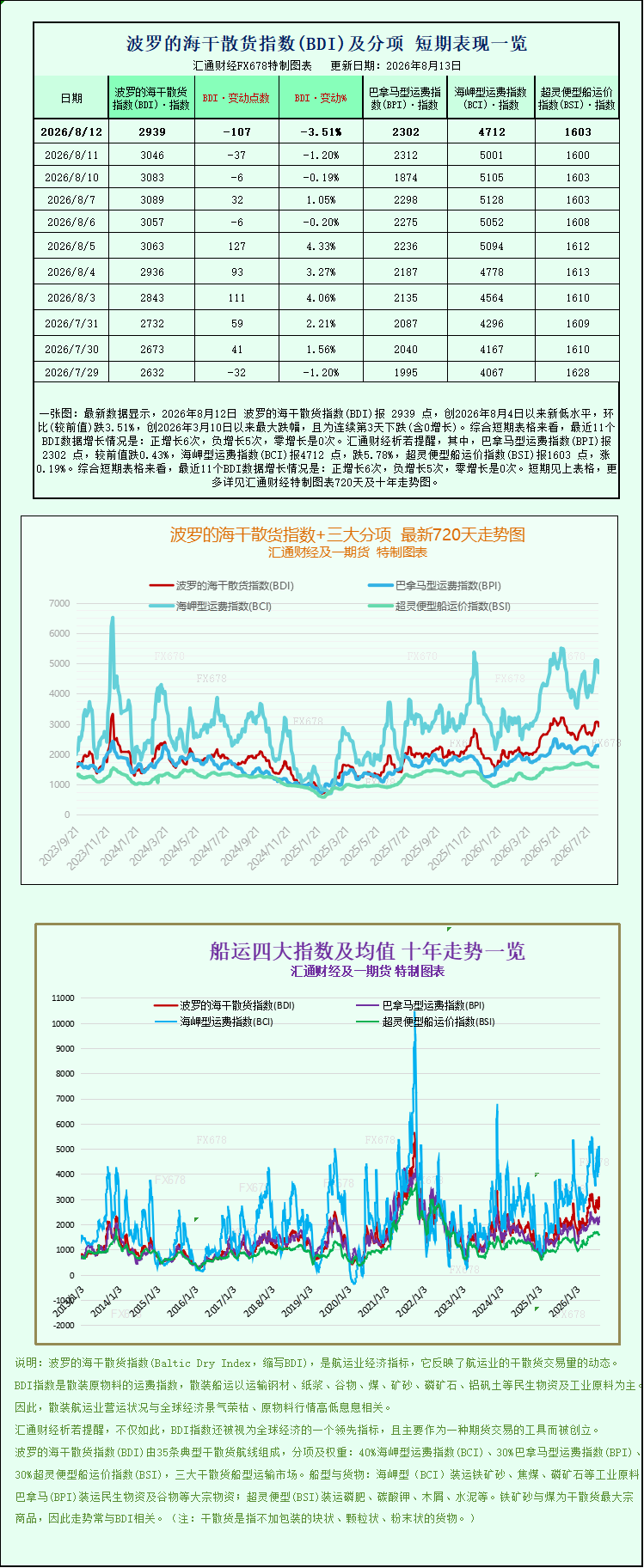 The Baltic Dry Index (BDI) released its latest market data, showing that the international dry bulk freight index continued its downward trend on August 12, recording its third consecutive day of decline. Dragged down by falling freight rates for the two main vessel types, Capesize and Panamax, the index closed significantly lower. Only the Supramax market maintained a slight increase, further widening the gap in market performance between different vessel types, reflecting the current uneven distribution of demand in the global dry bulk shipping market. The BDI fell 107 points, a drop of 3.5%, closing at 2939 points. Looking back at the short-term trend, the index had just reached its highest point since June 3 last Friday. After a period of upward movement, the bullish momentum quickly subsided, and the market entered a correction phase. As a core indicator of the global dry bulk shipping market, this comprehensive index covers charter freight rate changes for three major types of bulk carriers: Capesize, Panamax, and Supramax. Its fluctuations directly reflect the demand for seaborne transportation of bulk commodities such as iron ore, coal, and grain, and are considered a leading indicator of global industrial and trade conditions. Looking at different vessel types, Capesize vessels, the largest in size, were the main drag on the index this time. The Capesize index fell sharply by 289 points, a drop of 5.8%, closing at 4712 points. This vessel type mainly handles the ocean transport of industrial raw materials such as iron ore and metallurgical coal up to 150,000 tons, and is a core carrier for the cross-border flow of raw materials in the upstream of the steel industry chain. Data shows that the average daily earnings of Capesize vessels fell sharply by $2,619 to $39,237, resulting in a significant reduction in spot profits for shipowners. The decline in Capesize freight rates is closely related to short-term disturbances in the Chinese iron ore market. Affected by Typhoon Dolphin, many parts of central China implemented disaster prevention and mitigation measures, leading to the temporary suspension of numerous infrastructure and steel-related construction projects. This suppressed short-term demand for iron ore spot prices, resulting in narrow-range fluctuations in domestic iron ore futures. However, the market is not entirely pessimistic. Market expectations suggest that steel industry procurement plans may be implemented later, providing a floor for iron ore prices and limiting further downside potential. China is the world's largest importer of iron ore, and most Capesize cargoes are transported from Australian and Brazilian ore to China. The pace of domestic steel industry operations and the intensity of raw material restocking directly influence the release of cargoes in the Capesize market, thereby altering the supply-demand balance in the spot charter market. The Panamax market also ended its previous strong performance. The Panamax index fell 10 points, or 0.4%, to 2302 points, ending a ten-day winning streak. Panamax vessels typically have a deadweight tonnage of 60,000-70,000 tons, primarily carrying coal, grain, and other commodities. Their trade routes span the Pacific and Atlantic Oceans, covering the maritime demand for both energy and agricultural products. The average daily revenue for these vessels decreased by $97 to $20,716. The previous consecutive days of increases were mainly due to the release of cargo from energy restocking and grain trade in some parts of the world. However, as the short-term concentrated release of cargo passed, coupled with the gradual increase in available shipping capacity and the improved bargaining power of charterers, the upward trend in freight rates was unsustainable, resulting in a slight correction. Amidst a generally weak market environment, the small and medium-sized Supramax vessel market showed independent performance. The Supramax index rose slightly by 3 points, an increase of 0.2%, closing at 1603 points. Supramax vessels are equipped with their own loading and unloading equipment, making them more adaptable to port conditions. Their route network is more diversified, handling not only coal and grain but also small-batch bulk cargo such as fertilizers, bauxite, and building materials. This diversification of trade flows makes them less affected by fluctuations in demand from a single cargo type or country. When the large vessel market declined due to demand disruptions from iron ore and coal, diversified cargo sources provided support, allowing Supramax freight rates to demonstrate resilience and becoming one of the few sectors to record gains that day. From a market perspective, the recent index surge and subsequent pullback was the result of multiple factors. On one hand, after the previous round of price increases, some cargo owners completed concentrated bookings, leading to a decrease in new cargo volume in the short term, and the market entered a period of digestion. On the other hand, extreme weather disrupted downstream operations in China, suppressing large vessel cargo volume and becoming the direct trigger for the short-term correction. However, the divergent trends among different vessel types also indicate that the dry bulk market has not entered a full-blown bear market, and structural opportunities still exist in specific cargo types and routes. Looking ahead, the future trend of the dry bulk market still requires close monitoring of several key variables. Firstly, the recovery of China's steel industry, the pace of project resumption after the typhoon, and the extent to which steel mills replenish their raw material inventories will directly determine the subsequent supply of cargo for Capesize vessels. Secondly, the pace of global grain and coal exports will affect the demand for Panamax and Supramax vessels. Simultaneously, the deployment of new capacity in the global dry bulk fleet and fluctuations in fuel costs will continue to disrupt freight rates. In the short term, the market is likely to maintain a volatile pattern. Large vessel stocks are susceptible to fluctuations in the domestic ferrous metals industry chain, while small and medium-sized vessels are expected to maintain relative resilience due to diversified cargo sources.
The Baltic Dry Index (BDI) released its latest market data, showing that the international dry bulk freight index continued its downward trend on August 12, recording its third consecutive day of decline. Dragged down by falling freight rates for the two main vessel types, Capesize and Panamax, the index closed significantly lower. Only the Supramax market maintained a slight increase, further widening the gap in market performance between different vessel types, reflecting the current uneven distribution of demand in the global dry bulk shipping market. The BDI fell 107 points, a drop of 3.5%, closing at 2939 points. Looking back at the short-term trend, the index had just reached its highest point since June 3 last Friday. After a period of upward movement, the bullish momentum quickly subsided, and the market entered a correction phase. As a core indicator of the global dry bulk shipping market, this comprehensive index covers charter freight rate changes for three major types of bulk carriers: Capesize, Panamax, and Supramax. Its fluctuations directly reflect the demand for seaborne transportation of bulk commodities such as iron ore, coal, and grain, and are considered a leading indicator of global industrial and trade conditions. Looking at different vessel types, Capesize vessels, the largest in size, were the main drag on the index this time. The Capesize index fell sharply by 289 points, a drop of 5.8%, closing at 4712 points. This vessel type mainly handles the ocean transport of industrial raw materials such as iron ore and metallurgical coal up to 150,000 tons, and is a core carrier for the cross-border flow of raw materials in the upstream of the steel industry chain. Data shows that the average daily earnings of Capesize vessels fell sharply by $2,619 to $39,237, resulting in a significant reduction in spot profits for shipowners. The decline in Capesize freight rates is closely related to short-term disturbances in the Chinese iron ore market. Affected by Typhoon Dolphin, many parts of central China implemented disaster prevention and mitigation measures, leading to the temporary suspension of numerous infrastructure and steel-related construction projects. This suppressed short-term demand for iron ore spot prices, resulting in narrow-range fluctuations in domestic iron ore futures. However, the market is not entirely pessimistic. Market expectations suggest that steel industry procurement plans may be implemented later, providing a floor for iron ore prices and limiting further downside potential. China is the world's largest importer of iron ore, and most Capesize cargoes are transported from Australian and Brazilian ore to China. The pace of domestic steel industry operations and the intensity of raw material restocking directly influence the release of cargoes in the Capesize market, thereby altering the supply-demand balance in the spot charter market. The Panamax market also ended its previous strong performance. The Panamax index fell 10 points, or 0.4%, to 2302 points, ending a ten-day winning streak. Panamax vessels typically have a deadweight tonnage of 60,000-70,000 tons, primarily carrying coal, grain, and other commodities. Their trade routes span the Pacific and Atlantic Oceans, covering the maritime demand for both energy and agricultural products. The average daily revenue for these vessels decreased by $97 to $20,716. The previous consecutive days of increases were mainly due to the release of cargo from energy restocking and grain trade in some parts of the world. However, as the short-term concentrated release of cargo passed, coupled with the gradual increase in available shipping capacity and the improved bargaining power of charterers, the upward trend in freight rates was unsustainable, resulting in a slight correction. Amidst a generally weak market environment, the small and medium-sized Supramax vessel market showed independent performance. The Supramax index rose slightly by 3 points, an increase of 0.2%, closing at 1603 points. Supramax vessels are equipped with their own loading and unloading equipment, making them more adaptable to port conditions. Their route network is more diversified, handling not only coal and grain but also small-batch bulk cargo such as fertilizers, bauxite, and building materials. This diversification of trade flows makes them less affected by fluctuations in demand from a single cargo type or country. When the large vessel market declined due to demand disruptions from iron ore and coal, diversified cargo sources provided support, allowing Supramax freight rates to demonstrate resilience and becoming one of the few sectors to record gains that day. From a market perspective, the recent index surge and subsequent pullback was the result of multiple factors. On one hand, after the previous round of price increases, some cargo owners completed concentrated bookings, leading to a decrease in new cargo volume in the short term, and the market entered a period of digestion. On the other hand, extreme weather disrupted downstream operations in China, suppressing large vessel cargo volume and becoming the direct trigger for the short-term correction. However, the divergent trends among different vessel types also indicate that the dry bulk market has not entered a full-blown bear market, and structural opportunities still exist in specific cargo types and routes. Looking ahead, the future trend of the dry bulk market still requires close monitoring of several key variables. Firstly, the recovery of China's steel industry, the pace of project resumption after the typhoon, and the extent to which steel mills replenish their raw material inventories will directly determine the subsequent supply of cargo for Capesize vessels. Secondly, the pace of global grain and coal exports will affect the demand for Panamax and Supramax vessels. Simultaneously, the deployment of new capacity in the global dry bulk fleet and fluctuations in fuel costs will continue to disrupt freight rates. In the short term, the market is likely to maintain a volatile pattern. Large vessel stocks are susceptible to fluctuations in the domestic ferrous metals industry chain, while small and medium-sized vessels are expected to maintain relative resilience due to diversified cargo sources.
- Risk Warning and Disclaimer
- The market involves risk, and trading may not be suitable for all investors. This article is for reference only and does not constitute personal investment advice, nor does it take into account certain users’ specific investment objectives, financial situation, or other needs. Any investment decisions made based on this information are at your own risk.